Global Marketing Management - Market Entry Strategies:
Week Three Lecture - Part 1
1.1 MARKET ENTRY STRATEGY:
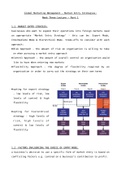
businesses who want to expand their operations into foreign markets need
an appropriate ‘Market Entry Strategy’ - this can be: Export Mode,
Intermediate Mode & Hierarchical Mode. trade-offs to consider with each
approach:
• Risk Approach - the amount of risk an organisation is willing to take
on when pursuing a market entry approach
• Control Approach - the amount of overall control an organisation would
like to have when entering new markets
• Flexibility Approach - the degree of flexibility required by an
organisation in order to carry out the strategy on their own terms
• opting for export strategy
- low levels of risk, low
levels of control & high
flexibility
• opting for hierarchical
strategy - high levels of
risk, high levels of
control & low levels of
flexibility
1.2 FACTORS INFLUENCING THE CHOICE OF ENTRY MODE:
a business’s decision to use a specific form of market entry is based on
conflicting factors e.g. centred on a business’s contribution to profit.
,four categories that factor the choice of market entry mode:
• internal factors, desired mode characteristics, transaction-specific
factors & external factors
• Internal Factors - firm size (resources available), internal experience
(obtained by management), product complexity (physical features of
product/service) & product/service differentiation advantage (increase
price levels to absorb contribution costs
• Desired Mode Characteristics - risk-averse (managers who are risk-
averse favour the export mode) & control and flexibility (the degree of
each needs to be judged)
• Transaction Specific Factors - tacit nature of know how (a firm’s know-
how is tacit supports the hierarchical modes as it is easier to
communicate throughout the organisation), opportunistic behaviour &
transaction costs
• External Factors: sociocultural distance (language & education),
country risk (domestic markets are less risky than foreign markets),
market size and growth, direct and indirect trade barriers (import
tariffs & quotas encourage domestic production) & intensity of
competition (greater intensity reduces potential profit)
, Global Marketing Management - The Export Modes:
Week Three Lecture - Part 2
2.1 EXPORT MODES OF MARKET ENTRY:
the company will continue to manufacture in their existing markets & send
over goods or products to a new market which they are intending to enter;
the cost of doing this is modest & the business model is unchanged
export options below:
• Indirect Export - sending goods to an external buying agent or
piggybacking
• Direct Export - sending goods directly through a distributor
• Co-Operative Export - sending goods through an export marketing group
Key Considerations:
regardless of which export strategy a firm deploys, it needs to have
trust, commitment & co-operation from the agents and partners they are
working with - known as ‘Partner Mindshare’
Gibbs (2005) defines the drivers of Partner Mindshare:
• commitment & trust
• collaboration
• mutuality of interest & common purpose
other considerations to take into account:
• Brand - the reputation & brand of both the exporter and partners
• Product - the quality of the product & value it adds
• Profit - the amount of margin that is achievable in different markets
2.2 THE INDIRECT EXPORT:
the key entry modes for indirect exporting:
• Export Buying Agent - a representative of foreign buyers who is based
in the home country of the exporter
Week Three Lecture - Part 1
1.1 MARKET ENTRY STRATEGY:
businesses who want to expand their operations into foreign markets need
an appropriate ‘Market Entry Strategy’ - this can be: Export Mode,
Intermediate Mode & Hierarchical Mode. trade-offs to consider with each
approach:
• Risk Approach - the amount of risk an organisation is willing to take
on when pursuing a market entry approach
• Control Approach - the amount of overall control an organisation would
like to have when entering new markets
• Flexibility Approach - the degree of flexibility required by an
organisation in order to carry out the strategy on their own terms
• opting for export strategy
- low levels of risk, low
levels of control & high
flexibility
• opting for hierarchical
strategy - high levels of
risk, high levels of
control & low levels of
flexibility
1.2 FACTORS INFLUENCING THE CHOICE OF ENTRY MODE:
a business’s decision to use a specific form of market entry is based on
conflicting factors e.g. centred on a business’s contribution to profit.
,four categories that factor the choice of market entry mode:
• internal factors, desired mode characteristics, transaction-specific
factors & external factors
• Internal Factors - firm size (resources available), internal experience
(obtained by management), product complexity (physical features of
product/service) & product/service differentiation advantage (increase
price levels to absorb contribution costs
• Desired Mode Characteristics - risk-averse (managers who are risk-
averse favour the export mode) & control and flexibility (the degree of
each needs to be judged)
• Transaction Specific Factors - tacit nature of know how (a firm’s know-
how is tacit supports the hierarchical modes as it is easier to
communicate throughout the organisation), opportunistic behaviour &
transaction costs
• External Factors: sociocultural distance (language & education),
country risk (domestic markets are less risky than foreign markets),
market size and growth, direct and indirect trade barriers (import
tariffs & quotas encourage domestic production) & intensity of
competition (greater intensity reduces potential profit)
, Global Marketing Management - The Export Modes:
Week Three Lecture - Part 2
2.1 EXPORT MODES OF MARKET ENTRY:
the company will continue to manufacture in their existing markets & send
over goods or products to a new market which they are intending to enter;
the cost of doing this is modest & the business model is unchanged
export options below:
• Indirect Export - sending goods to an external buying agent or
piggybacking
• Direct Export - sending goods directly through a distributor
• Co-Operative Export - sending goods through an export marketing group
Key Considerations:
regardless of which export strategy a firm deploys, it needs to have
trust, commitment & co-operation from the agents and partners they are
working with - known as ‘Partner Mindshare’
Gibbs (2005) defines the drivers of Partner Mindshare:
• commitment & trust
• collaboration
• mutuality of interest & common purpose
other considerations to take into account:
• Brand - the reputation & brand of both the exporter and partners
• Product - the quality of the product & value it adds
• Profit - the amount of margin that is achievable in different markets
2.2 THE INDIRECT EXPORT:
the key entry modes for indirect exporting:
• Export Buying Agent - a representative of foreign buyers who is based
in the home country of the exporter