
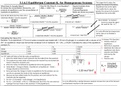
3.1.6.2 Equilibrium Constant Kc for Homogeneous Systems The Larger the KC value, the
greater the amount of products
What Does Kc Actually Mean? How Do We Show Kc in an Equation? - Square brackets show (Equilibrium lies to the right)
Kc shows the concentration (Hence the c) of 2NO2 -> 2NO + O2 concentration
[NO]2[O2] The smaller the KC value, the
products at equilibrium over the concentration of Kc = [NO ] - Products/Reactants
greater the amount of reactants
reactants at equilibrium 2 - Moles are shown as powers
(Equilibrium lies to the left)
How Do We Work Out the Units of Kc? Kc = Moldm-3 Moldm-3 Moldm-3 Moldm-3 Moldm-3 Moldm-3
Kc =
Substitute Moldm-3 into the equation Moldm-3 Moldm-3
[S2-][H+]2 More Moldm-3 on bottom?
Kc = [H2S]
1.Substitute Moldm-3 into the equation 2.Cancel out = Moldm-3 - Invert (so swap the signs)
- No need for the + in +6
Moldm-3 Moldm-3 1
Kc = Kc =
Moldm Moldm-3 Moldm-3 Moldm-3
-3
Kc = Moldm Moldm
-3 -3
Moldm Moldm-3
-3
Moldm-3 Moldm-3 Moldm-3 Moldm-3
[NH3]2 Kc is only affected by temperature
Kc = (same rules as Le Chatelier’s
[N2][H2]3
1.Substitute Moldm-3 into the equation 2.Cancel out = Mol-2dm6 principle)
Calculating the Value of Kc:
Question: In an experiment, 0.73 mol of carbon monoxide was heated with 1.25 mol of hydrogen in a container with a volume of 0.6 To Answer This Question:
1. Find the moles at
dm3. An equilibrium mixed was formed that contained 0.43 of methanol. CO + 2H2 ⇋ CH3OH. Calculate the value of the equilibrium
equilibrium
constant, Kc
2. Write the Kc equation
CO H2 CH3OH
3. Substitute the moles at
Initial 0.73 1.25 0.00
equilibrium into the Kc
Change 0.43 0.86 0.43 equation and divide
Equilibrium 0.30 0.39 0.43 each one by the
An ‘ICE’ table will help us find the moles at equilibrium 0.43 volume
1. Enter the initial moles of each molecule into the table (from the question) 0.6 4. Find the units
2. The product has initial moles of 0 because the reaction has not started (we Kc = 0.3 0.39 2
haven’t mixed the reactants yet)
1
0.6 0.6 3 [CH3OH]
3. Enter the moles of methanol at equilibrium (from the question)
4. Initial Moles + Change In Moles = Equilibrium so Equilibrium – Initial =
Kc = [CO][H ]2
2
Change (therefore 0.43-0=0.43)
5. Since we know the change in moles to equilibrium for the product, we can = 3.39 mol-2dm6 2
use this to calculate the moles of the reactants at equilibrium 4
6. Because we have added moles for the product, we must subtract for the
reactants (do the opposite)
7. For CO = 0.73 (initial) – 0.43 (change) = 0.3 (equilibrium)
8. For H2 = 1.25 (initial) – 0.43 x 2 = 0.86 (because the 0.43 is for one mole but Kc is not affected by a catalyst because catalysts increase the rate of the forward
hydrogen has two moles in this reaction) = 0.39 (equilibrium) and backward reaction to the same extent


