

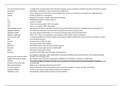
The circular flow of income A model of the economy which shows the flow of goods, services and factors and their payments around the economy
Investment Expenditure undertaken by firms to add to the capital stock
Taxation A levy/charge by the overnment on householders (VAT, income tax) and firms (corporation tax, capital gains tax)
Savings Income not spent on consumption
J Injections (investment, exports, government spending)
W Withdrawals (taxation, savings, imports)
J=W Economy is stable
J>W There is economic growth, GDP is increasing
J<W There is a recession, GDP is decreasing
The multiplier process Any injection into the circular flow of income will increase national income by a multiplied amount, denoted by 'K'
Aggregate demand The total level of demand in an economy at any given price level at any given time
Aggregate supply The total amount of production in an economy at any given price level at any given time
Negative output gap When Ya<Yf, there is unemployment, spare capacity, little inflation and low confidence
The economic cycle A recognised pattern of economic activity (aka changes to GDP) recorded in the macroeconomy over time (3-5 years)
GDP Gross Domestic Product
Growth Sustained rises in GDP over time
Boom The point at which GDP is highest
Downturn When GDP starts to contract afer a period of growth
Recession A period of 2 consecutive quarters of falling GDP
Slump The point at which GDP is lowest
Recovery A period in which GDP shows first signs of improvement
Eg. changes to spending, credit, wealth effects, investment spending, government finances, X/M, planned spending
Demand-side economic shocks (interest, tax, exchange rates)
Supply-side economic shocks Eg. changes in price of factors of production, depletion of raw materials, (advances in technology)
Inflation The sustained
A measure rise in themeasures
of inflation, general level of prices
changes in theover
pricetime and
level of the decrease
a market in the
basket purchasinggoods/services
of consumer power of moneypurchased
Consumer Price Index (CPI) by households
Demand-pull inflation Rising levels of AD pull up the price level of GDP
Cost-push inflation Rising costs for the factors of production push up the price charged for output, eg wage cost inflation
Imported inflation A lower value currency makes imports appear more expensive
Inflationary noise The distortion of the functions of price caused by inflation
Investment Expenditure undertaken by firms to add to the capital stock
Taxation A levy/charge by the overnment on householders (VAT, income tax) and firms (corporation tax, capital gains tax)
Savings Income not spent on consumption
J Injections (investment, exports, government spending)
W Withdrawals (taxation, savings, imports)
J=W Economy is stable
J>W There is economic growth, GDP is increasing
J<W There is a recession, GDP is decreasing
The multiplier process Any injection into the circular flow of income will increase national income by a multiplied amount, denoted by 'K'
Aggregate demand The total level of demand in an economy at any given price level at any given time
Aggregate supply The total amount of production in an economy at any given price level at any given time
Negative output gap When Ya<Yf, there is unemployment, spare capacity, little inflation and low confidence
The economic cycle A recognised pattern of economic activity (aka changes to GDP) recorded in the macroeconomy over time (3-5 years)
GDP Gross Domestic Product
Growth Sustained rises in GDP over time
Boom The point at which GDP is highest
Downturn When GDP starts to contract afer a period of growth
Recession A period of 2 consecutive quarters of falling GDP
Slump The point at which GDP is lowest
Recovery A period in which GDP shows first signs of improvement
Eg. changes to spending, credit, wealth effects, investment spending, government finances, X/M, planned spending
Demand-side economic shocks (interest, tax, exchange rates)
Supply-side economic shocks Eg. changes in price of factors of production, depletion of raw materials, (advances in technology)
Inflation The sustained
A measure rise in themeasures
of inflation, general level of prices
changes in theover
pricetime and
level of the decrease
a market in the
basket purchasinggoods/services
of consumer power of moneypurchased
Consumer Price Index (CPI) by households
Demand-pull inflation Rising levels of AD pull up the price level of GDP
Cost-push inflation Rising costs for the factors of production push up the price charged for output, eg wage cost inflation
Imported inflation A lower value currency makes imports appear more expensive
Inflationary noise The distortion of the functions of price caused by inflation


