
Binary Stars
Binary stars orbit a common centre of mass. The more massive star orbits
closer to the centre of mass. If the two stars’ angular separation is large
enough, the individual stars can both be resolved using a telescope. These
systems are called visual binaries.
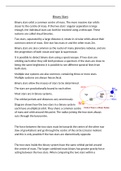
Two stars, separated by a large distance d, rotate in circular orbits about their
common centre of mass. One star has mass m and the other mass 2m.
Binary stars are also common as the nuclei of many planetary nebulae, and are
the progenitors of both novae and type la supernovae.
It is possible to detect binary stars using a spectroscope. If two stars are
orbiting each other they will both produce a spectrum. If the stars are close to
being the same brightness it is possible to see different spectral lines from
both stars.
Multiple star systems are also common, containing three or more stars.
Multiple systems are always hierarchical.
Binary stars allow the masses of stars to be determined.
The stars are gravitationally bound to each other.
Most stars are in binary systems.
The orbital periods and distances vary enormously.
Diagram shows how the two stars in a binary system
each have an elliptical orbit. They share a common centre
of mass and orbit around this point. The radius joining the two stars always
cuts through the barycentre.
The force between the two stars must be towards the centre of the other star
(law of gravitation) and go through the centre of the circle (circular motion)
and this is only possible if the two stars are diametrically opposite.
The two stars inside the binary system have the same orbital period around
the centre of mass. The larger combined mass binary has greater gravity force
acting between the two stars. When comparing the two stars within a
Binary stars orbit a common centre of mass. The more massive star orbits
closer to the centre of mass. If the two stars’ angular separation is large
enough, the individual stars can both be resolved using a telescope. These
systems are called visual binaries.
Two stars, separated by a large distance d, rotate in circular orbits about their
common centre of mass. One star has mass m and the other mass 2m.
Binary stars are also common as the nuclei of many planetary nebulae, and are
the progenitors of both novae and type la supernovae.
It is possible to detect binary stars using a spectroscope. If two stars are
orbiting each other they will both produce a spectrum. If the stars are close to
being the same brightness it is possible to see different spectral lines from
both stars.
Multiple star systems are also common, containing three or more stars.
Multiple systems are always hierarchical.
Binary stars allow the masses of stars to be determined.
The stars are gravitationally bound to each other.
Most stars are in binary systems.
The orbital periods and distances vary enormously.
Diagram shows how the two stars in a binary system
each have an elliptical orbit. They share a common centre
of mass and orbit around this point. The radius joining the two stars always
cuts through the barycentre.
The force between the two stars must be towards the centre of the other star
(law of gravitation) and go through the centre of the circle (circular motion)
and this is only possible if the two stars are diametrically opposite.
The two stars inside the binary system have the same orbital period around
the centre of mass. The larger combined mass binary has greater gravity force
acting between the two stars. When comparing the two stars within a


