SECTION: Accuracy of Eyewitness Testimony
TOPIC: Memory
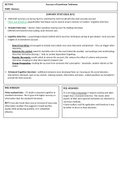
SUMMARY OF KEY IDEAS (K/U)
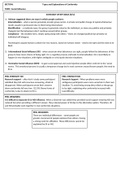
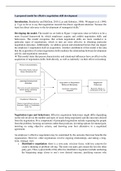
1. With EWT accuracy can be low but it is vital that the truth is told with the most accurate account.
Fisher and Geiselman argued better techniques can be used to ensure memory is recalled = Cognitive Interview
2. Standard Interview = shorter, faster questions leaving room for leading interviews
Different environment than coding, lacks retrieval cues.
3. Cognitive Interview = a psychological based method which uses four techniques aiming to gain deeper, more accurate
insights of an eyewitness account.
- Report Everything: encouraged to include every detail, even ones that seem unimportant – this can trigger other
memories.
- Reinstate the context: asked to mentally return to the event (describe weather, surroundings) and recall feelings
(how they felt before/during.) – links to context dependent forgetting.
- Reorder the events: usually asked to reverse the account, this reduces the effect of schema and prevents
memories changing to what they expect to happen next
- Change Perspective: recalling the account from someone else’s perceptive – bystander, another witness or the
victim.
4. Enhanced Cognitive Interview = additional elements were developed later on, focusing on the social dynamics
(interaction.) Elements such as eye contact, reducing anxiety, distractions and open - ended questions are included to
provide the best accounts.
PEEL STRENGTH PEEL WEAKNESS
Meta analysed data – 55 studies compared cognitive to CI is very time consuming; it requires training and takes
standard interviews. The CI gave 41% higher accuracy in longer than a standard interview. This means other
information than the standard interviews. aspects of their job is ignored and police are reluctant to
use these methods.
BUT it was also found there was an increase of inaccurate
It lacks realism, real life application and therefore it may
information recalled. This suggests CI could sacrifice
be better to focus on basic elements.
quality while producing quantity, isn’t completely
effective.
TOPIC: Memory
SUMMARY OF KEY IDEAS (K/U)
1. With EWT accuracy can be low but it is vital that the truth is told with the most accurate account.
Fisher and Geiselman argued better techniques can be used to ensure memory is recalled = Cognitive Interview
2. Standard Interview = shorter, faster questions leaving room for leading interviews
Different environment than coding, lacks retrieval cues.
3. Cognitive Interview = a psychological based method which uses four techniques aiming to gain deeper, more accurate
insights of an eyewitness account.
- Report Everything: encouraged to include every detail, even ones that seem unimportant – this can trigger other
memories.
- Reinstate the context: asked to mentally return to the event (describe weather, surroundings) and recall feelings
(how they felt before/during.) – links to context dependent forgetting.
- Reorder the events: usually asked to reverse the account, this reduces the effect of schema and prevents
memories changing to what they expect to happen next
- Change Perspective: recalling the account from someone else’s perceptive – bystander, another witness or the
victim.
4. Enhanced Cognitive Interview = additional elements were developed later on, focusing on the social dynamics
(interaction.) Elements such as eye contact, reducing anxiety, distractions and open - ended questions are included to
provide the best accounts.
PEEL STRENGTH PEEL WEAKNESS
Meta analysed data – 55 studies compared cognitive to CI is very time consuming; it requires training and takes
standard interviews. The CI gave 41% higher accuracy in longer than a standard interview. This means other
information than the standard interviews. aspects of their job is ignored and police are reluctant to
use these methods.
BUT it was also found there was an increase of inaccurate
It lacks realism, real life application and therefore it may
information recalled. This suggests CI could sacrifice
be better to focus on basic elements.
quality while producing quantity, isn’t completely
effective.