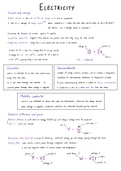
ELECTRICITY
current and
charge
Electric current rate of flow of
is the
charge in a wire or
component
due to of metals ( collide with other and the fixed the metal )
charge conduction each
↳ carriers e- + ve ions in
passage
a :
.
salt solution : ions (
charged atoms or molecules )
Convention for direction of current to
negative
:
positive
current ( I ) force between two current
; ampere
(A) :
magnetic parallel wires when
they carry the same
(Q ); ( C)
charge coulomb :
charge flow in one second when the current is one
ampere .
C current A
charge , ,
Current of due to flow of second
IA
charge 1C
Q
is
It
a
•
per .
=
of 1.6 -19C current of IA due to
charge
↳ 1 e- 10 is
;
: ×
time ,
s
's
each
6. 25×10 e-
passing along a wire second 1 A =
1000mA
Insulator Semiconductor
number of temperature
each e- is attached to atom and cannot charge carriers increases with an increase in
•
.
an move
from the atom resistance of semiconductor decreases as
temperature increases
away
.
insulator A
through the
semiconducting material called intrinsic semiconductor
-
no e- can move no is an
pure
•
.
. .
from the atoms
current
passes through when
voltage is
applied .
↳ conduction is due to e- that break free .
Metallic conductor
most attached to but de localised these
. e- are atoms some are are the
charge carriers
conduction attracted towards terminal
• when
voltage is
applied ,
electrons are
positive
Potential difference and
power
Potential difference done ( or transfer )
is work
energy per
unit
charge voltage across the
component
volt V 1 coulomb work done J
=
joule per u
,
p.d.
,
W
,
V =
Q
charge ,
C
Electromotive force ( emf ) of of
electricity electrical unit
charge passing through the source
a source
energy per
:
Heating effect :
when electric current
passes through component with resistance
↳ also has
magnetic effect ( in electric motors and
loudspeakers )
power ,
W current A ,
work done ,
J voltage ,
V
time
P
S
VI W VIT
,
= =
V current A
voltage ,
.
, Resistance
resistance A V
,
voltage ,
of
a measure of
difficulty making current
pass through the
component ✓
•
.
R =
Resistance is
the
pd across the component T
current A
-
the current
through it ,
caused
↳
by the
repeated collisions between the
charge carriers in the material with each other and with the fixed
of the
positive ions material .
Ohm 's Law states that the
pd across a metallic conductor is
proportional to the current
through it
,
conditions do not
provided the
physical change .
voltage ,
V
treat
Unless
specifically stated in the
question
:
,
Ammeters 0 resistance
as
having
-
Voltmeters infinite resistance
as
having
-
0
current ,
I
Resistivity
'
, p resistance ( r )
①
resistance ,
A
resistance R
resistivity rm
RA
,
, '
cross-sectional area
,
m
P
=
L cross-sectional area A
length ,
m
"
1 " d
R ✗ L R ✗ A =
0
4
A length 1m )
Superconductor is a wire or device made of material that has 0
resistivity at and below a critical temperature
that
depends on the material
This
property is called
superconductivity .
↳ when a current
passes through it
,
there is no
p.d. across it because its resistance is 0 .
( accelerators )
Applications : used to make
high-power electromagnets to
generate very strong magnetic fields .
MRI scanners
, particle
:
reduction of
energy
loss in transmission of electric
power ( lightweight electric motors
, power
cables )
Measuring the variation of current with
p.d. for a
component :
divider ) variable resistor
i )
potential ii
current to
|
through and the
-
the
•
current the
component .
varies a minimum
pd across it can be reduced to 0 .
A ( cannot be reduced to 0 )
✗
A
I.
V
V
current and
charge
Electric current rate of flow of
is the
charge in a wire or
component
due to of metals ( collide with other and the fixed the metal )
charge conduction each
↳ carriers e- + ve ions in
passage
a :
.
salt solution : ions (
charged atoms or molecules )
Convention for direction of current to
negative
:
positive
current ( I ) force between two current
; ampere
(A) :
magnetic parallel wires when
they carry the same
(Q ); ( C)
charge coulomb :
charge flow in one second when the current is one
ampere .
C current A
charge , ,
Current of due to flow of second
IA
charge 1C
Q
is
It
a
•
per .
=
of 1.6 -19C current of IA due to
charge
↳ 1 e- 10 is
;
: ×
time ,
s
's
each
6. 25×10 e-
passing along a wire second 1 A =
1000mA
Insulator Semiconductor
number of temperature
each e- is attached to atom and cannot charge carriers increases with an increase in
•
.
an move
from the atom resistance of semiconductor decreases as
temperature increases
away
.
insulator A
through the
semiconducting material called intrinsic semiconductor
-
no e- can move no is an
pure
•
.
. .
from the atoms
current
passes through when
voltage is
applied .
↳ conduction is due to e- that break free .
Metallic conductor
most attached to but de localised these
. e- are atoms some are are the
charge carriers
conduction attracted towards terminal
• when
voltage is
applied ,
electrons are
positive
Potential difference and
power
Potential difference done ( or transfer )
is work
energy per
unit
charge voltage across the
component
volt V 1 coulomb work done J
=
joule per u
,
p.d.
,
W
,
V =
Q
charge ,
C
Electromotive force ( emf ) of of
electricity electrical unit
charge passing through the source
a source
energy per
:
Heating effect :
when electric current
passes through component with resistance
↳ also has
magnetic effect ( in electric motors and
loudspeakers )
power ,
W current A ,
work done ,
J voltage ,
V
time
P
S
VI W VIT
,
= =
V current A
voltage ,
.
, Resistance
resistance A V
,
voltage ,
of
a measure of
difficulty making current
pass through the
component ✓
•
.
R =
Resistance is
the
pd across the component T
current A
-
the current
through it ,
caused
↳
by the
repeated collisions between the
charge carriers in the material with each other and with the fixed
of the
positive ions material .
Ohm 's Law states that the
pd across a metallic conductor is
proportional to the current
through it
,
conditions do not
provided the
physical change .
voltage ,
V
treat
Unless
specifically stated in the
question
:
,
Ammeters 0 resistance
as
having
-
Voltmeters infinite resistance
as
having
-
0
current ,
I
Resistivity
'
, p resistance ( r )
①
resistance ,
A
resistance R
resistivity rm
RA
,
, '
cross-sectional area
,
m
P
=
L cross-sectional area A
length ,
m
"
1 " d
R ✗ L R ✗ A =
0
4
A length 1m )
Superconductor is a wire or device made of material that has 0
resistivity at and below a critical temperature
that
depends on the material
This
property is called
superconductivity .
↳ when a current
passes through it
,
there is no
p.d. across it because its resistance is 0 .
( accelerators )
Applications : used to make
high-power electromagnets to
generate very strong magnetic fields .
MRI scanners
, particle
:
reduction of
energy
loss in transmission of electric
power ( lightweight electric motors
, power
cables )
Measuring the variation of current with
p.d. for a
component :
divider ) variable resistor
i )
potential ii
current to
|
through and the
-
the
•
current the
component .
varies a minimum
pd across it can be reduced to 0 .
A ( cannot be reduced to 0 )
✗
A
I.
V
V