
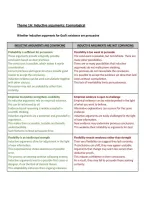
Theme 1A: Inductive arguments: Cosmological
Whether inductive arguments for God’s existence are persuasive
INDUCTIVE ARGUMENTS ARE CONVINCING INDUCTIVE ARGUMENTS ARE NOT CONVINCING
robability is sufficient for persuasion
P ossibility is too weak to persuade
P
These arguments provide a logically possible The conclusion is possible, but not definite. There are
conclusion based on clear premises. many other possibilities.
The conclusion is possible, which makes it worth There are so many possibilities that inductive
consideration. arguments do not really prove anything.
Correct premises and logical structure provide good The premises do not necessitate the conclusion.
reason to accept the conclusion. It is possible to accept the evidence yet deny that God
Inductive evidence can be used cumulatively together exists without contradiction.
with other sources. This lack of inevitability limits persuasiveness.
Persuasion may rest on probability rather than
certainty.
E mpirical foundation strengthens credibility E mpirical evidence is open to challenge
As inductive arguments rely on empirical evidence, Empirical evidence can be misinterpreted in the light
this can be witnessed by all. of what you want to believe.
Evidence-based reasoning is widely accepted in Alternative explanations can account for the same
scientific thinking. evidence.
Inductive arguments are a posteriori and grounded in Inductive arguments are easily challenged in the light
experience. of new information.
This makes them accessible, testable and broadly New evidence may undermine previous conclusions.
understandable. This weakens their reliability as arguments for God.
Such features increase persuasive force.
F lexibility is an intellectual strength F lexibility reveals weakness rather than strength
Inductive arguments allow for adjustment in the light Their very flexibility can suggest they lack certainty.
of new information. If conclusions can shift, they may appear unstable.
This responsiveness shows awareness of possible Arguments that change may seem less secure than
error. deductive proofs.
The process can develop without collapsing entirely. This reduces confidence in their conclusions.
Inductive arguments lead to a possible first cause or As a result, they may fail to persuade those seeking
designer, if not the God of classical theism. certainty.
This adaptability enhances their ongoing relevance.
, Theme 1A: Inductive arguments: Cosmological
The extent to which the Kalam cosmological argument is convincing
THE KCA IS VERY CONVINCING THE KCA IS NOT AT ALL CONVINCING
I t leads clearly to a personal God T he personal God conclusion is not proven
The Kalam argument leads us to a personal God more The Kalam argument does not prove a personal God;
clearly than any other version. it only makes it logically possible.
This argument leads naturally to a personal God much The conclusion of a personal God seems to ignore
more consistent with theism. other possibilities for a first cause.
Through the elimination of some possibilities, we can God is not proven, but there are no clear reasons to
see that a personal God is possible. reject the possibility.
The conclusion identifies a deliberate personal cause The move from “cause” to “personal creator” goes
rather than impersonal physical laws. beyond the evidence.
This strengthens its appeal to classical theism. This weakens its persuasive force.
I ts use of mathematics strengthens the case athematical claims are disputable
M
The use of mathematics in the Kalam argument makes Set theory rejects actual infinites, which makes an
it more convincing and trustworthy. infinite God impossible.
The Kalam argument uses mathematical reasoning on Set theory is mathematical, but it is not the sole
infinity. mathematical opinion.
Set theory rejects actual infinites, supporting the claim If infinity is coherent mathematically, the argument
that an actual infinite past is impossible. against an infinite past weakens.
This provides rational support for a finite beginning. The denial of infinity may be overstated.
Such reasoning increases credibility. This undermines the argument’s foundation.
I t aligns with scientific understanding of causality ausality may not be universal
C
The Kalam argument uses scientific knowledge that Heisenberg’suncertainty principle shows that notall
Aquinasdid not possess. things are caused.
Causality is a general rule of the universe, consistent If causality is not absolute, the first premise is
with general observation. weakened.
Modern cosmology supports a finite universe with a Quantum events challenge the assumption that
beginning. everything that begins must have a cause.
This gives empirical strength to the first premise. The argument depends heavily on this causal claim.
Scientific backing enhances persuasiveness. If causality fails, the argument collapses.
, Theme 1B: Inductive arguments: Teleological
Effectiveness of the cosmological/teleological argument for God’s existence
COSMOLOGICAL AS EFFECTIVE/INEFFECTIVE TELEOLOGICAL AS EFFECTIVE/INEFFECTIVE
S cientific consistencyvs limited conclusion E mpirical evidencevs interpretation
The CA is consistent with the scientific suggestion that The TA provides clear empirical evidence of order and
there must be a first cause. Unlike the TA, it does not apparent purpose in the universe. Fine-tuning and
rely upon weak analogies but on real factual evidence. biological complexity suggest intentional design. As an
It shows that a first cause is a probable explanation a posteriori argument, it is grounded in observation,
even if it does not prove God. making it accessible and persuasive.
All the CA proves is a first cause. To conclude that God The empirical evidence is open to interpretation.
exists shows limited imagination regarding other Evolution and natural necessity can explain
possible first causes. The move from “first cause” to complexity without reference to God. The evidence
“God” is not logically necessary. does not logically require a designer.
ltimate explanationvs alternative possibilities
U S cientific compatibilityvs weak analogy
God is presented as the only explanation for the The TA can withstand evolutionary theory if evolution
universe that requires no further explanation. The CA is seen as God’s method. Modern fine-tuning
offers a rational stopping point in explaining existence. arguments strengthen the case beyond simple
God is not necessarily the only explanation for the machine analogies, showing adaptability in light of
universe. Other possible first causes cannot be ruled scientific progress.
out, which weakens the claim that the argument is The argument relies on weak analogies between the
decisive. world and machines. Douglas Adams’ puddle parody
suggests apparent design may simply reflect
adaptation. If the analogy fails, the conclusion
weakens.
ational structure vsmodern challenges
R umulative supportvs alternative explanations
C
The CA is grounded in cause-and-effect reasoning, The TA adds cumulative weight when combined with
which mirrors scientific thinking and remains relevant other arguments for God’s existence. It strengthens
in the 21st century. the overall theistic case even if not decisive alone.
Modern scientific developments offer alternative Alternative explanations, such as chance or multiverse
accounts of origins, reducing the necessity of a divine theories, reduce the need for a designer. As a result,
first cause and limiting its effectiveness. the TA may be suggestive but not conclusive.
, Theme 1B: Inductive arguments: Teleological
Persuasiveness of cosmological/teleological arguments in the 21st century
COSMOLOGICAL ARGUMENT IS/ISN’T PERSUASIVE TELEOLOGICAL ARGUMENT IS/ISN’T PERSUASIVE
E mpirical groundingvs scientific self-sufficiency bservable designvs natural explanation
O
Twenty-first-century humans require empirical Twenty-first-century humans require empirical
evidence to support truth claims. The cosmological evidence, and the TA appeals to observable
argument begins from the observable fact that the complexity and apparent purpose in nature. Evolution
universe exists. Theories such as the Big Bang can can be interpreted as God’s method and need not
support the thesis of God and do not necessarily conflict with design.
conflict with it. Evolution does not require God as an explanation.
Modern methodology requires testable conclusions, Apparent design can arise through natural selection
and God is an untestable hypothesis. God is an without intention.
unnecessary explanation since the Big Bang does not
require it. Scientific accounts reduce the need for
metaphysical causes.
ause and effectvs quantum challenge
C I ntelligent design resurgencevs ridicule
Experiences of cause and effect are universal There has been a resurgence of the TA through the
throughout time and underpin both science and intelligent design movement. The movement attempts
cosmological reasoning. This makes the argument rational support for those with faith in a modern
rationally structured and accessible. scientific context.
Cause and effect are not universally true, as shown by The intelligent design movement is ridiculed by much
quantum physics. If causation is not absolute, the first of the modern world, reducing its credibility within
premise of cosmological reasoning is weakened. mainstream science.
eaningful explanationvs worldview dependence
M E xistential appealvs perception of chaos
The argument addresses why the universe exists, not Some are drawn to explanations that give meaning or
just how it functions, offering a deeper metaphysical purpose to life through perceived order and
explanation and purpose. complexity in the universe.
Religious people and atheists interpret data according Some perceive chaos and lack of purpose in the world.
to their pre-existing faith perspective. Persuasiveness Religious and non-religious individuals interpret the
depends largely on prior belief rather than logical same data differently, limiting universal
force. persuasiveness.


