
AQA Chem · 3.1.1 p.1
atomic structure
Models change as evidence changes: plum pudding → nuclear / electron shell model (Rutherford scattering, 1911).
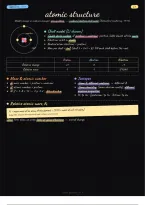
nucleus Shell model (Li shown)
Small, dense nucleus of protons + neutrons : positive, holds almost all the mass
Electrons orbit in shells
Neutral atom: electrons = protons
shell Max per shell = 2n² (shell 2 = 2×4 = 8). Fill each shell before the next.
Proton Neutron Electron
Relative charge +1 0 −1
Relative mass 1 1 1/1840
Mass & atomic number Isotopes
A mass number = protons + neutrons Same Z, different neutrons → different A
Z atomic number = protons Same chemistry (same electron config), different
N: Z = 7, A = 14 → 7 p, 7 e⁻, 14 − 7 = 7 n physical properties
H: 1p 0n · Deuterium: 1p 1n · Tritium: 1p 2n
Relative atomic mass, Aᵣ
of a C-12 atom)
Aᵣ = mean mass of an atom of the element ÷ (1/12 × mass
t
takes the relative abundance of each isotope into accoun
Ions form when an atom loses or gains electrons → overall charge.
atomic structure ·


