
A-LEVEL MATHEMATICS / INTEGRATION / INDEPENDENT SUPPLEMENT
METHOD SUMMARY + ORIGINAL PRACTICE
Integration:
signs, crossings and area
A-Level Maths
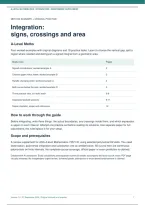
Four worked examples with original diagrams and 18 practice tasks. Learn to choose the vertical gap, split a
region where needed and distinguish a signed integral from a geometric area.
Study route Pages
Signed contributions; worked example A 2
Choose upper minus lower; worked example B 3
Handle changing order; worked example C 4
Both curves below the axis; worked example D 5
Three practice sets, six tasks each 6-8
Separated worked solutions 9-11
Repair checklist, scope and references 12
How to work through the guide
Before integrating, write three things: the actual boundaries, any crossings inside them, and which expression
is upper on each interval. Attempt one practice set before reading its solutions. Use separate paper for full
calculations; the ruled space is for your setup.
Scope and prerequisites
A narrow supplement for AQA A-level Mathematics 7357 H3, using selected polynomial H2 skills. You need
factorisation, polynomial integration and substitution into an antiderivative. All curves here are continuous
polynomials on finite intervals. No complete-course coverage, official paper or exam prediction is claimed.
Created with AI assistance. Exact calculations and separate numerical checks accompany the local source; every PDF page
visually reviewed. No independent expert review, achieved grade, attendance or exam-board endorsement is claimed.
Version 1.0 | 27 September 2026 | Original methods and practice 1
, A-LEVEL MATHEMATICS / INTEGRATION / INDEPENDENT SUPPLEMENT
01 / AXIS CROSSINGS
An integral can cancel
A vertical strip has signed height f(x), but its geometric height above or below the x-axis is |f(x)|. For bounds a
< b, integrate f for a signed total. For total geometric area, find zeros inside the interval and add the
nonnegative areas of the pieces.
Notation used here
Write I(a,b; f) for the definite integral of f(x) with respect to x from a to b. If F'(x) = f(x), then I(a,b; f) = F(b) - F(a). This compact
notation keeps the bounds readable. An indefinite integral includes +C; the constant cancels in a definite difference.
Worked example A: y = x - 2 on [0, 5]
y
x
0 2 5
Teal: y = x - 2. Rust: x-axis. The shaded pieces meet at x = 2.
The zero is x = 2. An antiderivative is F(x) = x2/2 - 2x, so F(0) = 0, F(2) = -2 and F(5) = 5/2.
Interval Signed contribution Geometric area
[0, 2] -2 2
[2, 5] 9/2 9/2
Total 5/2 13/2
Independent geometry check: the triangles have areas (2 x 2)/2 = 2 and (3 x 3)/2 = 9/2. The absolute value of the whole integral
is only 5/2: cancellation has already happened. Area is 13/2 square units.
Version 1.0 | 27 September 2026 | Original methods and practice 2
METHOD SUMMARY + ORIGINAL PRACTICE
Integration:
signs, crossings and area
A-Level Maths
Four worked examples with original diagrams and 18 practice tasks. Learn to choose the vertical gap, split a
region where needed and distinguish a signed integral from a geometric area.
Study route Pages
Signed contributions; worked example A 2
Choose upper minus lower; worked example B 3
Handle changing order; worked example C 4
Both curves below the axis; worked example D 5
Three practice sets, six tasks each 6-8
Separated worked solutions 9-11
Repair checklist, scope and references 12
How to work through the guide
Before integrating, write three things: the actual boundaries, any crossings inside them, and which expression
is upper on each interval. Attempt one practice set before reading its solutions. Use separate paper for full
calculations; the ruled space is for your setup.
Scope and prerequisites
A narrow supplement for AQA A-level Mathematics 7357 H3, using selected polynomial H2 skills. You need
factorisation, polynomial integration and substitution into an antiderivative. All curves here are continuous
polynomials on finite intervals. No complete-course coverage, official paper or exam prediction is claimed.
Created with AI assistance. Exact calculations and separate numerical checks accompany the local source; every PDF page
visually reviewed. No independent expert review, achieved grade, attendance or exam-board endorsement is claimed.
Version 1.0 | 27 September 2026 | Original methods and practice 1
, A-LEVEL MATHEMATICS / INTEGRATION / INDEPENDENT SUPPLEMENT
01 / AXIS CROSSINGS
An integral can cancel
A vertical strip has signed height f(x), but its geometric height above or below the x-axis is |f(x)|. For bounds a
< b, integrate f for a signed total. For total geometric area, find zeros inside the interval and add the
nonnegative areas of the pieces.
Notation used here
Write I(a,b; f) for the definite integral of f(x) with respect to x from a to b. If F'(x) = f(x), then I(a,b; f) = F(b) - F(a). This compact
notation keeps the bounds readable. An indefinite integral includes +C; the constant cancels in a definite difference.
Worked example A: y = x - 2 on [0, 5]
y
x
0 2 5
Teal: y = x - 2. Rust: x-axis. The shaded pieces meet at x = 2.
The zero is x = 2. An antiderivative is F(x) = x2/2 - 2x, so F(0) = 0, F(2) = -2 and F(5) = 5/2.
Interval Signed contribution Geometric area
[0, 2] -2 2
[2, 5] 9/2 9/2
Total 5/2 13/2
Independent geometry check: the triangles have areas (2 x 2)/2 = 2 and (3 x 3)/2 = 9/2. The absolute value of the whole integral
is only 5/2: cancellation has already happened. Area is 13/2 square units.
Version 1.0 | 27 September 2026 | Original methods and practice 2


