Topic 1: Atomic Structure
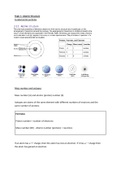
Fundemental particles
g
Mass number and isotopes
Mass number (A) and atomic (proton) number (Z).
Isotopes are atoms of the same element with different numbers of neutrons and the
same number of protons.
Formulas
Proton number = number of electrons
Mass number (Mr) - Atomic number (protons) = neutrons
If an atom has a ‘+’ charge, then the atom has lost an electron. If it has a ‘-’ charge then
the atom has gained an electron.
, Time of flight Mass Spectrometer
The mass spectrometer gives accurate information about relative isotopic mass and also
about the relative abundance of isotopes.
Mass spectrometry can be used to identify elements. Mass spectrometry can be used to
determine relative molecular mass.
Particles of a substance are ionised to form 1+ ions.
Stage 1: Ionisation
Electron impact is when the sample is vapourised and high energy electrons are fired at
it. They are fired from an electron gun which is a hot wire filament with a current that
emits electrons. This knocks off one electron from each particle, forming a +1 ion. This is
used for substances with low formula mass. Fragmentation can occur.
Electrospray ionisation is when the sample is dissolved in a volatile solvent (vapourises at
room temp) and injected through a fine hypodermic needle to give a fine mist. The tip of
the needle is attached to a positive terminal of a high voltage supply. The particles gain a
proton (H+ ion) from the solvent as they leave the needle. Used for biological molecules
with high molecular mass. Fragmentation is rare.
In both methods they exit through a negatively charged plate which attracts the positive
ions
Fundemental particles
g
Mass number and isotopes
Mass number (A) and atomic (proton) number (Z).
Isotopes are atoms of the same element with different numbers of neutrons and the
same number of protons.
Formulas
Proton number = number of electrons
Mass number (Mr) - Atomic number (protons) = neutrons
If an atom has a ‘+’ charge, then the atom has lost an electron. If it has a ‘-’ charge then
the atom has gained an electron.
, Time of flight Mass Spectrometer
The mass spectrometer gives accurate information about relative isotopic mass and also
about the relative abundance of isotopes.
Mass spectrometry can be used to identify elements. Mass spectrometry can be used to
determine relative molecular mass.
Particles of a substance are ionised to form 1+ ions.
Stage 1: Ionisation
Electron impact is when the sample is vapourised and high energy electrons are fired at
it. They are fired from an electron gun which is a hot wire filament with a current that
emits electrons. This knocks off one electron from each particle, forming a +1 ion. This is
used for substances with low formula mass. Fragmentation can occur.
Electrospray ionisation is when the sample is dissolved in a volatile solvent (vapourises at
room temp) and injected through a fine hypodermic needle to give a fine mist. The tip of
the needle is attached to a positive terminal of a high voltage supply. The particles gain a
proton (H+ ion) from the solvent as they leave the needle. Used for biological molecules
with high molecular mass. Fragmentation is rare.
In both methods they exit through a negatively charged plate which attracts the positive
ions