
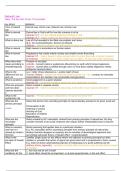
Natural Law
Telos, The four tiers of law, The precepts
Key Word: Definition:
Tiers of natural Eternal Law, Divine Law, Natural Law, Human Law
law
What is eternal Eternal law is God's will for how the universe is to be
law Aquinas' S.T - it is the 'rational guidance of things in God'
Aquinas’ S.T - 'nature inclines to that which is necessary for the perfection of the community'
What is divine law Law of God revealed in the Bible via prophets and Jesus
(E.g. Ten Commandments, Sermon on Mount)
Aquinas - ‘biblical revelations are affirmations of what is knowable by reason’
What is natural Right reason in accordance w/ human nature
law
What is human Regulations that create orderly society and enable human flourishing
law Aquinas' ST - 'man is bound to obey secular rulers to extent that order of justice requires'
St Ambrose - 'natural law is in heart, written law on tables. All men are under natural law'
What does telos Purpose or end goal
mean according to Aristotle - human's telos is eudaimonia (flourishing on earth which brings happiness)
Aristotle/Aquinas Aquinas - human telos is fulfilled through union w/ God (thus earthly happiness merely
prefigures heavenly bliss)
What is the Lex = letter of law whereas Ius = justice (spirit of law)
difference b/w Ius Thomas Hobbes - ‘Natural law should be understood as 'ius > lex', contrary to manualist
and Lex interpretations b/c situation may necessitate transgressions
What is prudence Good judgement in a given situation
Aquinas' ST - ‘prudence considers reason but also application to action’
What are precepts Rules created to regulate society
and how does Aquinas' ST - 'order of precepts of natural law is the order of our natural inclinations'
Aquinas describe
it
What is the Aquinas - ‘Primary precept is disposition to do good and avoid evil’
synderesis rule
What are the Rules that derive from overriding principle of natural law/key precept to do good, avoid evil
primary precepts
Preservation of life
POWER Ordering of society
Worship of God
Education of children
Reproduction
What are the Rules created by RC manualists, derived from primary precepts of natural law, b/c they
secondary consider humans to be social creatures who require further interpretative laws to flourish
precepts
What is casuistry Moral reasoning that applies laws to a particular situation
and how is it E.g. RC manualists derive secondary precepts from primary precepts of natural law
viewed by modern Modern thomists disagree w/ casuistry due to minutiae of deontological approach and
thomists accordingly advocate theory of double effect + proportionalism
What is the Justifies single action w/ two effects where one adheres to primary precepts but other
principle of Double violates it, provided that action of agent has good intent and is proportional to harm caused
Effect E.g. Intent of doctor administering injection in Euthanasia is to avoid suffering not kill
Anthony Kenny (agnostic) - ‘principle of double effect must form a part of any rational system
of morality’
What are the 1. Act must not be evil in itself
conditions for the 2. Good effect should be as important, or at least proportionate, to the evil effect
,principle of Double Aquinas ST - ‘an act might have a good intention but still be wrong if it is not proportional to
Effect the end’ (e.g. using excessive violence as self-defence)
3. Intent of agent must be good (i.e. not desiring evil result)
4. Proportionately serious reason must be present to justify bad effect
Criticisms of 1. Naïve concept b/c assumes humans are able to understand virtuous behaviour
Natural Law Natural law uses a posteriori observation of world to establish precepts that enable humans
flourishing
Aquinas’ S.T - 'nature inclines to that which is necessary for the perfection of the community'
Suggests humans can understand virtuous behaviour by reflecting on nature; therefore
provides more accessible and sympathetic understanding of human nature as it
acknowledges not only those who follow divine law can also display virtuous behaviour
Hugo Grotius - 'natural law would be valid, irrespective of God's existence'
Shows natural law provides timeless, absolute framework
,St Paul in Romans 2:15 - ‘the requirements of the law are written on men's hearts’
Cicero - 'there will be one eternal and unchangeable law valid for all nations and for all
times'
Suggests natural law appeals to humans’ innate knowledge of morality and synderesis rule
‘to do good and avoid evil’
Nietschze’s ‘Beyond Good and Evil’ argues what is good may be evil and what is evil may
be thought to be good
Shows humans may make mistakes in their conscientia (application of reason to knowledge
of primary precepts in a given situation) by conflating apparent goods w/ real goods
Hume (emotivist) - ‘reason is a slave of the passions’ suggesting humans are not inclined to
make moral decisions through reason, but may make them through emotion
St Paul in 1 Timothy 4:2 - ‘Such teachings come through hypocritical liars, whose
consciences have been seared as w/ a hot iron
Shows humans cannot absolutely understand virtuous behaviour
C: Bonhoeffer’s coming of age concept - humans more civilised, educated and virtuous thus
natural law, which is predicated upon synderesis rule ‘to do good and avoid evil’, is valid
CC: William Barclay - ‘If we insist that in every situation every man must make his own
decision, then first of all we must make man morally and lovingly fit to make that decision;
otherwise we need the compulsion of law to make him do it’
William Barclay disagrees w/ Bonhoeffer’s coming of age concept as humans are inclined to
selfish individualism which prevents them from behaving virtuously and flourishing
Jeremiah 17:9 - ‘The heart is deceitful above all things, and desperately wicked: who can
know it?’
Karl Barth (Protestant) - ’the finite has no capacity for the infinite’
Barth reinforces human’s inability to comprehend natural law, which is derived from higher
tier of God’s eternal law, b/c human’s postlapsarian nature is corrupted
2. Natural law is practical
B/c of casuistry promoted by RC manualists
RC manualists derive secondary precepts from primary precepts of natural law b/c they
consider humans to be social creatures who require further interpretative laws to flourish
Secondary precepts therefore provide practical human laws that are flexible w/in
contemporary society
E.g. prohibiting abortion due to primary precept to preserve life
C: Natural law being deontological is inherently inflexible
Herbert McCabe (RC scholar) - 'manuals show no serious interest in the development of
Christian life'
Servais Pinckaers (RC scholar) - ‘The moral theology of the manuals lost sight of happiness
and the destiny of the human person’
Suggests natural law is too deontological which prevents humans fulfilling telos and
flourishing
CC: Distinction in natural law b/w ius and lex provides further practicality in moral decision-
making
Thomas Hobbes - ‘natural law should be understood as ius’
Shows promoting justice rather than rule of law enables prudent moral decision-making
3. Natural law incompatible w/ modern views
Aquinas' ST - 'man is bound to obey secular rulers to extent that order of justice requires'
St Ambrose - 'natural law is in heart, written law on tables. All men are under natural law'
Shows human laws and cultural requirements may contravene natural law
Evidenced by divergent vitalist and instrumentalist positions regarding euthanasia despite
primary precept to preserve life, and divergent positions of fundamentalists and liberals on
homosexuality despite primary precept to reproduce
Kai Nielsen suggests there is not one unified human nature contrary to Aquinas’ notion that
all humans have infallible inclination to do good and avoid evil (synderesis)
, J.S. Mill argued that similar to O.T divine law, natural law ethics was pertinent in a
mediaeval socio-economic time and should conform to modern views
Freud - religious morality reflected the ‘ignorant childhood days of the human race’
Increasing spread of atheism in 21st century suggests social conditioning determines our
moral views, not natural law
C: Natural Law compatible w/ modern views due to John Finnis (modern, secular Thomist)
developments of theory on premise of human rights
Finnis proscribes torture, taking life as means to end, being unduly lied to, being
condemned on false charges
Shows natural law theory is understandable in modernity
Principle of double effect (justifies single action w/ two effects where one adheres to primary
precepts but other violates it, provided that action of agent has good intent and is
proportional to harm caused) endorsed by natural law theorists makes natural law
accessible in modernity
Anthony Kenny (agnostic) - ‘principle of double effect must form a part of any rational
system of morality’
Proportionalists like Bernard Hoose suggest if an action causes a greater balance of ontic
good (enables flourishing) compared to ontic evil (inhibits flourishing) then it is morally
justified, even if contradicts primary precepts
E.g. Intent of doctor administering injection in Euthanasia is to avoid suffering not kill patient
so is permissible and not condemned as intrinsically immoral
Shows natural law can adapt to contemporary issues
CC: Pope John Paul II rejected proportionalism as the purpose of natural law is our
intentional alignment w/ God’s eternal law
Aquinas suggests human’s telos is fulfilled through union w/ God (thus earthly happiness
merely prefigures heavenly bliss), contrary to Aristotle’s notion that humans’ telos is
eudaimonia (flourishing on earth which brings happiness), thus his concept of natural law
law is not compatible w/ modern views as it is focussed on following higher tier of God’s
eternal law, rather than lower tier of human law
Discuss whether or Natural law may be defined as right reason in accordance w/ human nature.
not natural law This essay posits that natural law does not provide a helpful method of moral decision-
provides helpful making on the following grounds:
method of moral
decision-making 1. Naïve concept b/c assumes humans are able to understand virtuous behaviour
2. Natural law is practical (although)
3. Natural law incompatible w/ modern views
Discuss whether or Aquinas (influenced by Aristotelian idea of eudaimonia) suggests telos is a union w/ God
not judgements Aquinas suggests adherence to natural law enables fulfilment of telos
about something Although judgements on morality can be made on fulfilment of telos, and broader


