

EPS Foundation Year University of Birmingham LF Mathematics I
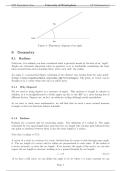
Ray
Vertex
Ray
Figure 1: Elementary diagram of an angle.
9 Geometry
9.1 Radians
Until now, it is unlikely you have considered what is precisely meant by the idea of an “angle”.
Angles are extremely important ideas in geometry so it is worthwhile considering the basic
ideas around them and re-learning them, with a new unit: the radian.
An angle is “a geometrical figure consisting of two distinct rays issuing from the same point”
(https://encyclopediaofmath.org/index.php?title=Angle). The point, or vertex, can be
thought of as a corner where the rays (or sides) meet.
9.1.1 Why Degrees?
We are used to using degrees as a measure of angles. This measure is taught in schools to
children as it is straightforward to divide angles up due to the 360◦ in a circle having lots of
different factors. Degrees are, in fact, an arbitrary scaling although useful nonetheless.
As we start to study more mathematics, we will find that we need a more natural measure
of angle so that our functions behave normally.
9.1.2 Radians
Radians are a natural unit for measuring angles. The definition of 1 radian is: The angle
subtended by two equal length lines such that the arc length (the circular path followed from
one point to another) between them is also the same length is 1 radian.
Note that 1 radian ≈ 57.3◦ .
A sector of a circle is a section of a circle, divided from its centre to side through some angle,
θ. The arc length of a sector and its radius are proportional to each other. If the radius of
a sector increases, so does the arc length. If we increase the angle of the sector, we can also
expect the arc length to increase, leading us to a general formula for arc length:
s = rθ (9.1.1)
If we have a full circle, we can define the angle to be 2π where π is some constant we can
Page 1
, EPS Foundation Year University of Birmingham LF Mathematics I
s x
r x
θ 1 Radian
r x
(a) Example of a sector of a circle. We usually (b) Scale diagram showing an angle of 1
denote the arc length as s and the radius as r. radian. All the lengths, x are the same.
calculate. If we could physically draw a perfect circle and measure arc length and radius, we
would find:
π ≈ 3.14159265358979323846264338327950 . . . (9.1.2)
π is an irrational number. There are ways to calculate π theoretically, but these methods go
far beyond the scope of foundation year mathematics.
The formula s = rθ should fit with our previous experience of circles, given that for a full
circle, the circumference, c, (a special case of arc length) is c = 2πr, which fits with our
defintion. Radians give circles a natural sense of scale.
Since 2π = 360◦ , we can convert angles between radians and degrees:
π
θrad = θ◦ (9.1.3)
180◦
Likewise, it is possible to take our knowledge of the area of a circle and scale it to the area of
a sector, A. For a circle, we know that A = πr2 , for a sector:
θr2
A= (9.1.4)
2
9.2 Trigonometry of Right Angled Triangles
π
A right angle is an angle of 90◦ or radians. A right angled triangle has one angle of π/2 and
2
the other two will also sum to π/2 (as the sum of the angles in any triangle is always π).
9.2.1 Pythagoras’ Theorem
To analyse right angled triangles, we first need to convince ourselves of a result that has been
established for approximately 2500 year: Pythagoras’ theorem.
It is possible to construct a diagram, as shown in figure 4, by taking 4 identical right angled
triangles consisting of hypotenuse, c, and other lengths a and b. The two non-right angles are
denoted with θ and ϕ. Since θ + ϕ = π/2 (so the sum of all three angles is π), we can see that
the quadrilateral in the middle is in fact a square as the remaining angle must also be π/2 as
Page 2
Ray
Vertex
Ray
Figure 1: Elementary diagram of an angle.
9 Geometry
9.1 Radians
Until now, it is unlikely you have considered what is precisely meant by the idea of an “angle”.
Angles are extremely important ideas in geometry so it is worthwhile considering the basic
ideas around them and re-learning them, with a new unit: the radian.
An angle is “a geometrical figure consisting of two distinct rays issuing from the same point”
(https://encyclopediaofmath.org/index.php?title=Angle). The point, or vertex, can be
thought of as a corner where the rays (or sides) meet.
9.1.1 Why Degrees?
We are used to using degrees as a measure of angles. This measure is taught in schools to
children as it is straightforward to divide angles up due to the 360◦ in a circle having lots of
different factors. Degrees are, in fact, an arbitrary scaling although useful nonetheless.
As we start to study more mathematics, we will find that we need a more natural measure
of angle so that our functions behave normally.
9.1.2 Radians
Radians are a natural unit for measuring angles. The definition of 1 radian is: The angle
subtended by two equal length lines such that the arc length (the circular path followed from
one point to another) between them is also the same length is 1 radian.
Note that 1 radian ≈ 57.3◦ .
A sector of a circle is a section of a circle, divided from its centre to side through some angle,
θ. The arc length of a sector and its radius are proportional to each other. If the radius of
a sector increases, so does the arc length. If we increase the angle of the sector, we can also
expect the arc length to increase, leading us to a general formula for arc length:
s = rθ (9.1.1)
If we have a full circle, we can define the angle to be 2π where π is some constant we can
Page 1
, EPS Foundation Year University of Birmingham LF Mathematics I
s x
r x
θ 1 Radian
r x
(a) Example of a sector of a circle. We usually (b) Scale diagram showing an angle of 1
denote the arc length as s and the radius as r. radian. All the lengths, x are the same.
calculate. If we could physically draw a perfect circle and measure arc length and radius, we
would find:
π ≈ 3.14159265358979323846264338327950 . . . (9.1.2)
π is an irrational number. There are ways to calculate π theoretically, but these methods go
far beyond the scope of foundation year mathematics.
The formula s = rθ should fit with our previous experience of circles, given that for a full
circle, the circumference, c, (a special case of arc length) is c = 2πr, which fits with our
defintion. Radians give circles a natural sense of scale.
Since 2π = 360◦ , we can convert angles between radians and degrees:
π
θrad = θ◦ (9.1.3)
180◦
Likewise, it is possible to take our knowledge of the area of a circle and scale it to the area of
a sector, A. For a circle, we know that A = πr2 , for a sector:
θr2
A= (9.1.4)
2
9.2 Trigonometry of Right Angled Triangles
π
A right angle is an angle of 90◦ or radians. A right angled triangle has one angle of π/2 and
2
the other two will also sum to π/2 (as the sum of the angles in any triangle is always π).
9.2.1 Pythagoras’ Theorem
To analyse right angled triangles, we first need to convince ourselves of a result that has been
established for approximately 2500 year: Pythagoras’ theorem.
It is possible to construct a diagram, as shown in figure 4, by taking 4 identical right angled
triangles consisting of hypotenuse, c, and other lengths a and b. The two non-right angles are
denoted with θ and ϕ. Since θ + ϕ = π/2 (so the sum of all three angles is π), we can see that
the quadrilateral in the middle is in fact a square as the remaining angle must also be π/2 as
Page 2


