
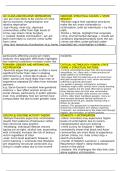
LR: CLASS AND RELATIVE DEPRIVATION MARXISM- STRUCTUAL CAUSES + STATE
-w/c are more likely to be victims of crime NEGLECT
due to economic marginalisation and -Marxists argue that capitalist structures
relative deprivation make the w/c more vulnerable to
-Lea+Young: inner-city, deprived victimisation, both by individuals + by the
communities suffer from high levels of state
crime, esp street crime/ burglary -Tombs + Whyte- highlight that corporate
= created ‘double victimisation’, w/c are crime, environmental damage + unsafe w/c
both more likely to commit crime/ suffer conditions disproportionately harm the w/c-
from crime crimes are often under-policed/ under-
-they lack resources of protection (e.g. home reported// w/c victimisation is hidden
security, private policing) -e.g. Grendell Tower Fire- state neglect +
e.g. knife crime + street robbery are corporate failure harming the w/c, victims
concentrated in low-income areas, were overwhelmingly w/c + ethnic minority
particularly affecting young w/c males residents
analysis: this approach effectively highlights
two material conditions increase victim risk
FEMINSM: GENDER AND PATRIARCHAL CRITICAL VICTIMOLOGY- POWER/ STATE
VICTIMISATION CRIME + STRUCTUAL FACTORS:
-feminists argue that gender is often a more -crictical victimologists argue that structural power
significant factor than class in shaping inequalities, inc: class/ race + state practices all
shape patterns of victimisation
victimhood e.g. crimes like D abuse + SV -they argue that the state has a lot of control over
Allen: women are more likely than men to who gets recognised as a ‘real’ victim and whose
experience repeated DV often from intimate suffering is ignored/ dismissed
partners e.g. people in poverty, immigrants, prisoners,
e.g. Sarah Everard- revealed how gendered homeless might suffer serious harm (unsafe housing,
abuse, neglect) but the state often fails to protect
violence + fear affect women across all them/ blames them for their own victimisation
social classes, particularly in public spheres e.g. Windrush scandal- state actions can create
eval: may underplay how w/c women face victims: older black Caribbean people= many w.c
compounded risk due to both gender/ class were wrongly detained/ denied healthcare or
deported by the UK gov, despite having living in
Britain for decades
analysis: This perspective is important because it
shows that victimisation isn’t always caused by
"criminals", but sometimes by the state itself through
neglect, discrimination, or harmful policies
LIFESTYLE/ ROUTINE ACTIVITY THEORY ETHNICITY + VICTIMISATION
-lifetsyle theorists argue that victimisation -ethnic minorities may experience higher
results from patterns of behaviour rather levels of victimisation due to racism,
than structural class position marginalisation and over policing
-Hindelang: individual lifestyle choices -crime survey for England + Wales=
(going out at night, alcohol use, associating consistently shows that black and Asian
with criminals) increase the risk of being a communities are more likely to experience
victim regardless of class certain crimes, Inc. hate crime/ stop +
-eval: micro level approach/ however, is search encounters
victim blaming + overlooks how lifestyles -murder of Stephen Lawrence + subsequent
are shaped by structural constraints e.g. Macpherson report= deep institutional
living in unsafe areas due to low income racism in the police
-analysis: this challenges the idea that class
alone explains victimisation-
, A strong overall argument
intersectionality between class/ ethnicity
Your essay could argue:
Class is an important influence on victimisation because poverty, relative deprivation and
structural inequality can increase exposure to crime and reduce protection from it.
However, class is not necessarily the main influence in all circumstances, because gender,
ethnicity, age and lifestyle can independently affect both the likelihood and type of
victimisation experienced. Therefore, victimisation is best understood through an
intersectional approach rather than by class alone.
1. LEFT REALISM — CLASS & RELATIVE DEPRIVATION : plan idea to use to make your own
essay:
P — Point
Left Realists argue that working-class people are disproportionately likely to be victims of
crime, meaning class is a major influence on victimisation.
E — Explain
Left Realists such as Lea and Young argue that relative deprivation can create feelings of
resentment when people compare themselves with others who are more materially
successful. This can contribute to crime, particularly in deprived communities. (link to
feelings of marginalisation).
This means there can be a concentration of crime and victimisation within poorer
communities. The working class may therefore experience a double disadvantage:
They are more likely to experience deprivation AND more likely to become victims of
crime.
Young also uses the idea of marginalisation. Groups who lack political power and influence
may struggle to improve their circumstances or protect their communities, potentially
increasing their vulnerability.
E — Evidence
Use the idea that crime is often concentrated geographically. If disadvantaged
communities experience higher levels of certain types of crime, people living there may
have greater exposure to potential offenders.
C — Criticise
However, this does not necessarily prove that class itself is the main cause. Other factors
are involved.
For example, the ONS has found that victimisation varies according to a range of
demographic and household characteristics, not simply social class. Younger people, for
example, have a higher risk of victimisation, and different groups experience different
forms of crime.


