

,
,• 10.1 Role of ATP
• 10.1.1 define bioenergetics;
• 10.1.2 describe the structure of ATP and its mechanism of storing energy in high-
energy phosphate bonds;
• 10.2 Photosynthesis
• 10.2.1 define photosynthesis with word and chemical equation; FA
• 10.2.2 describe the significance of photosynthesis; FA
• 10.2.3 illustrate the internal structure of thylakoid membrane to show the
arrangement of photosynthetic pigments in the form of photosystems, electron
transport chain and ATP-synthase complex; A
• 10.2.4 explain the role of chlorophyll and other photosynthetic pigments, light,
carbon dioxide and water in photosynthesis; FA
• 10.2.5 illustrate the absorption spectrum and action spectrum of photosynthetic
pigments (e.g., chlorophyll a, b and carotenoids); A
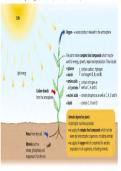
, Bioenergetics is the study of energy relationships and energy transformations
(conversions) in living organisms.
Organisms obtain energy by metabolizing the food they eat or prepare. Food
contains potential energy in its C-H bonds. When these bonds are broken down,
a large amount of kinetic energy is usually released.
Some of this energy is stored in the form of potential energy in the bonds of
ATP molecules while the rest escapes as heat. The potential energy stored in
ATP is again transformed into kinetic energy to carry out life activities
Nilma AKHSS Gahkuch
,• 10.1 Role of ATP
• 10.1.1 define bioenergetics;
• 10.1.2 describe the structure of ATP and its mechanism of storing energy in high-
energy phosphate bonds;
• 10.2 Photosynthesis
• 10.2.1 define photosynthesis with word and chemical equation; FA
• 10.2.2 describe the significance of photosynthesis; FA
• 10.2.3 illustrate the internal structure of thylakoid membrane to show the
arrangement of photosynthetic pigments in the form of photosystems, electron
transport chain and ATP-synthase complex; A
• 10.2.4 explain the role of chlorophyll and other photosynthetic pigments, light,
carbon dioxide and water in photosynthesis; FA
• 10.2.5 illustrate the absorption spectrum and action spectrum of photosynthetic
pigments (e.g., chlorophyll a, b and carotenoids); A
, Bioenergetics is the study of energy relationships and energy transformations
(conversions) in living organisms.
Organisms obtain energy by metabolizing the food they eat or prepare. Food
contains potential energy in its C-H bonds. When these bonds are broken down,
a large amount of kinetic energy is usually released.
Some of this energy is stored in the form of potential energy in the bonds of
ATP molecules while the rest escapes as heat. The potential energy stored in
ATP is again transformed into kinetic energy to carry out life activities
Nilma AKHSS Gahkuch


