

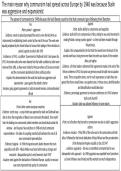
The main reason why communsim had spread across Europe by 1948 was because Stailn
was aggressive and expansionist
The spread of communism by 1948 discusses the Nazi liberate countries that had communist govs following their liberation
For: Against:
. Point: poland – aggressive . Point: stalins ability to compromise and negotiate
. Evidnece: events in poland prompted the west to view the Red Army as . Evidnece: stalin did try to compromise at Yalta, stating he was only interested in
instrumental in establishing Soviet control at the end of the war. The west were making Poland a strong country against – as they had been invaded through
equally perplexed by the Soviet failure to honour their pledge of free elections in Poland twice.
poland, agreed at yalta in feb 1945 . Explain: this compounded by the fact that the soviets bore the brunt of the
. Evidnence: in 1945, a coalition ‘Government of National Unity’ took power. By second world war, losing more men than the entire war losses of the western
1947, the london exiles who were allowed into the lublin coalition by stalin were allies put togther
removed from offie, as they were invited to Moscow where all 16 were arrested . Evidnece: all three leaders coferemed their agreements made at the end of the
and the communists abolished all other political parties Tehran conference 1943, that post war germany would be split into occupation
. Explain: this demonstrated to the west that stalin was aggressive and zones. Three occupation zones, one for each superpower, at yalta they also
expansionist – goes against the atlantic charter agreed that france would have a occupation zone. In these zones, demilitarisation
. Analyse: going against agreements at yalta increaed tensions, and emphasisied and denazification would take place
ditrust . Evidence: percentage agreement at moscow conference oct 1944, between
stalin and churchill
For: . Explain: stalin was allowed influence in some places
. Point: other easten european countries
. Evidence: czech-coup – a coup d’etet was approved by stalin and Gottwald was
able to force the resignation of Benes (non-communist President). One month Against
later the leading non-communist cabinet member was found dead outside his . Point: not all nations that turned to communism was due to stalin’s aggressive
window – Jan Masaryk. New elections in 1948 only had commuinst actions
representatives – the idea of accepting marshall aid had been the end of all . Evidence: romaina – 1946, 80% of the vote was to the communists and their
none communist representation allies. Folllowed by the forced abdication of King Michael and the proclamation
. Evidnece: bulgaria – in 1946 the Agrarian party leader became the main of the Romanian Peoples republic on Dec 30 1947
opposition with 28% - Nikola Petkov was faced with made up charges and . evidence: yugoslavia – tito was a committed commuinst but he was
executed – allopposition party’s were banned in April 1947 independet in his approach – by 1948 yugoslavia was expelled from Cominform
. Analyse: went against the declaration of liberated Europe. Loyalty to moscow as Soviet influence was limited and tito exerted too much independence
was more important than purity of commuinsm
,It was the USA’s commitment to a post-war democratic Europe that caused both the Yalta
and Postdam conferences to end in failure
The failure of Yalta and Postdam is the failure to make any successful political, economic and military agreements at these confreneces
For:
Point: Agreements made at Yalta to ensure a democratic post war Europe Against:
Evidence: Declaration on Liberated Europe – stating it is ‘the right of all peoples Ponit: Stalins expansionism policies
to choose the form of gov under which they live Evidence: Poland – at Yalta Stalin promised to hold free elections in Poland, despite
Explain: This was very open to misinterpretation – states ‘the three govs will this the USSR had installed the Provisional Gov of the Republic of Poland in Lublin,
jointly assist the people in any liberated state or former Axis satellite state in dominated by Communists and controlled by the USSr in Polish territory, supported
Europe where in their judgment conditions require by the red army
Evidence: Germany – agreed to split Germany into four zones of occupation, had Explain: goes against the Declaration on Liberated Europe – at Yalta
been three at Teharn, the fourth being France, with the set up of a ‘Committee Evidence: Yalta – original govs would be restored to all liberated countries except
of Dismemberment of Germany’ which would decide wht would happen in the Romania and Bulgaria (and France and Poland for different reasons), because the
long run USSR had already liquidated their govs
Explain: commitment to a democratic Germany governend by four different Explain: foreshadows Soviet Expansionism
states with opposing ideologies was always going to end in conflict Analyse: Roosevelt had not understood Stalins genuine desire for security due to
Analyse: DLE became key text for all future accusations of Soviet betrayal repeated invasions on his western border
For:
Against:
Point: Agreements made at Potsdam to ensure a democratic post war Europe
Point: ideologies and changing leaders
Evidence: After signing the Potsdam Agreement in August 1945, the Berlin
Evidence: Potsdam saw Truman replace Roosevelt and Atlee replace Churchill
Declaration was signed on 5 june 1945, it was agreed that n Allied Control
(halfway through). Truman was much more anti-communist and was becoming
Council would administer Germany but each had control over their own area.
increasingly conserned over Stalins intentions in Eastern Europe, unlike Roosevelt
The council had the aims of the 5D’s, one of which being democratisation
who thought him and Stalin had a special bond
Explain: with the Soviets having control of their own area, democratisation
Explain: less likely to agree with Stalin, less successful outcomes
would be hard to enforce – East Germany run under Red Army until 1949 when
Evidence: Germanys surrender in May 1945 meant the loss of the common enemy
GDR was formed
and resurfacing of their ideological differences. US had been hostile to communism
Evidence: Austria was also divided into four zones, aswell as its capital
as shown by the first Red Scare 1919-20 after the Bolshevik Revolution of 1917
Explain: as it is right in the middle of Europe, can be seen to have influence
Explain: the big three had only pushed their dfferences aside for the common
Analyse: Rather than it being US intention to have a democtractic Europe, these
cause, now their was no reason to work together
agreements can be seen to hint towards a Western controlled Europe, as the
Analyse: even if leaders had not changed, disagreements would have pervaled
East (Soviet) are out numbered in every agreement
,To what extent were the Yalta and Postdam Conferences responisble for the growth of Cold War tensions in the years 1945 to 1946
The growth of cold war tensions from 1945-46 refers to the differeing policies between the East and West by 1946 as oppossed to allined policies in 1945
For Against
Point: Yalta Point: shift in power – atomic bomb
Evidence: United Nations – Stalin only agreed to join on the promise he would be Evidence: 16 July 1945, the US successfully tested the worlds first ever atomic
th
granted the power to veto, as did all members on the security council. Stalin also bomb
requested that other Societ Republics (16 at the time) be granted UN mebership, Explain: the day before the Potsdam conference. Whilst Truman only hinted at it,
but onlly Ukraine and Byelorussia were granted this Stslin already knew because of spies. This caused a shift in the balance of power,
Explain: USSR was severly outnumbered by Western states – tension. Veto as the USSR did not have a weapon that could even compare. Start of Arms Race
allowed USSR to block UN policies – led to Soviet suspicion and accelerated Soviet nuclear programme
Evidence: Declaration on Liberated Europe – stating it is ‘the right of all peoples to Evidence: 6th August, atomic bomb dropped on Hiroshima, and then on Nagasaki
choose the form of gov under which they live on 9th August.
Explain: This was very open to misinterpretation – states ‘the three govs will Explain: USSR had invaded at midnight on 9th August, had declared war on the
jointly assist the people in any liberated state or former Axis satellite state in 8th, but as Japan formally surrendered on 2nd sep, Stalin had no time to make
Europe where in their judgment conditions require advances in Japan.
Analyse: DLE became key text for all future accusations of Soviet betrayal Analyse: As Stalin already knew about the abomb at Potsdam, its use in Japan
could not have been a surprise
For Against
Point: Potsdam Point: war of words
Evidence: After signing the Potsdam Agreement in August 1945, the Berlin Evidence: Kennan’s long Telegram – an 8,000 word telegram from George Kennan, a
Declaration was signed on 5 june 1945 which divided Germany into four Zones, US embasador in Moscow, received on 22nd Feb 1946. it stated that due to
with Berlin following the same principle, but being in the Eastern Zone of ideological differences the USSR could not work alongside the US and saw
influence capitalsim as evil, and that soviet aggression was enshrined in their history. Kennan
Explain: this meant not only was their western policies right next to communist also percived the USSR would continue to expand
ones, but their was actually western influence right in the center of the Soviet Explain: This formed the basis of the US policyb towards the Soviets of containment
zone Evidence: Churchills ‘iorn curtain’ speech (5th march 1946) – originally called ‘the
Evidence: Potsdam declaration – ‘The Proclamation Defining Terms of Japanses Sinews of Peace’. Argued against US isolationasim and a united west against
Surrender’, the USSr did not sign because they were not yet at war with Japan Communism
Explain: USSR agreed to join three months after the war in Europe was over, by Explain: led to tensions – Stalin called him a ‘warmonger’ – first acknowledgment of
this time US had made arms advancments and no longer needed the USSR cold war
Analyse: would not have caused tensions if the US had not tried to assert power Analyse: although first acknowledgement, tensions had already been set in place
, It was the actions of the USSR that had laid the foundtions of the cold war by 1947
The foundations of the cold war are the tensions and conflicting policies between the West and the Soviet Union
For:
For Point: US economic involvement in Europe
Point: not honouring agreements made at the Yalta and Potsdam conferences Evidence: Truman Doctrine (12th March 1947) – stated, it must be the policy of the
Evidence: at Yalta Stalin promised to hold free elections in Poland, despite this United States to support peoples who resist being enslaved by armed minorities
the USSR had installed the Provisional Gov of the Republic of Poland in Lublin, or by outside pressure
dominated by Communists and controlled by the USSr in Polish territory, Explain: goes directly against the Declaration on Liberated Europe, as not allowing
supported by the red army free elections, as getting involved. Part of containment policy against
Explain: goes against the Declaration on Liberated Europe – at Yalta communism, when Dean Acheson came up with the term ‘domino theory’, as if
Evidence: Germany – The Allied Control Council aimed to implement the 5D’s on Greece and Turkey fell countries South wards to them would
their zones of occupation, one of which was democratisation. Nevertheless, East Evidence: Congress allocated $400 million for the Truman Doctrine, $350 mil
Germany run under Red Army until 1949 when GDR was formed specifically for Greece, to prevent these to govs from falling to communism
Explain: not following agreements made at Potsdam – especially significant as Explain: increased tensions as it was direct aid to prevent states falling to
was in an area the west was highly incolved in communism, despite the Greek gov being corrupt and undemocratic
Analyse: DLE became key text for all future accusations of Soviet betrayal Analyse: Although Greek communists had been getting some help from
Yugoslavia, Stalin had given no help
For
Against:
Point: Hostile policies
Point: war of words
Evidence: Zhdanov Doctrine (1946) – proposed the world is divided into two
Evidence: Kennan’s long Telegram – an 8,000 word telegram from George Kennan,
camps; the imperialists, headed by the US, and the democratic, headed by the
a US embasador in Moscow, received on 22nd Feb 1946. it stated that due to
USSR ideological differences the USSR could not work alongside the US and saw
Explain: showing a clear divide and opposing ideologies. One being presented as
capitalsim as evil, and that soviet aggression was enshrined in their history.
good and the other bad
Kennan also percived the USSR would continue to expand
Evidence: Cominform (sep 1947) – created as an organisation of communist
Explain: This formed the basis of the US policyb towards the Soviets of
parties as a response to the Paris Conference (July 1947). It worked to ensure that containment
communist govs in the Soviet bloc operated according to Stalinist principles,
Evidence: Churchills ‘iorn curtain’ speech (5th march 1946) – originally called ‘the
rather than those of alternative forms of communism. Every satellite state had to Sinews of Peace’. Argued against US isolationasim and a united west against
be part Communism
Explain: West becomes more worried about expansionist policies
Explain: led to tensions – Stalin called him a ‘warmonger’ – first acknowledgment
Analyse: neither of these policies came unprevoked, West was doing the same
of cold war
was aggressive and expansionist
The spread of communism by 1948 discusses the Nazi liberate countries that had communist govs following their liberation
For: Against:
. Point: poland – aggressive . Point: stalins ability to compromise and negotiate
. Evidnece: events in poland prompted the west to view the Red Army as . Evidnece: stalin did try to compromise at Yalta, stating he was only interested in
instrumental in establishing Soviet control at the end of the war. The west were making Poland a strong country against – as they had been invaded through
equally perplexed by the Soviet failure to honour their pledge of free elections in Poland twice.
poland, agreed at yalta in feb 1945 . Explain: this compounded by the fact that the soviets bore the brunt of the
. Evidnence: in 1945, a coalition ‘Government of National Unity’ took power. By second world war, losing more men than the entire war losses of the western
1947, the london exiles who were allowed into the lublin coalition by stalin were allies put togther
removed from offie, as they were invited to Moscow where all 16 were arrested . Evidnece: all three leaders coferemed their agreements made at the end of the
and the communists abolished all other political parties Tehran conference 1943, that post war germany would be split into occupation
. Explain: this demonstrated to the west that stalin was aggressive and zones. Three occupation zones, one for each superpower, at yalta they also
expansionist – goes against the atlantic charter agreed that france would have a occupation zone. In these zones, demilitarisation
. Analyse: going against agreements at yalta increaed tensions, and emphasisied and denazification would take place
ditrust . Evidence: percentage agreement at moscow conference oct 1944, between
stalin and churchill
For: . Explain: stalin was allowed influence in some places
. Point: other easten european countries
. Evidence: czech-coup – a coup d’etet was approved by stalin and Gottwald was
able to force the resignation of Benes (non-communist President). One month Against
later the leading non-communist cabinet member was found dead outside his . Point: not all nations that turned to communism was due to stalin’s aggressive
window – Jan Masaryk. New elections in 1948 only had commuinst actions
representatives – the idea of accepting marshall aid had been the end of all . Evidence: romaina – 1946, 80% of the vote was to the communists and their
none communist representation allies. Folllowed by the forced abdication of King Michael and the proclamation
. Evidnece: bulgaria – in 1946 the Agrarian party leader became the main of the Romanian Peoples republic on Dec 30 1947
opposition with 28% - Nikola Petkov was faced with made up charges and . evidence: yugoslavia – tito was a committed commuinst but he was
executed – allopposition party’s were banned in April 1947 independet in his approach – by 1948 yugoslavia was expelled from Cominform
. Analyse: went against the declaration of liberated Europe. Loyalty to moscow as Soviet influence was limited and tito exerted too much independence
was more important than purity of commuinsm
,It was the USA’s commitment to a post-war democratic Europe that caused both the Yalta
and Postdam conferences to end in failure
The failure of Yalta and Postdam is the failure to make any successful political, economic and military agreements at these confreneces
For:
Point: Agreements made at Yalta to ensure a democratic post war Europe Against:
Evidence: Declaration on Liberated Europe – stating it is ‘the right of all peoples Ponit: Stalins expansionism policies
to choose the form of gov under which they live Evidence: Poland – at Yalta Stalin promised to hold free elections in Poland, despite
Explain: This was very open to misinterpretation – states ‘the three govs will this the USSR had installed the Provisional Gov of the Republic of Poland in Lublin,
jointly assist the people in any liberated state or former Axis satellite state in dominated by Communists and controlled by the USSr in Polish territory, supported
Europe where in their judgment conditions require by the red army
Evidence: Germany – agreed to split Germany into four zones of occupation, had Explain: goes against the Declaration on Liberated Europe – at Yalta
been three at Teharn, the fourth being France, with the set up of a ‘Committee Evidence: Yalta – original govs would be restored to all liberated countries except
of Dismemberment of Germany’ which would decide wht would happen in the Romania and Bulgaria (and France and Poland for different reasons), because the
long run USSR had already liquidated their govs
Explain: commitment to a democratic Germany governend by four different Explain: foreshadows Soviet Expansionism
states with opposing ideologies was always going to end in conflict Analyse: Roosevelt had not understood Stalins genuine desire for security due to
Analyse: DLE became key text for all future accusations of Soviet betrayal repeated invasions on his western border
For:
Against:
Point: Agreements made at Potsdam to ensure a democratic post war Europe
Point: ideologies and changing leaders
Evidence: After signing the Potsdam Agreement in August 1945, the Berlin
Evidence: Potsdam saw Truman replace Roosevelt and Atlee replace Churchill
Declaration was signed on 5 june 1945, it was agreed that n Allied Control
(halfway through). Truman was much more anti-communist and was becoming
Council would administer Germany but each had control over their own area.
increasingly conserned over Stalins intentions in Eastern Europe, unlike Roosevelt
The council had the aims of the 5D’s, one of which being democratisation
who thought him and Stalin had a special bond
Explain: with the Soviets having control of their own area, democratisation
Explain: less likely to agree with Stalin, less successful outcomes
would be hard to enforce – East Germany run under Red Army until 1949 when
Evidence: Germanys surrender in May 1945 meant the loss of the common enemy
GDR was formed
and resurfacing of their ideological differences. US had been hostile to communism
Evidence: Austria was also divided into four zones, aswell as its capital
as shown by the first Red Scare 1919-20 after the Bolshevik Revolution of 1917
Explain: as it is right in the middle of Europe, can be seen to have influence
Explain: the big three had only pushed their dfferences aside for the common
Analyse: Rather than it being US intention to have a democtractic Europe, these
cause, now their was no reason to work together
agreements can be seen to hint towards a Western controlled Europe, as the
Analyse: even if leaders had not changed, disagreements would have pervaled
East (Soviet) are out numbered in every agreement
,To what extent were the Yalta and Postdam Conferences responisble for the growth of Cold War tensions in the years 1945 to 1946
The growth of cold war tensions from 1945-46 refers to the differeing policies between the East and West by 1946 as oppossed to allined policies in 1945
For Against
Point: Yalta Point: shift in power – atomic bomb
Evidence: United Nations – Stalin only agreed to join on the promise he would be Evidence: 16 July 1945, the US successfully tested the worlds first ever atomic
th
granted the power to veto, as did all members on the security council. Stalin also bomb
requested that other Societ Republics (16 at the time) be granted UN mebership, Explain: the day before the Potsdam conference. Whilst Truman only hinted at it,
but onlly Ukraine and Byelorussia were granted this Stslin already knew because of spies. This caused a shift in the balance of power,
Explain: USSR was severly outnumbered by Western states – tension. Veto as the USSR did not have a weapon that could even compare. Start of Arms Race
allowed USSR to block UN policies – led to Soviet suspicion and accelerated Soviet nuclear programme
Evidence: Declaration on Liberated Europe – stating it is ‘the right of all peoples to Evidence: 6th August, atomic bomb dropped on Hiroshima, and then on Nagasaki
choose the form of gov under which they live on 9th August.
Explain: This was very open to misinterpretation – states ‘the three govs will Explain: USSR had invaded at midnight on 9th August, had declared war on the
jointly assist the people in any liberated state or former Axis satellite state in 8th, but as Japan formally surrendered on 2nd sep, Stalin had no time to make
Europe where in their judgment conditions require advances in Japan.
Analyse: DLE became key text for all future accusations of Soviet betrayal Analyse: As Stalin already knew about the abomb at Potsdam, its use in Japan
could not have been a surprise
For Against
Point: Potsdam Point: war of words
Evidence: After signing the Potsdam Agreement in August 1945, the Berlin Evidence: Kennan’s long Telegram – an 8,000 word telegram from George Kennan, a
Declaration was signed on 5 june 1945 which divided Germany into four Zones, US embasador in Moscow, received on 22nd Feb 1946. it stated that due to
with Berlin following the same principle, but being in the Eastern Zone of ideological differences the USSR could not work alongside the US and saw
influence capitalsim as evil, and that soviet aggression was enshrined in their history. Kennan
Explain: this meant not only was their western policies right next to communist also percived the USSR would continue to expand
ones, but their was actually western influence right in the center of the Soviet Explain: This formed the basis of the US policyb towards the Soviets of containment
zone Evidence: Churchills ‘iorn curtain’ speech (5th march 1946) – originally called ‘the
Evidence: Potsdam declaration – ‘The Proclamation Defining Terms of Japanses Sinews of Peace’. Argued against US isolationasim and a united west against
Surrender’, the USSr did not sign because they were not yet at war with Japan Communism
Explain: USSR agreed to join three months after the war in Europe was over, by Explain: led to tensions – Stalin called him a ‘warmonger’ – first acknowledgment of
this time US had made arms advancments and no longer needed the USSR cold war
Analyse: would not have caused tensions if the US had not tried to assert power Analyse: although first acknowledgement, tensions had already been set in place
, It was the actions of the USSR that had laid the foundtions of the cold war by 1947
The foundations of the cold war are the tensions and conflicting policies between the West and the Soviet Union
For:
For Point: US economic involvement in Europe
Point: not honouring agreements made at the Yalta and Potsdam conferences Evidence: Truman Doctrine (12th March 1947) – stated, it must be the policy of the
Evidence: at Yalta Stalin promised to hold free elections in Poland, despite this United States to support peoples who resist being enslaved by armed minorities
the USSR had installed the Provisional Gov of the Republic of Poland in Lublin, or by outside pressure
dominated by Communists and controlled by the USSr in Polish territory, Explain: goes directly against the Declaration on Liberated Europe, as not allowing
supported by the red army free elections, as getting involved. Part of containment policy against
Explain: goes against the Declaration on Liberated Europe – at Yalta communism, when Dean Acheson came up with the term ‘domino theory’, as if
Evidence: Germany – The Allied Control Council aimed to implement the 5D’s on Greece and Turkey fell countries South wards to them would
their zones of occupation, one of which was democratisation. Nevertheless, East Evidence: Congress allocated $400 million for the Truman Doctrine, $350 mil
Germany run under Red Army until 1949 when GDR was formed specifically for Greece, to prevent these to govs from falling to communism
Explain: not following agreements made at Potsdam – especially significant as Explain: increased tensions as it was direct aid to prevent states falling to
was in an area the west was highly incolved in communism, despite the Greek gov being corrupt and undemocratic
Analyse: DLE became key text for all future accusations of Soviet betrayal Analyse: Although Greek communists had been getting some help from
Yugoslavia, Stalin had given no help
For
Against:
Point: Hostile policies
Point: war of words
Evidence: Zhdanov Doctrine (1946) – proposed the world is divided into two
Evidence: Kennan’s long Telegram – an 8,000 word telegram from George Kennan,
camps; the imperialists, headed by the US, and the democratic, headed by the
a US embasador in Moscow, received on 22nd Feb 1946. it stated that due to
USSR ideological differences the USSR could not work alongside the US and saw
Explain: showing a clear divide and opposing ideologies. One being presented as
capitalsim as evil, and that soviet aggression was enshrined in their history.
good and the other bad
Kennan also percived the USSR would continue to expand
Evidence: Cominform (sep 1947) – created as an organisation of communist
Explain: This formed the basis of the US policyb towards the Soviets of
parties as a response to the Paris Conference (July 1947). It worked to ensure that containment
communist govs in the Soviet bloc operated according to Stalinist principles,
Evidence: Churchills ‘iorn curtain’ speech (5th march 1946) – originally called ‘the
rather than those of alternative forms of communism. Every satellite state had to Sinews of Peace’. Argued against US isolationasim and a united west against
be part Communism
Explain: West becomes more worried about expansionist policies
Explain: led to tensions – Stalin called him a ‘warmonger’ – first acknowledgment
Analyse: neither of these policies came unprevoked, West was doing the same
of cold war


