

Memory
• The multi-store model of memory: sensory register, short-term memory and long-term memory.
Features of each store: coding, capacity and duration.
• Types of long-term memory: episodic, semantic, procedural.
• The working memory model: central executive, phonological loop, visuo-spatial sketchpad and
episodic buffer. Features of the model: coding and capacity.
• Explanations for forgetting: proactive and retroactive interference and retrieval failure due to
absence of cues.
• Factors affecting the accuracy of eyewitness testimony: misleading information, including leading
questions and post-event discussion; anxiety.
• Improving the accuracy of eyewitness testimony, including the use of the cognitive interview.
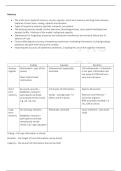
Coding Capacity Duration
Sensory Multicoded – uses all the Unknown but supposedly 250 milliseconds – if attention
register senses unlimited is not paid, information will
not move to STM and has a
Raw/ unprocessed very short duration
information
Short By sound, acoustic – 5-9 chunks of information – Approx 18 seconds
term Baddeley’s research –
memory participants confused Jacobs - average span 7.4 Peterson and Peterson –
acoustically similar words letters and 9.3 words nonsense trigrams
e.g. cat, sat, bat 80% accurately recalled in 3
sec, 10% in 18 sec.
Long By meaning, semantic Potentially unlimited Up to a lifetime – year book
term study
memory Baddeley's research –
participants confused
semantically similar
words, e.g. huge, big, giant
Coding – the way information is stored
Duration – the length of time information can be stored
Capacity – the amount of information that can be held
,The multi-store model of memory: sensory register, short-term memory and long-term memory.
Features of each store: coding, capacity and duration
• First model of memory – separate stores: sensory register, short-term memory (STM), long-term
memory (LTM)
• Information processing model – linear made up of unitary stores.
Information moves from one store to another in a linear and passive way.
• Information from the senses first enters the sensory register, which has a large capacity but a very
short duration and is multi-coded. If attention is paid, information then enters the short-term
memory.
• STM is coded acoustically (by sound), with a duration of approx. 18 seconds and a capacity of 5-9
chunks of information. If information is elaborately rehearsed, it enters long term memory.
• Rehearsal loop – maintenance in STM
• LTM it is coded semantically (by meaning) and can last a lifetime and has a potentially unlimited
capacity.
• Information can be forgotten from each stage.
Evidence that supports the functional separation of AO3 - evidence that supports the coding, capacity,
the stores duration of the three stores, e.g. Baddeley, Jacobs,
Bahrick et al. Further discussion of that evidence.
Evidence from brain scans has shown that different
areas of the brain are active when performing STM Jacobs – support capacity of STM
tasks (hippocampus and subiculum) and LTM tasks Average span was 7.3 letters and 9.3 words.
(motor cortex). The hippocampus is also involved in
transferring short-term memories into long-term Peterson & Peterson – duration of STM approx. 18
memories. This suggests that different brain secs
regions are responsible for the different
components of the MSM, supporting the idea that Bahrick – supports the idea of a lifetime duration in
our memory is made up of discrete stores. LTM
Clive Wearing – severe amnesia; unable to transfer However – discuss if this is an accurate way of
information from STM to LTM (could only measuring memory? Lab?
remember information for 20-30 seconds), but was Artificial task (Peterson & Peterson)
able to retrieve information successfully (e.g. play Population validity
the piano)
– emotions/consequences
, à supports the idea that memories are formed by
passing information from one store to the next in a
linear fashion
AO3 – The role of rehearsal AO3 – influential – first model to incorporate
different stores.
RWA – helpful – learn – revise/rehearse.
Further models have since been developed with
One issue with the MSM is that it places too much multiple components – Working memory model.
emphasis on the role of rehearsal. This may not be
as important as once imagined because some of This model hights the dynamic nature of memory.
the time information moves to the LTM without Therefore, the MSM has increased our
rehearsal. Furthermore, information can be understanding of memory significantly as well as
rehearsed a lot and never move to LTM. Therefore, elevating the status of cognitive psychology.
this model is incomplete and missing ways in which
information moved between the different stores.
• The multi-store model of memory: sensory register, short-term memory and long-term memory.
Features of each store: coding, capacity and duration.
• Types of long-term memory: episodic, semantic, procedural.
• The working memory model: central executive, phonological loop, visuo-spatial sketchpad and
episodic buffer. Features of the model: coding and capacity.
• Explanations for forgetting: proactive and retroactive interference and retrieval failure due to
absence of cues.
• Factors affecting the accuracy of eyewitness testimony: misleading information, including leading
questions and post-event discussion; anxiety.
• Improving the accuracy of eyewitness testimony, including the use of the cognitive interview.
Coding Capacity Duration
Sensory Multicoded – uses all the Unknown but supposedly 250 milliseconds – if attention
register senses unlimited is not paid, information will
not move to STM and has a
Raw/ unprocessed very short duration
information
Short By sound, acoustic – 5-9 chunks of information – Approx 18 seconds
term Baddeley’s research –
memory participants confused Jacobs - average span 7.4 Peterson and Peterson –
acoustically similar words letters and 9.3 words nonsense trigrams
e.g. cat, sat, bat 80% accurately recalled in 3
sec, 10% in 18 sec.
Long By meaning, semantic Potentially unlimited Up to a lifetime – year book
term study
memory Baddeley's research –
participants confused
semantically similar
words, e.g. huge, big, giant
Coding – the way information is stored
Duration – the length of time information can be stored
Capacity – the amount of information that can be held
,The multi-store model of memory: sensory register, short-term memory and long-term memory.
Features of each store: coding, capacity and duration
• First model of memory – separate stores: sensory register, short-term memory (STM), long-term
memory (LTM)
• Information processing model – linear made up of unitary stores.
Information moves from one store to another in a linear and passive way.
• Information from the senses first enters the sensory register, which has a large capacity but a very
short duration and is multi-coded. If attention is paid, information then enters the short-term
memory.
• STM is coded acoustically (by sound), with a duration of approx. 18 seconds and a capacity of 5-9
chunks of information. If information is elaborately rehearsed, it enters long term memory.
• Rehearsal loop – maintenance in STM
• LTM it is coded semantically (by meaning) and can last a lifetime and has a potentially unlimited
capacity.
• Information can be forgotten from each stage.
Evidence that supports the functional separation of AO3 - evidence that supports the coding, capacity,
the stores duration of the three stores, e.g. Baddeley, Jacobs,
Bahrick et al. Further discussion of that evidence.
Evidence from brain scans has shown that different
areas of the brain are active when performing STM Jacobs – support capacity of STM
tasks (hippocampus and subiculum) and LTM tasks Average span was 7.3 letters and 9.3 words.
(motor cortex). The hippocampus is also involved in
transferring short-term memories into long-term Peterson & Peterson – duration of STM approx. 18
memories. This suggests that different brain secs
regions are responsible for the different
components of the MSM, supporting the idea that Bahrick – supports the idea of a lifetime duration in
our memory is made up of discrete stores. LTM
Clive Wearing – severe amnesia; unable to transfer However – discuss if this is an accurate way of
information from STM to LTM (could only measuring memory? Lab?
remember information for 20-30 seconds), but was Artificial task (Peterson & Peterson)
able to retrieve information successfully (e.g. play Population validity
the piano)
– emotions/consequences
, à supports the idea that memories are formed by
passing information from one store to the next in a
linear fashion
AO3 – The role of rehearsal AO3 – influential – first model to incorporate
different stores.
RWA – helpful – learn – revise/rehearse.
Further models have since been developed with
One issue with the MSM is that it places too much multiple components – Working memory model.
emphasis on the role of rehearsal. This may not be
as important as once imagined because some of This model hights the dynamic nature of memory.
the time information moves to the LTM without Therefore, the MSM has increased our
rehearsal. Furthermore, information can be understanding of memory significantly as well as
rehearsed a lot and never move to LTM. Therefore, elevating the status of cognitive psychology.
this model is incomplete and missing ways in which
information moved between the different stores.


