
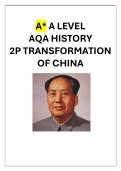
A* A LEVEL
AQA HISTORY
2P TRANSFORMATION
OF CHINA
,Contents/timeline:
1. Pre 1911
2. GMD, CKS strengths and weaknesses
3. Sino Japanese War 1936-45
4. Civil War 1946-49
5. CCP position + Maoism 1949
6. International Relations 1949-52
7. Political developments 1952-62
8. CCP Agricultural Policy 1949-58
9. CCP Industrial Policy 1953-57
10. Social Reform 1949-58
11. International Relations 1952-62
12. Great Leap Forward 1958-62
13. Pragmatists vs Radicals
14. Socialist Education Campaign 1964-
15. Economic Developments 1962-66
16. Social Reform 1962-66
17. International Relations 1962-66
18. Cultural Revolution 1966-76
19. Economic Development (Deng) 1976-1997
20. Political Developments (Deng) + Tiananmen Square (89) 1979-1997
21. International relations 1976-1997
,How was China governed before 1911?:
- Chinese rulers felt superior to other countries by 18 thC
they had published more books than the world, 300
million subjects, greatest producer of goods
- No need for western culture = became isolated, fell
behind eventually
- 1790s no interest in trading with Britain – damaging for
China, pre to opium wars
- Believed in the Mandate of Heaven
- Emperor treated as divine ‘god like’, hard as one
individual to rule landmass
Confucianism: Elitist ideas (rule under dictatorship)
Ideas from Confucius, 2000 years old – Chinese philosopher
taught that harmony and peace is produced through:
- Correct behaviour
- Respect for authority
- Courtesy to all
- Avoiding wars & conflict
- Hierarchal, customs and tradition above change
- Everyone ‘knew their place’ – women…
Empress Dowager Cixi: 1861-1908
Commitment to tradition + inward looking approach resulting in China falling behind under Qing
- Autocrat – resistant to reforms
- Officials in Beijing were corrupt and unable to control warlords who ruled and defied government
- Her refusal to modernise
Life for Chinese people:
Traditions
- Practices seemed out-dated + cruel
- Aimed towards women – foot binding for gratification of men
Peasants + Landlords:
- 95% of 430 million Chinese people in 1900 were peasants
- Landlords owned all land
- Outdated methods
- Landlords exploited peasants – took large parts of crops as rents and taxes
- Landlords seemed beyond the law forced extra work and severely beat peasants questioning
Lack of Industrial development
- Shanghai = most modern city at the end of the Yangtze River ideal for trading and industry
- West controlled most of that industry investing in Shanghai in return for exemption from Chinese laws
- Contacts with west = new ideas and trade – foreign imperialism was resented
Why was the Qing Dynasty in trouble by 1911?
Long term causes:
Foreign interference:
- Opium imports drained the economy – caused addiction + ineffective workforce – money leaving China
- Opium wars highlighted China’s failure to resist British military (shortcomings of military tech), showed
lack of Emperor’s power
- ‘Unequal Treaties’ gave rights to foreigners, Hong Kong + 5 ports handed to British – China’s wealthiest
and most developed cities (trading ports), China felt exploited + humiliated by the loss of power and
wealth
- Further resentment from foreign interference: converted many to Christianity, stripping away Chinese
culture, religion + independence
- Qing blamed – seen as weak due to inability to resist
China’s internal problems:
, - Problems of China’s economy: opium addiction – drain of Chinese money, dependent on west +
remained agricultural economy
- Social problems: opium addiction – increase in crime, prostitution + gang violence
- Rebellions in Taiping + Nian: rebellions against a dynasty seen as a sign that ruling family had lost
Mandate of Heaven
- ‘Hundred Day’s Reform’ – established schools + new universities, removal of corruption BUT these
reforms were resisted by Cixi
- Cixi’s actions undermining Qing: refusal to reform created resentment, highlighted internal division in
the ruling family – calls for abdication
Short term causes:
The Growth of Nationalism:
- Revolutionaries emerging: Sun Yatsen + Sworn Chinese Brother hood later GMD
- Sun Yatsen considered radical and dangerous, wanted to embrace western technology, gov + society
AIMS:
- Nationalism - to rid China of foreign exploitation
- Democracy - to create a more modern system of government acceptable to the Chinese people
- Social advance - to bring about reforms in industry and everyday life to improve the situation of the
peasants and workers
- Boxer Rebellion: (spring 1900) targeted foreign missionaries, businesses + Chinese employees or those
owning western possessions. – objected to imperialists
- Cixi removal of Boxer threat: contacted Boxers + offered her support to deflect attacks away from Qing
dynasty
- Western reaction to Boxer Rebellion; western forces advanced on Beijing in 1900 – Cixi abandoned the
Boxers. West demanded $450million in compensation for destroyed railways lines, murdered
foreigners etc… Boxers were publicly beheaded, taxes raised increasing resentment toward dynasty –
Qing weak
Trigger:
Boy Emperor:
- Cixi reforms: New Model army, Western style unis, promise of democratically elected parliament
- Reforms caused harm to Qing: taxes increased to pay for reforms (outrage), showed Qing had been
wrong when previously resisting reform, the reforms only benefitted the educated elite = increase
peasant frustration
- Prince Chun: fired able ministers + appointed friends instead = corruption
- Puyi symbolises failings of dynasty: child therefore embodied weakness + lack of wisdom
- Triggered frustrations to turn outright rebellious: harvest failure – intensified harships
Chiang Kai-Shek (Jiang Jieshi) and the GMD:
Strengths of CKS Weaknesses of CKS
Personal • Military man = leadership and • Links to triads undermined his
Qualities and respect of military in China reputation as a low enforcer and
Beliefs • Could match the warlords = gained moralistic leader
reputation for strong leadership - • Cold, harsh, aloof, appeared arrogant
appealing following the chaos of the as an individual (luckily his wife's
Qing charm made up for this)
• Good relations with some of the • Aggressively anti-communist, but
Triads - could control them - also critical of capitalism - shows
minority groups uncertainty
• Religious convictions (Methodist) = • Belief that China could learn from the
commitment/moral fibre? west would alienate poorer/exploited
• Commitment to Confucian values, classes and perhaps some of the
(Chinese traditions) and true older generation
patriots - would win support over • Confucian values might also alienate
the older generation + upper classes the poor/oppressed
• New life movement: enhancing • Links to wealthy classes through
society's stability/harmony - won marriage alienate the poor
over middle classes
AQA HISTORY
2P TRANSFORMATION
OF CHINA
,Contents/timeline:
1. Pre 1911
2. GMD, CKS strengths and weaknesses
3. Sino Japanese War 1936-45
4. Civil War 1946-49
5. CCP position + Maoism 1949
6. International Relations 1949-52
7. Political developments 1952-62
8. CCP Agricultural Policy 1949-58
9. CCP Industrial Policy 1953-57
10. Social Reform 1949-58
11. International Relations 1952-62
12. Great Leap Forward 1958-62
13. Pragmatists vs Radicals
14. Socialist Education Campaign 1964-
15. Economic Developments 1962-66
16. Social Reform 1962-66
17. International Relations 1962-66
18. Cultural Revolution 1966-76
19. Economic Development (Deng) 1976-1997
20. Political Developments (Deng) + Tiananmen Square (89) 1979-1997
21. International relations 1976-1997
,How was China governed before 1911?:
- Chinese rulers felt superior to other countries by 18 thC
they had published more books than the world, 300
million subjects, greatest producer of goods
- No need for western culture = became isolated, fell
behind eventually
- 1790s no interest in trading with Britain – damaging for
China, pre to opium wars
- Believed in the Mandate of Heaven
- Emperor treated as divine ‘god like’, hard as one
individual to rule landmass
Confucianism: Elitist ideas (rule under dictatorship)
Ideas from Confucius, 2000 years old – Chinese philosopher
taught that harmony and peace is produced through:
- Correct behaviour
- Respect for authority
- Courtesy to all
- Avoiding wars & conflict
- Hierarchal, customs and tradition above change
- Everyone ‘knew their place’ – women…
Empress Dowager Cixi: 1861-1908
Commitment to tradition + inward looking approach resulting in China falling behind under Qing
- Autocrat – resistant to reforms
- Officials in Beijing were corrupt and unable to control warlords who ruled and defied government
- Her refusal to modernise
Life for Chinese people:
Traditions
- Practices seemed out-dated + cruel
- Aimed towards women – foot binding for gratification of men
Peasants + Landlords:
- 95% of 430 million Chinese people in 1900 were peasants
- Landlords owned all land
- Outdated methods
- Landlords exploited peasants – took large parts of crops as rents and taxes
- Landlords seemed beyond the law forced extra work and severely beat peasants questioning
Lack of Industrial development
- Shanghai = most modern city at the end of the Yangtze River ideal for trading and industry
- West controlled most of that industry investing in Shanghai in return for exemption from Chinese laws
- Contacts with west = new ideas and trade – foreign imperialism was resented
Why was the Qing Dynasty in trouble by 1911?
Long term causes:
Foreign interference:
- Opium imports drained the economy – caused addiction + ineffective workforce – money leaving China
- Opium wars highlighted China’s failure to resist British military (shortcomings of military tech), showed
lack of Emperor’s power
- ‘Unequal Treaties’ gave rights to foreigners, Hong Kong + 5 ports handed to British – China’s wealthiest
and most developed cities (trading ports), China felt exploited + humiliated by the loss of power and
wealth
- Further resentment from foreign interference: converted many to Christianity, stripping away Chinese
culture, religion + independence
- Qing blamed – seen as weak due to inability to resist
China’s internal problems:
, - Problems of China’s economy: opium addiction – drain of Chinese money, dependent on west +
remained agricultural economy
- Social problems: opium addiction – increase in crime, prostitution + gang violence
- Rebellions in Taiping + Nian: rebellions against a dynasty seen as a sign that ruling family had lost
Mandate of Heaven
- ‘Hundred Day’s Reform’ – established schools + new universities, removal of corruption BUT these
reforms were resisted by Cixi
- Cixi’s actions undermining Qing: refusal to reform created resentment, highlighted internal division in
the ruling family – calls for abdication
Short term causes:
The Growth of Nationalism:
- Revolutionaries emerging: Sun Yatsen + Sworn Chinese Brother hood later GMD
- Sun Yatsen considered radical and dangerous, wanted to embrace western technology, gov + society
AIMS:
- Nationalism - to rid China of foreign exploitation
- Democracy - to create a more modern system of government acceptable to the Chinese people
- Social advance - to bring about reforms in industry and everyday life to improve the situation of the
peasants and workers
- Boxer Rebellion: (spring 1900) targeted foreign missionaries, businesses + Chinese employees or those
owning western possessions. – objected to imperialists
- Cixi removal of Boxer threat: contacted Boxers + offered her support to deflect attacks away from Qing
dynasty
- Western reaction to Boxer Rebellion; western forces advanced on Beijing in 1900 – Cixi abandoned the
Boxers. West demanded $450million in compensation for destroyed railways lines, murdered
foreigners etc… Boxers were publicly beheaded, taxes raised increasing resentment toward dynasty –
Qing weak
Trigger:
Boy Emperor:
- Cixi reforms: New Model army, Western style unis, promise of democratically elected parliament
- Reforms caused harm to Qing: taxes increased to pay for reforms (outrage), showed Qing had been
wrong when previously resisting reform, the reforms only benefitted the educated elite = increase
peasant frustration
- Prince Chun: fired able ministers + appointed friends instead = corruption
- Puyi symbolises failings of dynasty: child therefore embodied weakness + lack of wisdom
- Triggered frustrations to turn outright rebellious: harvest failure – intensified harships
Chiang Kai-Shek (Jiang Jieshi) and the GMD:
Strengths of CKS Weaknesses of CKS
Personal • Military man = leadership and • Links to triads undermined his
Qualities and respect of military in China reputation as a low enforcer and
Beliefs • Could match the warlords = gained moralistic leader
reputation for strong leadership - • Cold, harsh, aloof, appeared arrogant
appealing following the chaos of the as an individual (luckily his wife's
Qing charm made up for this)
• Good relations with some of the • Aggressively anti-communist, but
Triads - could control them - also critical of capitalism - shows
minority groups uncertainty
• Religious convictions (Methodist) = • Belief that China could learn from the
commitment/moral fibre? west would alienate poorer/exploited
• Commitment to Confucian values, classes and perhaps some of the
(Chinese traditions) and true older generation
patriots - would win support over • Confucian values might also alienate
the older generation + upper classes the poor/oppressed
• New life movement: enhancing • Links to wealthy classes through
society's stability/harmony - won marriage alienate the poor
over middle classes


