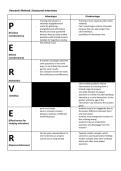
Research Method: Structured Interviews
Advantages Disadvantages
- Training interviewers is - Training is more expensive than other
P
(Practical
-
-
relatively straightforward
useful for gathering
straightforward information
Results are easily quantified
-
methods
Can’t reach huge numbers of people
because they can take longer than
other methods.
because they use close ended - possibility of interviewer bias
considerations)
questions with limited answers
- Suitable for hypothesis testing
- Few ethical issues
E
(Ethical
considerations)
- If another sociologist asked the
same questions in the same
way, it is very likely they would
R
get the same results.
- Can compare answers to easily
find similarities and differences.
(Reliability)
- Close-ended questions restrict
V
(Validity)
-
interviewees to choosing from a
limited range of answers.
very little freedom to explain
questions or clarify misunderstandings
- Interview is a social interaction, so the
gender, ethnicity, age of the
interviewer may influence the answers
given.
- quick and simple - students may lie or exaggerate due to
E
(Effectiveness for
- easy to compare answers
between students of different
stratified groups -
the power difference between them
and interviewer
students may change their answers in
fear of being wrong
- students may not understand
studying education)
questions and disengage from the
research
- Can be quite representative if a - Typically smaller samples, which
R
(Representativeness)
short interview as answers
cannot be too long winded -
cannot be used to generalise findings
Smaller samples than other methods
which also offer close ended
questions.
, - Positivists: see structured - Interpretivists: interviews are artificial
T
(Theoretical) -
interviews as revealing the
attitudes and behaviour of
people in everyday life
standardised questions and -
situations and only reveal what the
interviewee wants the interviewer to
know
impose researchers' framework of
answers produce reliable data. ideas on interviewees.
- often large scale and thus more
representative
Unstructured interviews
Advantages Disadvantages
- inexpensive - take a long time to conduct
P
(Practical
-
-
-
sample size if often small
require more thorough training than
structured interviews
interviewer needs very good
interpersonal skills
considerations)
- Few ethical issues
E
(Ethical
considerations)
- Not reliable because they’re not
standardised
- Each interview is unique, like a
R
conversation
- Almost impossible for a different
researcher to replicate the interviews
and compare findings with their own.
(Reliability)
- Data is more valid as the - Critics argue that as interviews involve
V
(Validity)
interviewer is given the
opportunity to ask follow up
questions that are relevant to
find out more information
an interaction between the
interviewer and the interviewee the
information obtained is inevitably
distorted.
- allows for questions to be - could mistakenly ask leading questions
E
(Effectiveness for
-
-
explained if not understood
help to overcome the power
and status inequality
better for sensitive subjects like
which influences pupils’ responses and
doubts the validity of the research
bullying, which can be quite
studying education)
common in schools.
- Time consuming so very small sample,
R
(Representativeness)
-
most likely that the sample
interviewed will not be representative
Means it’s harder to make
generalisations from the findings of
the interviews.
, - Interpretivists: offer greater - Positivists: less reliable because of
T
(Theoretical)
flexibility, providing participants
with the opportunity to be
more open and say what they
really think about an issue
their unstructured design, making
comparisons and replication difficult.
- achieve main goal of validity
Research Method: Group Interviews
Advantages Disadvantages
- inexpensive - more time consuming than other
P
(Practical
- more people at once, less time
consuming
methods
considerations)
E
(Ethical
considerations)
- a group conversation so unlikely to be
repeatable and therefore is not
reliable
R
(Reliability)
- participants may feel more - peer group pressure, answers not fully
V
(Validity) -
comfortable being with others
and thus are more likely to open
up
participants stimulate each
-
honest
other's thinking, produces more
reflective data
E
Advantages Disadvantages
- Training interviewers is - Training is more expensive than other
P
(Practical
-
-
relatively straightforward
useful for gathering
straightforward information
Results are easily quantified
-
methods
Can’t reach huge numbers of people
because they can take longer than
other methods.
because they use close ended - possibility of interviewer bias
considerations)
questions with limited answers
- Suitable for hypothesis testing
- Few ethical issues
E
(Ethical
considerations)
- If another sociologist asked the
same questions in the same
way, it is very likely they would
R
get the same results.
- Can compare answers to easily
find similarities and differences.
(Reliability)
- Close-ended questions restrict
V
(Validity)
-
interviewees to choosing from a
limited range of answers.
very little freedom to explain
questions or clarify misunderstandings
- Interview is a social interaction, so the
gender, ethnicity, age of the
interviewer may influence the answers
given.
- quick and simple - students may lie or exaggerate due to
E
(Effectiveness for
- easy to compare answers
between students of different
stratified groups -
the power difference between them
and interviewer
students may change their answers in
fear of being wrong
- students may not understand
studying education)
questions and disengage from the
research
- Can be quite representative if a - Typically smaller samples, which
R
(Representativeness)
short interview as answers
cannot be too long winded -
cannot be used to generalise findings
Smaller samples than other methods
which also offer close ended
questions.
, - Positivists: see structured - Interpretivists: interviews are artificial
T
(Theoretical) -
interviews as revealing the
attitudes and behaviour of
people in everyday life
standardised questions and -
situations and only reveal what the
interviewee wants the interviewer to
know
impose researchers' framework of
answers produce reliable data. ideas on interviewees.
- often large scale and thus more
representative
Unstructured interviews
Advantages Disadvantages
- inexpensive - take a long time to conduct
P
(Practical
-
-
-
sample size if often small
require more thorough training than
structured interviews
interviewer needs very good
interpersonal skills
considerations)
- Few ethical issues
E
(Ethical
considerations)
- Not reliable because they’re not
standardised
- Each interview is unique, like a
R
conversation
- Almost impossible for a different
researcher to replicate the interviews
and compare findings with their own.
(Reliability)
- Data is more valid as the - Critics argue that as interviews involve
V
(Validity)
interviewer is given the
opportunity to ask follow up
questions that are relevant to
find out more information
an interaction between the
interviewer and the interviewee the
information obtained is inevitably
distorted.
- allows for questions to be - could mistakenly ask leading questions
E
(Effectiveness for
-
-
explained if not understood
help to overcome the power
and status inequality
better for sensitive subjects like
which influences pupils’ responses and
doubts the validity of the research
bullying, which can be quite
studying education)
common in schools.
- Time consuming so very small sample,
R
(Representativeness)
-
most likely that the sample
interviewed will not be representative
Means it’s harder to make
generalisations from the findings of
the interviews.
, - Interpretivists: offer greater - Positivists: less reliable because of
T
(Theoretical)
flexibility, providing participants
with the opportunity to be
more open and say what they
really think about an issue
their unstructured design, making
comparisons and replication difficult.
- achieve main goal of validity
Research Method: Group Interviews
Advantages Disadvantages
- inexpensive - more time consuming than other
P
(Practical
- more people at once, less time
consuming
methods
considerations)
E
(Ethical
considerations)
- a group conversation so unlikely to be
repeatable and therefore is not
reliable
R
(Reliability)
- participants may feel more - peer group pressure, answers not fully
V
(Validity) -
comfortable being with others
and thus are more likely to open
up
participants stimulate each
-
honest
other's thinking, produces more
reflective data
E