Please Hold (Ciaran O’Driscoll)
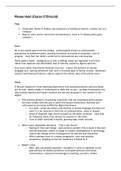
Title
• Establishes theme of modern day annoyance of waiting on hold on a phone call to a
company.
• Robotic voice and its instruction and dominance, irony in its falsely polite guise
(‘please’).
Form
All in one stanza apart from the ending – uninterrupted stream of consciousness
popularised by modernist poets, growing frustration and sense of escalation. Lack of
progress – irony that the robot’s words fail to communicate any real meaning.
Omits speech marks – ambiguity as to who is talking, words are ingrained in his mind
rather than separate and identifiable (loss of identity caused by digital takeover).
Free verse rather than rhyme/rhythmic structure – mimics the patterns of natural
language (e.g. starting sentences with ‘and’ is frowned upon in formal writing - deliberate
natural conversational feature), able to capture the robotic tone of the phone voice.
Voice
O’Driscoll inspired to write following experiences with automated phone calls and being
put on hold, robots unable to understand his thick Irish accent – perhaps frustrated by the
way national identity and human variation are lost and devalued in the transfer to the
digital.
• Poet persona presents his growing frustration with the automated phone system,
and more widely with the way in which the human connections, diversity and
achievements are being nullified by digital dominance
o As a poet, values the artistry and emotion of human language and does not
want it to be reduced to this form of communication, sense of despair
o Sense of impotent rage which increases as the poem continues – irony that
he fruitlessly shouts and conveys his emotion to the robot.
o Tone of teeth-clenched irritation, growing rage, bitter sarcasm.
• Wife’s voice repeatedly interjects – “This is the future”.
o Passing of time and change – poet persona wonders if he is stuck in the past
and old-fashioned, unable to adapt to modern developments in technology,
resents the change and its consequences for identity and interaction
o Wife is perhaps more of a realist/pragmatist, calm and satisfied
acceptance, laughing at how her husband is irritated by it.
• Robot’s voice
o Basic, glib automated responses (‘wonderful’) come to represent to the
poet persona its shallow pretences to emulate personal and human
conversations, interprets increasingly as mocking, sarcastic, hollow.
Title
• Establishes theme of modern day annoyance of waiting on hold on a phone call to a
company.
• Robotic voice and its instruction and dominance, irony in its falsely polite guise
(‘please’).
Form
All in one stanza apart from the ending – uninterrupted stream of consciousness
popularised by modernist poets, growing frustration and sense of escalation. Lack of
progress – irony that the robot’s words fail to communicate any real meaning.
Omits speech marks – ambiguity as to who is talking, words are ingrained in his mind
rather than separate and identifiable (loss of identity caused by digital takeover).
Free verse rather than rhyme/rhythmic structure – mimics the patterns of natural
language (e.g. starting sentences with ‘and’ is frowned upon in formal writing - deliberate
natural conversational feature), able to capture the robotic tone of the phone voice.
Voice
O’Driscoll inspired to write following experiences with automated phone calls and being
put on hold, robots unable to understand his thick Irish accent – perhaps frustrated by the
way national identity and human variation are lost and devalued in the transfer to the
digital.
• Poet persona presents his growing frustration with the automated phone system,
and more widely with the way in which the human connections, diversity and
achievements are being nullified by digital dominance
o As a poet, values the artistry and emotion of human language and does not
want it to be reduced to this form of communication, sense of despair
o Sense of impotent rage which increases as the poem continues – irony that
he fruitlessly shouts and conveys his emotion to the robot.
o Tone of teeth-clenched irritation, growing rage, bitter sarcasm.
• Wife’s voice repeatedly interjects – “This is the future”.
o Passing of time and change – poet persona wonders if he is stuck in the past
and old-fashioned, unable to adapt to modern developments in technology,
resents the change and its consequences for identity and interaction
o Wife is perhaps more of a realist/pragmatist, calm and satisfied
acceptance, laughing at how her husband is irritated by it.
• Robot’s voice
o Basic, glib automated responses (‘wonderful’) come to represent to the
poet persona its shallow pretences to emulate personal and human
conversations, interprets increasingly as mocking, sarcastic, hollow.