

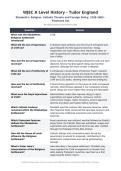
WJEC A Level History - Tudor England
Elizabeth I: Religion, Catholic Threats and Foreign Policy, 1558-1603 -
Flashcard Set
84 edited question-and-answer cards
Question Answer
When was the Elizabethan 1559.
Religious Settlement
introduced?
What did the Act of Supremacy It restored royal authority over the Church of England and
of 1559 do? gave Elizabeth the title Supreme Governor. Clergy,
magistrates and royal officers were required to swear an
oath recognising her authority; refusal normally resulted in
loss of office.
How was the Act of Supremacy All but one of the Marian bishops refused the oath and were
received? deprived. Several hundred parish clergy also lost their
positions, although the exact number is debated.
What did the Act of Uniformity of It introduced a revised Book of Common Prayer, required
1559 do? attendance at parish worship and made the Catholic Mass
illegal. The communion wording combined elements of the
1549 and 1552 books, allowing some doctrinal ambiguity.
How was the Act of Uniformity It faced strong opposition in the House of Lords and passed
received? narrowly. Most bishops opposed it, but compliance among
parish clergy was much higher than among the episcopate.
What were the Royal Injunctions Administrative orders that required clergy to reject
of 1559? superstition and papal authority, remove or control
controversial images, report recusancy, preach approved
doctrine and obtain permission before marrying.
Which Catholic features Elizabeth used the cautious title Supreme Governor rather
remained within the Elizabethan than Supreme Head, preserved the episcopal structure and
Settlement? retained some traditional ornaments and ceremonial
practices.
Which Protestant features Royal supremacy was restored, worship followed an English
defined the Elizabethan prayer book, the Catholic Mass was prohibited, images and
Settlement? superstition were attacked and doctrine was later clarified
through the Protestant Thirty-Nine Articles.
How did the House of Lords Catholic bishops and conservative peers forced the
influence the Religious government to amend its proposals, contributing to the
Settlement? settlement's compromises and narrow parliamentary
passage.
What is Peter Lake's Lake describes a 'two-speed settlement': Elizabeth may
interpretation of the Religious have regarded the 1559 arrangements as broadly final,
Settlement? while leading Protestant councillors saw them as a first
stage towards further reform.
Unofficial independent revision resource. Not affiliated with or endorsed by WJEC/CBAC or Eduqas.
, Question Answer
How important was Parliament Parliament was essential for legislation and taxation but
within Elizabethan government? remained secondary to the monarch, Privy Council and
royal household in the routine operation of government.
How often did Elizabeth summon Thirteen parliamentary assemblies met during her reign.
Parliament?
Approximately how many Acts About 438.
were passed during Elizabeth's
reign?
What happened in the The Crown sought taxation after the Northern Rebellion and
Parliament of 1571? Parliament strengthened treason legislation against
Catholic challenges, including the introduction of papal bulls
into England.
When were major Elizabethan Important legislation was passed in 1598 and consolidated
Poor Laws enacted? in the Poor Relief Act of 1601.
When did the Ridolfi Plot take 1571.
place?
What were the main features of Roberto Ridolfi promoted a plan for Spanish intervention,
the Ridolfi Plot? the marriage of Mary, Queen of Scots, to the Duke of
Norfolk and Elizabeth's removal. The scheme depended on
support from Philip II and the Duke of Alba. Norfolk was
executed.
When did the Throckmorton Plot 1583.
take place?
What were the main features of Francis Throckmorton acted as a link in a plan for forces led
the Throckmorton Plot? by the Duke of Guise to invade, release Mary and
encourage a Catholic rising. Walsingham's intelligence
network exposed the conspiracy and Throckmorton was
executed.
What political response followed The Bond of Association of 1584 bound signatories to
the Throckmorton Plot? defend Elizabeth and punish anyone involved in an attempt
on her life. It was reinforced by the Act for the Queen's
Safety in 1585.
When did the Parry Plot take 1585.
place?
What were the main features of William Parry confessed to considering Elizabeth's
the Parry Plot? assassination. He was convicted and executed, and the
case strengthened pressure for tighter measures protecting
the queen.
When did the Babington Plot 1586.
take place?
Unofficial independent revision resource. Not affiliated with or endorsed by WJEC/CBAC or Eduqas.
Elizabeth I: Religion, Catholic Threats and Foreign Policy, 1558-1603 -
Flashcard Set
84 edited question-and-answer cards
Question Answer
When was the Elizabethan 1559.
Religious Settlement
introduced?
What did the Act of Supremacy It restored royal authority over the Church of England and
of 1559 do? gave Elizabeth the title Supreme Governor. Clergy,
magistrates and royal officers were required to swear an
oath recognising her authority; refusal normally resulted in
loss of office.
How was the Act of Supremacy All but one of the Marian bishops refused the oath and were
received? deprived. Several hundred parish clergy also lost their
positions, although the exact number is debated.
What did the Act of Uniformity of It introduced a revised Book of Common Prayer, required
1559 do? attendance at parish worship and made the Catholic Mass
illegal. The communion wording combined elements of the
1549 and 1552 books, allowing some doctrinal ambiguity.
How was the Act of Uniformity It faced strong opposition in the House of Lords and passed
received? narrowly. Most bishops opposed it, but compliance among
parish clergy was much higher than among the episcopate.
What were the Royal Injunctions Administrative orders that required clergy to reject
of 1559? superstition and papal authority, remove or control
controversial images, report recusancy, preach approved
doctrine and obtain permission before marrying.
Which Catholic features Elizabeth used the cautious title Supreme Governor rather
remained within the Elizabethan than Supreme Head, preserved the episcopal structure and
Settlement? retained some traditional ornaments and ceremonial
practices.
Which Protestant features Royal supremacy was restored, worship followed an English
defined the Elizabethan prayer book, the Catholic Mass was prohibited, images and
Settlement? superstition were attacked and doctrine was later clarified
through the Protestant Thirty-Nine Articles.
How did the House of Lords Catholic bishops and conservative peers forced the
influence the Religious government to amend its proposals, contributing to the
Settlement? settlement's compromises and narrow parliamentary
passage.
What is Peter Lake's Lake describes a 'two-speed settlement': Elizabeth may
interpretation of the Religious have regarded the 1559 arrangements as broadly final,
Settlement? while leading Protestant councillors saw them as a first
stage towards further reform.
Unofficial independent revision resource. Not affiliated with or endorsed by WJEC/CBAC or Eduqas.
, Question Answer
How important was Parliament Parliament was essential for legislation and taxation but
within Elizabethan government? remained secondary to the monarch, Privy Council and
royal household in the routine operation of government.
How often did Elizabeth summon Thirteen parliamentary assemblies met during her reign.
Parliament?
Approximately how many Acts About 438.
were passed during Elizabeth's
reign?
What happened in the The Crown sought taxation after the Northern Rebellion and
Parliament of 1571? Parliament strengthened treason legislation against
Catholic challenges, including the introduction of papal bulls
into England.
When were major Elizabethan Important legislation was passed in 1598 and consolidated
Poor Laws enacted? in the Poor Relief Act of 1601.
When did the Ridolfi Plot take 1571.
place?
What were the main features of Roberto Ridolfi promoted a plan for Spanish intervention,
the Ridolfi Plot? the marriage of Mary, Queen of Scots, to the Duke of
Norfolk and Elizabeth's removal. The scheme depended on
support from Philip II and the Duke of Alba. Norfolk was
executed.
When did the Throckmorton Plot 1583.
take place?
What were the main features of Francis Throckmorton acted as a link in a plan for forces led
the Throckmorton Plot? by the Duke of Guise to invade, release Mary and
encourage a Catholic rising. Walsingham's intelligence
network exposed the conspiracy and Throckmorton was
executed.
What political response followed The Bond of Association of 1584 bound signatories to
the Throckmorton Plot? defend Elizabeth and punish anyone involved in an attempt
on her life. It was reinforced by the Act for the Queen's
Safety in 1585.
When did the Parry Plot take 1585.
place?
What were the main features of William Parry confessed to considering Elizabeth's
the Parry Plot? assassination. He was convicted and executed, and the
case strengthened pressure for tighter measures protecting
the queen.
When did the Babington Plot 1586.
take place?
Unofficial independent revision resource. Not affiliated with or endorsed by WJEC/CBAC or Eduqas.


