
Asch’s line study
Aim: To test the extent to which people will
conform to the opinion of others even when the
answer is unambiguous. Designed to investigate
how social pressure from a majority group could
influence an individual to conform
Procedure:
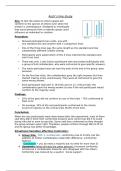
• Showed participants two cards, one with
one standard line and another with 3 comparison lines.
• One of the three lines was the same length as the standard and two
substantially different (clearly wrong)
• Participants were asked which of the 3 lines matched the standard and
said it out loud.
• There was only 1 real (naïve) participant who was tested individually with
a group of 6-8 confederates, who were instructed to give specific answers.
• The naïve participant was sat near the end/ at the end in the group- peer
pressure.
• On the first few trials, the confederates gave the right answers but then
started making errors unanimously. They were all instructed to give the
same wrong answer.
• Each participant took part in 18 trials and on 12 ‘critical trials’ the
confederates gave the wrong answer (to see if the real participant would
conform to the majority view)
Findings:
• 25% of the ppts did not conform on any of the trials – 75% conformed at
least once
• On average, 32% of the real participants conformed to the clearly
incorrect majority on the critical trials 36.8% of the time.
Conclusion:
When the real participants were interviewed after the experiment, most of them
said they didn’t think their conformed answers were correct but did it to avoid
being ridiculed or seen as peculiar. Some said they conformed as they thought
the group answers were right. Therefore, people conform through NSI (to fit in)
and ISI (group has better knowledge).
Situational Variables affecting Conformity:
Group Size: With 3 confederates, conformity rose to 31.8%, but the
addition of further confederates made little difference. (conformity
plateau)
(Conclusion = you do need a majority but no need for more than 3)
Unanimity (when all have the same opinion): Increases conformity.
Introduced a confederate/ dissenter who disagreed with the others.
Conformity was reduced by a quarter. Social support .
Aim: To test the extent to which people will
conform to the opinion of others even when the
answer is unambiguous. Designed to investigate
how social pressure from a majority group could
influence an individual to conform
Procedure:
• Showed participants two cards, one with
one standard line and another with 3 comparison lines.
• One of the three lines was the same length as the standard and two
substantially different (clearly wrong)
• Participants were asked which of the 3 lines matched the standard and
said it out loud.
• There was only 1 real (naïve) participant who was tested individually with
a group of 6-8 confederates, who were instructed to give specific answers.
• The naïve participant was sat near the end/ at the end in the group- peer
pressure.
• On the first few trials, the confederates gave the right answers but then
started making errors unanimously. They were all instructed to give the
same wrong answer.
• Each participant took part in 18 trials and on 12 ‘critical trials’ the
confederates gave the wrong answer (to see if the real participant would
conform to the majority view)
Findings:
• 25% of the ppts did not conform on any of the trials – 75% conformed at
least once
• On average, 32% of the real participants conformed to the clearly
incorrect majority on the critical trials 36.8% of the time.
Conclusion:
When the real participants were interviewed after the experiment, most of them
said they didn’t think their conformed answers were correct but did it to avoid
being ridiculed or seen as peculiar. Some said they conformed as they thought
the group answers were right. Therefore, people conform through NSI (to fit in)
and ISI (group has better knowledge).
Situational Variables affecting Conformity:
Group Size: With 3 confederates, conformity rose to 31.8%, but the
addition of further confederates made little difference. (conformity
plateau)
(Conclusion = you do need a majority but no need for more than 3)
Unanimity (when all have the same opinion): Increases conformity.
Introduced a confederate/ dissenter who disagreed with the others.
Conformity was reduced by a quarter. Social support .


