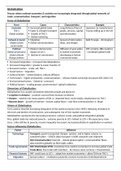
Globalisation
Process where national economies & societies are increasingly integrated through global networks of
trade, communication, transport, and migration
Forms of Globalisation
Form Cause Characteristics Example
Economic Increased global trade Long distance flows of Japanese car manufacturer
TNC’s Faster & cheaper transport goods, services, capital, Toyota setting up in the UK
Global markets Growth of TNC’s and information
Global marketing
Cultural & Social Migration Spread of information, Balti Triangle – Birmingham
Global culture Global communications ideas, and images
social media
Political Western democracies Diffusion of govt policy IMF contains 188 countries
Global governance impact on LIC’s & market economies - coordinate global trade
Global climate Decline of communism developing in former
change policies communist states
Increased integration = increased interdependence
Increased integration = greater & easier transfer of:
Economic factors – trade, aid, TNC’s
Social factors – migration
Cultural factors – westernisation, cultural diffusion
Tech factors – higher productivity, communications – African mobile ownership increased 20% (2010-13)
Environmental factors – linked by ‘commons’
Political factors – trading groups, governmental + global institutions
Dimensions of Globalisation:
Globalisation has caused connections between people and places to:
Lengthen in distance – products sourced from faraway continents
Deepen – extends into many aspects of life i.e. imported food, social media, employment via TNC’s
Become faster – growth of internet = instant capital flows + real-time communication i.e. Skype
History of Globalisation:
Term used to describe increasing integration of the world economy in the 1990’s following revolution in
info tech and decline of communism, and subsequent rise of free market economies
Globalisation represents the increasing economic, cultural, social, and political integration globally
Pros: global trade has reduced poverty – extreme poverty in LIC’s halved to 21% + life expectancy risen
Cons: 1.4bn still live in poverty, income inequality increased, increased pollution & exploitation or workers
Factors Influencing Globalisation:
Factor Influence
Technology Transport: goods transported cheaper, quicker, and in higher volume i.e.
containerisation – COSCO ships transport 13,000 containers per shipment
Info/Communication: Internet – instant global capital + communication flows -
data transfers globally via fibre-optic cables
Trade Agreements IMF/World Bank/WTO: incentivise free-market economies to increase global trade
Trade Blocs: free trade with members – EU shares same currency + financial laws
Financial Systems IMF: send loans to LIC’s – adopt free market economies + allow FDI from TNC’s
Migration Spread culture – remittance payments connect economies (interdependence)
,Flows of Globalisation
Capital Flows:
The flow of money between countries for investment, trade, or production - $5tn daily volume (2013)
Deregulation of the financial markets meant financial institutions could operate internationally
Core-periphery model assumes global power is
concentrated in developed (core) countries, and
they exploit less developed (periphery) countries
Outdated - rapid growth of NEE’s (MINT/BRIC)
Shows capital flows between core and periphery
regions, helping LIC’s develop, reducing inequality
FDI: TNC’s from core regions invest in physical
capital or assets of periphery regions – worth
$1.5tn/yr – in reality, TNC’s also invest into core
regions e.g. Toyota (Japan) setting up factory in UK
Aid: International organisations & NGO’s in core regions provide financial support to periphery regions
with the aims to increase economic development
Remittances: money transferred from workers in core regions to support families in periphery regions –
India receives $80bn/yr in remittances – generates 50% Somalia’s GNI
Leakages: TNC’s return profits made in periphery regions to core regions
Migration: periphery regions lose skilled workers stimulate economic growth by paying taxes/consuming
Labour Flows:
Migration typically occurs from developing regions to developed regions due to pull factors such as
employment opportunities, better living standards i.e. developed healthcare/education systems
Slows economic growth for developing countries – migrants typically skilled workers – govt receives less
tax revenue + less consumption leads to smaller multiplier effects & less input into circular flow
Trends of Migration:
HIC’s in North America & Europe attract the most migrants, who are
predominately from LIC’s in Africa, South America, and South Asia
Largest Inter-Regional Flow: 5mn migrated from South to West Asia
Also large inter-regional flows between sub-Saharan countries and from
Central to North America
Impact of Labour Flows:
Pros Cons
HIC’s Gain skilled workers – increases income tax Increased AD = inflation?
revenue + positive multiplier effect from Pressure on healthcare/education/housing
consumption – NHS = 12.5% foreign
LIC’s Remittance payments = 2nd largest income Lose skilled workers – income tax revenue falls +
source for developing countries negative multiplier effect – sluggish growth
40% Somalians dependent on remittances = Lack of anti-money laundering laws and fears of
50% GNI + 80% investment corruption led to banks in HIC’s withdrawing from
remittance payments – Somalia lost $1.2bn
Product Flows:
, Increased movement of products - caused by cheaper trade costs – nations exploit comparative advantage:
Transaction costs reduced by improvements in data flows – capital instantly transferred
Transport costs reduced by containerisation and international trade organisations removing trade barriers
Service Flows:
Instant communication & info transfer = rapid expansion of service sector – dominated CBD’s in HIC’s –
London is a global centre of finance – service sector in UK accounts for 80% GDP
Growth of transnational service conglomerates (different companies who coordinate different business
activities but belong to a single company) – extends global influence – e.g. HSBC in banking
Low level services centralised in developing countries – e.g. call centres in India – 20% lower labour costs
Information Flows:
Governed by migration and speed of info/communication transfer
Digitalisation/satellite tech has transformed info flows i.e. mobile tech, internet, live media, email
Info flows growth has expanded knowledge-intensive goods & services including research & development
and use of highly skilled labour – quaternary sector – high tech products e.g. software, pharmaceuticals
Dimensions of globalisation
Connections between people and places have:
Lengthened in distance (products and services sourced from faraway continents)
Deepened (sense of ‘global connection’ extends into many aspects of life, ranging from imported food
and TV programs to use of global social media)
Become faster (talk to each other in real-time using technology e.g. Skype)
Globalisation involves people and places becoming connected with different global flows:
Capital flows: Daily, enormous flows of money pass through global stock markets. Investment banks,
pension funds and private citizens buy and sell shares in different currencies to make profit. 2013 – daily
volume was $5 trillion
Labour flows: Increased migration – approximately 250 million economic migrants. Qatar dependent
on Indian construction workers
Product flows: Increased flows of manufactured foods, stimulated be low production costs in low-wage
economies e.g. China and Bangladesh. 2015 – global GDP: $80 trillion with a quarter generated by trade
flows in agriculture and industrial commodities
Service flows: By 2040, India projected to be second largest economy. India provides call centre services
from large US and EU firms
Information flows: The internet has brought real-time communication between distant places, allowing
goods and services to be bought globally - 2.7 billion Facebook users
Key point: Some places and people are highly globalised in one aspect but not in another. China is highly
globalised in trade and employment but don’t participate as freely in global social media and have a
‘shallow’ form of social/cultural globalisation
Factors that have increased the rate of globalisation:
Process where national economies & societies are increasingly integrated through global networks of
trade, communication, transport, and migration
Forms of Globalisation
Form Cause Characteristics Example
Economic Increased global trade Long distance flows of Japanese car manufacturer
TNC’s Faster & cheaper transport goods, services, capital, Toyota setting up in the UK
Global markets Growth of TNC’s and information
Global marketing
Cultural & Social Migration Spread of information, Balti Triangle – Birmingham
Global culture Global communications ideas, and images
social media
Political Western democracies Diffusion of govt policy IMF contains 188 countries
Global governance impact on LIC’s & market economies - coordinate global trade
Global climate Decline of communism developing in former
change policies communist states
Increased integration = increased interdependence
Increased integration = greater & easier transfer of:
Economic factors – trade, aid, TNC’s
Social factors – migration
Cultural factors – westernisation, cultural diffusion
Tech factors – higher productivity, communications – African mobile ownership increased 20% (2010-13)
Environmental factors – linked by ‘commons’
Political factors – trading groups, governmental + global institutions
Dimensions of Globalisation:
Globalisation has caused connections between people and places to:
Lengthen in distance – products sourced from faraway continents
Deepen – extends into many aspects of life i.e. imported food, social media, employment via TNC’s
Become faster – growth of internet = instant capital flows + real-time communication i.e. Skype
History of Globalisation:
Term used to describe increasing integration of the world economy in the 1990’s following revolution in
info tech and decline of communism, and subsequent rise of free market economies
Globalisation represents the increasing economic, cultural, social, and political integration globally
Pros: global trade has reduced poverty – extreme poverty in LIC’s halved to 21% + life expectancy risen
Cons: 1.4bn still live in poverty, income inequality increased, increased pollution & exploitation or workers
Factors Influencing Globalisation:
Factor Influence
Technology Transport: goods transported cheaper, quicker, and in higher volume i.e.
containerisation – COSCO ships transport 13,000 containers per shipment
Info/Communication: Internet – instant global capital + communication flows -
data transfers globally via fibre-optic cables
Trade Agreements IMF/World Bank/WTO: incentivise free-market economies to increase global trade
Trade Blocs: free trade with members – EU shares same currency + financial laws
Financial Systems IMF: send loans to LIC’s – adopt free market economies + allow FDI from TNC’s
Migration Spread culture – remittance payments connect economies (interdependence)
,Flows of Globalisation
Capital Flows:
The flow of money between countries for investment, trade, or production - $5tn daily volume (2013)
Deregulation of the financial markets meant financial institutions could operate internationally
Core-periphery model assumes global power is
concentrated in developed (core) countries, and
they exploit less developed (periphery) countries
Outdated - rapid growth of NEE’s (MINT/BRIC)
Shows capital flows between core and periphery
regions, helping LIC’s develop, reducing inequality
FDI: TNC’s from core regions invest in physical
capital or assets of periphery regions – worth
$1.5tn/yr – in reality, TNC’s also invest into core
regions e.g. Toyota (Japan) setting up factory in UK
Aid: International organisations & NGO’s in core regions provide financial support to periphery regions
with the aims to increase economic development
Remittances: money transferred from workers in core regions to support families in periphery regions –
India receives $80bn/yr in remittances – generates 50% Somalia’s GNI
Leakages: TNC’s return profits made in periphery regions to core regions
Migration: periphery regions lose skilled workers stimulate economic growth by paying taxes/consuming
Labour Flows:
Migration typically occurs from developing regions to developed regions due to pull factors such as
employment opportunities, better living standards i.e. developed healthcare/education systems
Slows economic growth for developing countries – migrants typically skilled workers – govt receives less
tax revenue + less consumption leads to smaller multiplier effects & less input into circular flow
Trends of Migration:
HIC’s in North America & Europe attract the most migrants, who are
predominately from LIC’s in Africa, South America, and South Asia
Largest Inter-Regional Flow: 5mn migrated from South to West Asia
Also large inter-regional flows between sub-Saharan countries and from
Central to North America
Impact of Labour Flows:
Pros Cons
HIC’s Gain skilled workers – increases income tax Increased AD = inflation?
revenue + positive multiplier effect from Pressure on healthcare/education/housing
consumption – NHS = 12.5% foreign
LIC’s Remittance payments = 2nd largest income Lose skilled workers – income tax revenue falls +
source for developing countries negative multiplier effect – sluggish growth
40% Somalians dependent on remittances = Lack of anti-money laundering laws and fears of
50% GNI + 80% investment corruption led to banks in HIC’s withdrawing from
remittance payments – Somalia lost $1.2bn
Product Flows:
, Increased movement of products - caused by cheaper trade costs – nations exploit comparative advantage:
Transaction costs reduced by improvements in data flows – capital instantly transferred
Transport costs reduced by containerisation and international trade organisations removing trade barriers
Service Flows:
Instant communication & info transfer = rapid expansion of service sector – dominated CBD’s in HIC’s –
London is a global centre of finance – service sector in UK accounts for 80% GDP
Growth of transnational service conglomerates (different companies who coordinate different business
activities but belong to a single company) – extends global influence – e.g. HSBC in banking
Low level services centralised in developing countries – e.g. call centres in India – 20% lower labour costs
Information Flows:
Governed by migration and speed of info/communication transfer
Digitalisation/satellite tech has transformed info flows i.e. mobile tech, internet, live media, email
Info flows growth has expanded knowledge-intensive goods & services including research & development
and use of highly skilled labour – quaternary sector – high tech products e.g. software, pharmaceuticals
Dimensions of globalisation
Connections between people and places have:
Lengthened in distance (products and services sourced from faraway continents)
Deepened (sense of ‘global connection’ extends into many aspects of life, ranging from imported food
and TV programs to use of global social media)
Become faster (talk to each other in real-time using technology e.g. Skype)
Globalisation involves people and places becoming connected with different global flows:
Capital flows: Daily, enormous flows of money pass through global stock markets. Investment banks,
pension funds and private citizens buy and sell shares in different currencies to make profit. 2013 – daily
volume was $5 trillion
Labour flows: Increased migration – approximately 250 million economic migrants. Qatar dependent
on Indian construction workers
Product flows: Increased flows of manufactured foods, stimulated be low production costs in low-wage
economies e.g. China and Bangladesh. 2015 – global GDP: $80 trillion with a quarter generated by trade
flows in agriculture and industrial commodities
Service flows: By 2040, India projected to be second largest economy. India provides call centre services
from large US and EU firms
Information flows: The internet has brought real-time communication between distant places, allowing
goods and services to be bought globally - 2.7 billion Facebook users
Key point: Some places and people are highly globalised in one aspect but not in another. China is highly
globalised in trade and employment but don’t participate as freely in global social media and have a
‘shallow’ form of social/cultural globalisation
Factors that have increased the rate of globalisation: