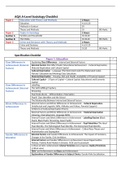
AQA A-Level Sociology Checklist
Paper 1 Education with Theory and Methods 2 Hours
Education 4,6,10,30
Methods in Context 20
Theory and Methods 10 80 Marks
Paper 2 Topics In Sociology 2 Hours
Section A Families and Households 10,10,20
Section B The Media 10,10,20 80 Marks
Paper 3 Crime and Deviance with Theory and Methods 2 Hours
Crime and Deviance 4,6,10,30
Theory and Methods 10,20 80 Marks
Specification Checklist
Paper 1: Education ✓
Class Differences In Explaining Class Differences – Internal and External Factors
Achievement (External External Factors that Affect Pupils’ Educational Achievement – Cultural Deprivation,
Factors) Material Deprivation and Cultural Capital
Cultural Deprivation – Language (The Restricted Code/The Elaborated Code),
Parents’ Education and Working-Class Subculture
Material Deprivation – Housing, Diet and Health, Availability of Financial Support
Cultural Capital – 3 Types of Capital = Cultural Capital, Educational and Economic
Capital
Class Differences In Labelling
Achievement (Internal The Self-Fulfilling Prophecy
Factors) Streaming
Pupil Subcultures – Differentiation, Polarisation
Pupils’ Class Identities and the School
The Relationship Between Internal and External Factors
Ethnic Differences In External Factors and Ethnic Differences in Achievement – Cultural Deprivation
Achievement (Intellectual and Linguistic Skills, Attitudes and Values, Parental Support)
Criticisms of Cultural Deprivation Theory
External Factors and Ethnic Differences in Achievement – Material Deprivation
(Housing, Unemployment, Language Skills)
Internal Factors and Ethnic Differences in Achievement – Labelling/Racism (Black
Pupils, Black Pupils’ Streaming, Asian Pupils)
Internal Factors and Ethnic Differences in Achievement – Pupil Identities (The Ideal
Pupil Identity, The Pathologised Pupil Identity, The Demonised Pupil Identity
Internal Factor and Ethnic Differences in Achievement – Critical Race Theory and
Marketisation and Segregation
Gender Differences In External Factors and Gender Differences in Achievement: The Impact of Feminism,
Education Changes in the Family, Girls Ambitions
Internal Factors and Gender Differences in Achievement: Equal Opportunities
Policies, Positive Role Models in Schools, GCSE and Coursework
2 Views of Girls’ Achievement: Liberal Feminists (see progress), Radical Feminists
(critical view)
Girls’ and Achievement and Boys and Achievement
Explanations of Gender Differences in Subject Choice: Gender Role Socialisation,
, Gender Domains, Gender Subject Images
Different ways in which Pupils’ Experiences in School help to Construct and
Reinforce their Gender Identities: Double Standards, Verbal Abuse, Male Peer
Groups, Female Peer Groups
The Role of Education ALL Sociological Perspectives on Education
In Society – Theories of
Education
Education Social Policy Educational Policy in Britain before 1988 – The Tripartite System, The
and Inequality Comprehensive School System
Marketisation – Parentrcracy, The Reproduction of Inequality, League Tables and
Cream Skimming/Silt Shifting
New Labour and Inequality – Policies at reducing Inequalities
Conservative Government Policies from 2010 – Academies, Free Schools
The Privatisation of Education
Paper 1: Education Methods In Context ✓
Choosing a Research Primary (Experiments, Surveys, Questionnaires, Interviews, Observations) and
Method Secondary (Stats, Historical Documents, Official Documents, Mass Media, Personal
Documents) Sources of Data – ESQIO SHOMP
Quantitative Data (Numerical) and Qualitative Data (Non-Numerical) Data – Know
* Time, Research and Bias, Definitions
Access, Money, Personal Factors Influencing Choice of Method – Practical (*TRAMP) , Ethical **(DRIPS),
Characteristics Reliability, Validity, Enough, Theory – PERVERT
** Deception, Right to
Factors Influencing Choice of Topic (The Sociologist’s Perspective, Society’s Values,
Withdraw, Informed
Practical Factors)
Consent, Protection for
Participant, Situational Education: The Research Context - 5 Main Groups and Settings in Education whose
Ethics Characteristics make them Easy/Hard to Study: Pupils, Teachers, Classrooms,
Schools and Parents
Theoretical Factors: Positivists vs Interpretivists (Each Method)
ESQIO (Primary) Advantages/Disadvantages of each Method and use PERVERT (Factors Influencing
SHOMP (Secondary) Choice of each Method)
Theory + Methods: Research Methods in General and Sociological Perspectives in General
Paper 2: Families and Households ✓
Couples The Domestic Division of Labour (Instrumental and Expressive Roles, Joint and
Segregated Conjugal Roles, The Symmetrical Family)
Couples becoming Equal? – The March of Progress View, Gender Division of Labour
– Cultural/Material Explanation of Inequality
Domestic Violence – Explanations (Feminists)
Childhood Historical Childhood and Modern Childhood
Reasons for Changes in the Position of Children (Law Restriction Child Labour,
Compulsory Schooling, Child Protection, Declining Family Size
Future Childhood (Postmodernity and Disappearance of Childhood)
Has the Position of Children Improved – March of Progress View – Child-Centred
Families + Age Patriarchy
Theories of the Family ALL Sociological Perspectives on Family
Demography Births/Deaths – Reasons for the Decline in Birth Rate and Death Rate
The Ageing Population – Effects of an Ageing Population (Public Services) – The
Paper 1 Education with Theory and Methods 2 Hours
Education 4,6,10,30
Methods in Context 20
Theory and Methods 10 80 Marks
Paper 2 Topics In Sociology 2 Hours
Section A Families and Households 10,10,20
Section B The Media 10,10,20 80 Marks
Paper 3 Crime and Deviance with Theory and Methods 2 Hours
Crime and Deviance 4,6,10,30
Theory and Methods 10,20 80 Marks
Specification Checklist
Paper 1: Education ✓
Class Differences In Explaining Class Differences – Internal and External Factors
Achievement (External External Factors that Affect Pupils’ Educational Achievement – Cultural Deprivation,
Factors) Material Deprivation and Cultural Capital
Cultural Deprivation – Language (The Restricted Code/The Elaborated Code),
Parents’ Education and Working-Class Subculture
Material Deprivation – Housing, Diet and Health, Availability of Financial Support
Cultural Capital – 3 Types of Capital = Cultural Capital, Educational and Economic
Capital
Class Differences In Labelling
Achievement (Internal The Self-Fulfilling Prophecy
Factors) Streaming
Pupil Subcultures – Differentiation, Polarisation
Pupils’ Class Identities and the School
The Relationship Between Internal and External Factors
Ethnic Differences In External Factors and Ethnic Differences in Achievement – Cultural Deprivation
Achievement (Intellectual and Linguistic Skills, Attitudes and Values, Parental Support)
Criticisms of Cultural Deprivation Theory
External Factors and Ethnic Differences in Achievement – Material Deprivation
(Housing, Unemployment, Language Skills)
Internal Factors and Ethnic Differences in Achievement – Labelling/Racism (Black
Pupils, Black Pupils’ Streaming, Asian Pupils)
Internal Factors and Ethnic Differences in Achievement – Pupil Identities (The Ideal
Pupil Identity, The Pathologised Pupil Identity, The Demonised Pupil Identity
Internal Factor and Ethnic Differences in Achievement – Critical Race Theory and
Marketisation and Segregation
Gender Differences In External Factors and Gender Differences in Achievement: The Impact of Feminism,
Education Changes in the Family, Girls Ambitions
Internal Factors and Gender Differences in Achievement: Equal Opportunities
Policies, Positive Role Models in Schools, GCSE and Coursework
2 Views of Girls’ Achievement: Liberal Feminists (see progress), Radical Feminists
(critical view)
Girls’ and Achievement and Boys and Achievement
Explanations of Gender Differences in Subject Choice: Gender Role Socialisation,
, Gender Domains, Gender Subject Images
Different ways in which Pupils’ Experiences in School help to Construct and
Reinforce their Gender Identities: Double Standards, Verbal Abuse, Male Peer
Groups, Female Peer Groups
The Role of Education ALL Sociological Perspectives on Education
In Society – Theories of
Education
Education Social Policy Educational Policy in Britain before 1988 – The Tripartite System, The
and Inequality Comprehensive School System
Marketisation – Parentrcracy, The Reproduction of Inequality, League Tables and
Cream Skimming/Silt Shifting
New Labour and Inequality – Policies at reducing Inequalities
Conservative Government Policies from 2010 – Academies, Free Schools
The Privatisation of Education
Paper 1: Education Methods In Context ✓
Choosing a Research Primary (Experiments, Surveys, Questionnaires, Interviews, Observations) and
Method Secondary (Stats, Historical Documents, Official Documents, Mass Media, Personal
Documents) Sources of Data – ESQIO SHOMP
Quantitative Data (Numerical) and Qualitative Data (Non-Numerical) Data – Know
* Time, Research and Bias, Definitions
Access, Money, Personal Factors Influencing Choice of Method – Practical (*TRAMP) , Ethical **(DRIPS),
Characteristics Reliability, Validity, Enough, Theory – PERVERT
** Deception, Right to
Factors Influencing Choice of Topic (The Sociologist’s Perspective, Society’s Values,
Withdraw, Informed
Practical Factors)
Consent, Protection for
Participant, Situational Education: The Research Context - 5 Main Groups and Settings in Education whose
Ethics Characteristics make them Easy/Hard to Study: Pupils, Teachers, Classrooms,
Schools and Parents
Theoretical Factors: Positivists vs Interpretivists (Each Method)
ESQIO (Primary) Advantages/Disadvantages of each Method and use PERVERT (Factors Influencing
SHOMP (Secondary) Choice of each Method)
Theory + Methods: Research Methods in General and Sociological Perspectives in General
Paper 2: Families and Households ✓
Couples The Domestic Division of Labour (Instrumental and Expressive Roles, Joint and
Segregated Conjugal Roles, The Symmetrical Family)
Couples becoming Equal? – The March of Progress View, Gender Division of Labour
– Cultural/Material Explanation of Inequality
Domestic Violence – Explanations (Feminists)
Childhood Historical Childhood and Modern Childhood
Reasons for Changes in the Position of Children (Law Restriction Child Labour,
Compulsory Schooling, Child Protection, Declining Family Size
Future Childhood (Postmodernity and Disappearance of Childhood)
Has the Position of Children Improved – March of Progress View – Child-Centred
Families + Age Patriarchy
Theories of the Family ALL Sociological Perspectives on Family
Demography Births/Deaths – Reasons for the Decline in Birth Rate and Death Rate
The Ageing Population – Effects of an Ageing Population (Public Services) – The