

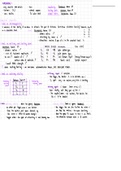
HALOGENS
-
very reactive
non -
metals -
toxic
reactivity hemorrhaged down 67
diatomic Ct , ) coloured vapours
boiling point innhreanen town 67
-
-
-
ions : halides -
1- e- outer shell atomic radius ingresses down 67
physical properties
trend in
electronegativity
is measure of the
ability of an atom to attract the pair of electrons ( withdraw electron density) towards itself
in annulatatbondm trend :
beheaded down 67 F 10
11 3.0
-
atomic radius 1
Br 1.8
e- 1
-
shielding by inner I 1.5
-
attraction : nucleus & pair of e- in the covalent bond to
trend in
melting and
boiling point
increases down 67 MPH) 13PM description 10k -
173°C)
mmmm
atomic radius ? Fa
-
-220 -188 pale yellow gas
of diatomic molecules 1
-
size 11, -101 -35 pale green gas
as size 9 number of e- 1 Bri -7 59 red brown liquid ( /brown )
orange
:
vapour
-
-
of molecule 9 I, (
184 vapour )
surface area 11h black solid purple
↳ result Vdw's 9
:
strength
I when melting /boiling =
we overcome intermolecular forces ,
NOT WVALENT BONDS
e-
trend in
oxidising ability oxidising agent :
acceptor
-
the
bigger the ,
harder it is to attract an e-
^|""É
1¥
" " """ "" """
"
" &" " "
"
"
+
"" """ " " " """
" """"
&
" &
oxidising = reducing power
power have extra e- )
reducing agent : e- donor
B -
how
readily will
they give up
the e-
the smaller / more nucleus the harder for
-
I, I tire
-
v
,
the e- to be donated
trends down
:
oxidising ability down the
group deireasesm reducing ability : a
group inweasesm
atoms get bigger e- further the bigger the ion the further the outer e-
-
as new
-
are ,
,
from the nucleus
from the nucleus and
,
more shielded
by are -
the more
shielding
the inner e- 1effect of nuclear
charge)
-
down the group it's easier to lose e- as there's
bigger atom less good attracting and less attraction between outer e- & nucleus
at e-
forming ions
-
=
, 3. 1.3 HALOGENS .
REACTIONS OF GROUP VII
OXIDATION be reduced halide ( OA)
=
each halogen can →
oxidising agent -
-
OT
F powerful OA 't be used solution reactions
tGIipowerful
ll ! %wn
=
i can in
' A "" M
=
Bret ON
oxidises both Br ions ; more OA than I D 67
A
Br -
-
more powerful than I
REDUCTION :
reagent : concentrated sulphuric acid -
both acid Cpt donor ) & oxidising agent
ionic halide :
sodium Hell Br II -
both base Cpt acceptor) & reducing agent
acid base NOT redox ; nomine of oxidation states
i. -
NEUTRAL KANON changed
t
Nat thson Natl son Ht thou not strong enough OA to oxidise For Cl
steamy fumes
t → t
-
i .
,
of
hydrogen halide produced (hydrogen fluoride chloride)
b Fla
or are not strong enough reducing agents (RAI
4 Ht
'
reduction son 't SO , IHO bromide and
strong enough
-
t Ze → t ions RA to reduce Hzsoy to so ,
-
: :
this deed of oxidation state of S
gas is a
→
-16 in Hz Sou th in SO ,
3.2.3.2 .
USES OF CHLORINE AND CHLORATE CD
CHLORINE dissolves in tho to some extent to GREEN SOLUTION
give
↳ reversible reaction to produce mixture of
hydrochloric acid and chloric acid
(h t tho e Ha t Hoa chloric ID acid =
powerful sterling agent -
added to tho
Ill ,
t 2h20 →
h HCl to , toxic to humans -
small amounts are beneficial
to health ( POOLS ! )
DISPROPORTIONATION REACTION
-
reaction of a with cold
,
dilute , aqueous NaOH Ill ,
t
/ NaOH → Nall t Na UO t Hall
↳ D. R one in which a
single substance is both
-
-
.
oxidised & reduced
→
Cl starts at:
an oxidation state of 0
ends up as -
I sodium chloride & H sodium chlorate CD
I
sold bleach
normally as
-
very reactive
non -
metals -
toxic
reactivity hemorrhaged down 67
diatomic Ct , ) coloured vapours
boiling point innhreanen town 67
-
-
-
ions : halides -
1- e- outer shell atomic radius ingresses down 67
physical properties
trend in
electronegativity
is measure of the
ability of an atom to attract the pair of electrons ( withdraw electron density) towards itself
in annulatatbondm trend :
beheaded down 67 F 10
11 3.0
-
atomic radius 1
Br 1.8
e- 1
-
shielding by inner I 1.5
-
attraction : nucleus & pair of e- in the covalent bond to
trend in
melting and
boiling point
increases down 67 MPH) 13PM description 10k -
173°C)
mmmm
atomic radius ? Fa
-
-220 -188 pale yellow gas
of diatomic molecules 1
-
size 11, -101 -35 pale green gas
as size 9 number of e- 1 Bri -7 59 red brown liquid ( /brown )
orange
:
vapour
-
-
of molecule 9 I, (
184 vapour )
surface area 11h black solid purple
↳ result Vdw's 9
:
strength
I when melting /boiling =
we overcome intermolecular forces ,
NOT WVALENT BONDS
e-
trend in
oxidising ability oxidising agent :
acceptor
-
the
bigger the ,
harder it is to attract an e-
^|""É
1¥
" " """ "" """
"
" &" " "
"
"
+
"" """ " " " """
" """"
&
" &
oxidising = reducing power
power have extra e- )
reducing agent : e- donor
B -
how
readily will
they give up
the e-
the smaller / more nucleus the harder for
-
I, I tire
-
v
,
the e- to be donated
trends down
:
oxidising ability down the
group deireasesm reducing ability : a
group inweasesm
atoms get bigger e- further the bigger the ion the further the outer e-
-
as new
-
are ,
,
from the nucleus
from the nucleus and
,
more shielded
by are -
the more
shielding
the inner e- 1effect of nuclear
charge)
-
down the group it's easier to lose e- as there's
bigger atom less good attracting and less attraction between outer e- & nucleus
at e-
forming ions
-
=
, 3. 1.3 HALOGENS .
REACTIONS OF GROUP VII
OXIDATION be reduced halide ( OA)
=
each halogen can →
oxidising agent -
-
OT
F powerful OA 't be used solution reactions
tGIipowerful
ll ! %wn
=
i can in
' A "" M
=
Bret ON
oxidises both Br ions ; more OA than I D 67
A
Br -
-
more powerful than I
REDUCTION :
reagent : concentrated sulphuric acid -
both acid Cpt donor ) & oxidising agent
ionic halide :
sodium Hell Br II -
both base Cpt acceptor) & reducing agent
acid base NOT redox ; nomine of oxidation states
i. -
NEUTRAL KANON changed
t
Nat thson Natl son Ht thou not strong enough OA to oxidise For Cl
steamy fumes
t → t
-
i .
,
of
hydrogen halide produced (hydrogen fluoride chloride)
b Fla
or are not strong enough reducing agents (RAI
4 Ht
'
reduction son 't SO , IHO bromide and
strong enough
-
t Ze → t ions RA to reduce Hzsoy to so ,
-
: :
this deed of oxidation state of S
gas is a
→
-16 in Hz Sou th in SO ,
3.2.3.2 .
USES OF CHLORINE AND CHLORATE CD
CHLORINE dissolves in tho to some extent to GREEN SOLUTION
give
↳ reversible reaction to produce mixture of
hydrochloric acid and chloric acid
(h t tho e Ha t Hoa chloric ID acid =
powerful sterling agent -
added to tho
Ill ,
t 2h20 →
h HCl to , toxic to humans -
small amounts are beneficial
to health ( POOLS ! )
DISPROPORTIONATION REACTION
-
reaction of a with cold
,
dilute , aqueous NaOH Ill ,
t
/ NaOH → Nall t Na UO t Hall
↳ D. R one in which a
single substance is both
-
-
.
oxidised & reduced
→
Cl starts at:
an oxidation state of 0
ends up as -
I sodium chloride & H sodium chlorate CD
I
sold bleach
normally as


