Section 5 ( Energy Transfer in between Organisms ), Topics 12
Respiration is the process of cells acquiring ATP energy molecules through organic
compounds such as Glucose. Alongside Oxygen, glucose can be dissociated for cells to use
the immediate energy source that is ATP, through cellular respiration.
Aerobic Respiration
o Requires oxygen and glucose, and produces carbon dioxide, water and ATP
energy.
Anaerobic Respiration
o Used by cells during oxygen deficit. Produces lactic acid as a harmful
biproduct of the partial dissociation of glucose, and produces a small amount
of ATP.
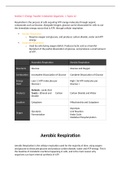
Anaerobic Respiration Aerobic Respiration
Reactants Glucose Glucose and Oxygen
Combustion Incomplete Dissociation of Glucose Complete Dissociation of Glucose
Energy Low ( 2 ATP molecules per High ( 36 ATP molecules per
Yield Glucose ) Glucose )
Animals : Lactic Acid
Products Yeasts : Ethanol and Carbon Carbon Dioxide and Water
Dioxide
Location Cytoplasm Mitochondria and Cytoplasm
Glycolysis
Glycolysis Link Reaction
Stages
Fermentation Krebs Cycle
Oxidative Phosphorylation
Aerobic Respiration
Aerobic Respiration is the cellular respiration used for the majority of time, using oxygen
and glucose to dissociate glucose and produce carbon dioxide, water and ATP energy. This is
the baseline of metabolic reactions happening in cells, and is the main reason why
organisms can have internal synthesis of ATP.
Respiration is the process of cells acquiring ATP energy molecules through organic
compounds such as Glucose. Alongside Oxygen, glucose can be dissociated for cells to use
the immediate energy source that is ATP, through cellular respiration.
Aerobic Respiration
o Requires oxygen and glucose, and produces carbon dioxide, water and ATP
energy.
Anaerobic Respiration
o Used by cells during oxygen deficit. Produces lactic acid as a harmful
biproduct of the partial dissociation of glucose, and produces a small amount
of ATP.
Anaerobic Respiration Aerobic Respiration
Reactants Glucose Glucose and Oxygen
Combustion Incomplete Dissociation of Glucose Complete Dissociation of Glucose
Energy Low ( 2 ATP molecules per High ( 36 ATP molecules per
Yield Glucose ) Glucose )
Animals : Lactic Acid
Products Yeasts : Ethanol and Carbon Carbon Dioxide and Water
Dioxide
Location Cytoplasm Mitochondria and Cytoplasm
Glycolysis
Glycolysis Link Reaction
Stages
Fermentation Krebs Cycle
Oxidative Phosphorylation
Aerobic Respiration
Aerobic Respiration is the cellular respiration used for the majority of time, using oxygen
and glucose to dissociate glucose and produce carbon dioxide, water and ATP energy. This is
the baseline of metabolic reactions happening in cells, and is the main reason why
organisms can have internal synthesis of ATP.