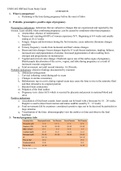
4.11.19 Managerial Economics
More realistic and complex pricing
Pricing schemes
o Low price scheme: MR<MC or (P-MC)/P<1/|e|
- Maximises total profit rather than profit for individual product lines
o Loss leader: pricing low to entice consumers.
Pricing commonly owned substitutes
o To price commonly owned products, use marginal analysis
o Lower price of a product to decrease the demand for the substitute product.
- E.G. If there were only one car dealerships Marginal analysis would find the point
where MR=MC in order to maximise profits
- If there were 2 dealerships, reducing prices for one firm is likely to steal sales from
the other.
- If firm 1 acquires the substitute firm, it can increase prices as there are no alternatives.
o Product portfolio: considered a bundle of goods.
- Demand for a bundle of substitutes is less elastic than demand for the individual
products – less elastic demand implies a higher optimal price.
- Raise the price more on the inelastic products to increase profit margins.
o After acquiring a substitute, a firm can reposition the products so that they don’t directly
compete with one another in the portfolio.
o Moving products farther apart ‘geographically’ or ‘in product attributes’ can further
increase profit.
Pricing commonly owned complements
o Pricing decisions must consider the effects on the other products use as well as the first
product’s use.
o E.G. Reducing the price at one increases the demand at the other and thus increases MR
at both. Supermarket purchasing an adjacent car park.
o Demand for a bundle/product portfolio of complements is more elastic than demand for
individual products
- More elastic demand implies a lower optimal price.
Advertising and promotional pricing
o Promotional spending affects demand:
More realistic and complex pricing
Pricing schemes
o Low price scheme: MR<MC or (P-MC)/P<1/|e|
- Maximises total profit rather than profit for individual product lines
o Loss leader: pricing low to entice consumers.
Pricing commonly owned substitutes
o To price commonly owned products, use marginal analysis
o Lower price of a product to decrease the demand for the substitute product.
- E.G. If there were only one car dealerships Marginal analysis would find the point
where MR=MC in order to maximise profits
- If there were 2 dealerships, reducing prices for one firm is likely to steal sales from
the other.
- If firm 1 acquires the substitute firm, it can increase prices as there are no alternatives.
o Product portfolio: considered a bundle of goods.
- Demand for a bundle of substitutes is less elastic than demand for the individual
products – less elastic demand implies a higher optimal price.
- Raise the price more on the inelastic products to increase profit margins.
o After acquiring a substitute, a firm can reposition the products so that they don’t directly
compete with one another in the portfolio.
o Moving products farther apart ‘geographically’ or ‘in product attributes’ can further
increase profit.
Pricing commonly owned complements
o Pricing decisions must consider the effects on the other products use as well as the first
product’s use.
o E.G. Reducing the price at one increases the demand at the other and thus increases MR
at both. Supermarket purchasing an adjacent car park.
o Demand for a bundle/product portfolio of complements is more elastic than demand for
individual products
- More elastic demand implies a lower optimal price.
Advertising and promotional pricing
o Promotional spending affects demand: