

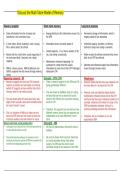
Discuss the Multi Store Model of Memory
Sensory receptor Short term memory Long term memory
Takes information from the 5 senses and Paying attention to this information moves it to Permanent storage of information, which is
transforms it into a memory trace. the STM. largely outside of our awareness.
2 main stores- Echoic (auditory), Iconic (visual), Information we are currently aware of Unlimited capacity, duration is a lifetime-
this is initial contact for stimuli (bahrick’s study) and coding is semantic.
Limited capacity – 7+/-2 items, duration of 18
Retains info for a short time, visual image lasts ½ sec, and coding- acoustically. When we want to retrieve memories they move
sec and sound lasts 2 seconds, has a large back to our STM by retrieval.
capacity. Maintenance rehearsal (repeating it to
oursleves for a long time) this causes Attention and rehearsal explain how information
MSM is a linear process. MSM by Atkinson and information to move into to the LTM. Prolonged moves through memory stores
Shiffrin, explains how info moves through memory rehearsal= LTM
stores.
Opposing research - KF Strength – STM/ LTM Weakness
Research suggests we have one STM, however There is research support for the STM and LTM Research states that the more you rehearse into
research by shallice and warrington on amnesia being qualitatively different. the more likely it is to move into the LTM.
patient KF suggests we have another short-term
memory store for non-verbal sounds. This was shown by baddleys study on coding, However craik and watkinds tested whether
he found that we mix up words that sound maintenance rehearsal moves info to the LTM
This was shown when KF recall when they read similar in the STM but mix up similar meaning and found that the type of rehearsal matters. For
digits to him (acoustic) were poor but better when words in LTM. example, rehearsing info allows it to stay in the
he read it himself (visual). STM but elaborate rehearsal- linking it to
Therefore, this supports the view that we have existing knowledge transfers the information.
This is a limitation of MSM as it states we only different memory stores that are separate and
have one STM store but this shows we have one independent as we code differently in each Therefore, this is a limitation as it is not
to process auditory info and another for visual. store. explained by MSM
Glanzer and Cuntiz- serial position effect Strength - HM
Participants were showed a list of 20 words presented one HM had his hippocampus removed to reduce
at a time and asked them to recall. epilepsy.
They found that when asking p’s to remember a list of He could no longer form long term memories
words greater than the capacity of STM they remember the but could remember things from before
words from the beginning and end of list. surgery, his STM was fine and he could
remember things for the duration of the STM
Sensory receptor Short term memory Long term memory
Takes information from the 5 senses and Paying attention to this information moves it to Permanent storage of information, which is
transforms it into a memory trace. the STM. largely outside of our awareness.
2 main stores- Echoic (auditory), Iconic (visual), Information we are currently aware of Unlimited capacity, duration is a lifetime-
this is initial contact for stimuli (bahrick’s study) and coding is semantic.
Limited capacity – 7+/-2 items, duration of 18
Retains info for a short time, visual image lasts ½ sec, and coding- acoustically. When we want to retrieve memories they move
sec and sound lasts 2 seconds, has a large back to our STM by retrieval.
capacity. Maintenance rehearsal (repeating it to
oursleves for a long time) this causes Attention and rehearsal explain how information
MSM is a linear process. MSM by Atkinson and information to move into to the LTM. Prolonged moves through memory stores
Shiffrin, explains how info moves through memory rehearsal= LTM
stores.
Opposing research - KF Strength – STM/ LTM Weakness
Research suggests we have one STM, however There is research support for the STM and LTM Research states that the more you rehearse into
research by shallice and warrington on amnesia being qualitatively different. the more likely it is to move into the LTM.
patient KF suggests we have another short-term
memory store for non-verbal sounds. This was shown by baddleys study on coding, However craik and watkinds tested whether
he found that we mix up words that sound maintenance rehearsal moves info to the LTM
This was shown when KF recall when they read similar in the STM but mix up similar meaning and found that the type of rehearsal matters. For
digits to him (acoustic) were poor but better when words in LTM. example, rehearsing info allows it to stay in the
he read it himself (visual). STM but elaborate rehearsal- linking it to
Therefore, this supports the view that we have existing knowledge transfers the information.
This is a limitation of MSM as it states we only different memory stores that are separate and
have one STM store but this shows we have one independent as we code differently in each Therefore, this is a limitation as it is not
to process auditory info and another for visual. store. explained by MSM
Glanzer and Cuntiz- serial position effect Strength - HM
Participants were showed a list of 20 words presented one HM had his hippocampus removed to reduce
at a time and asked them to recall. epilepsy.
They found that when asking p’s to remember a list of He could no longer form long term memories
words greater than the capacity of STM they remember the but could remember things from before
words from the beginning and end of list. surgery, his STM was fine and he could
remember things for the duration of the STM


