
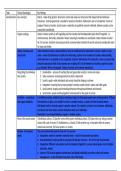
Topic Theory/Sociologist Key findings
Functionalism Key concepts Macro – looks at big picture. Structural- norms and values are structures that shape/restrain behaviour.
Consensus- shared agreement is needed for society to function. Modernism- part of a modernist ‘march of
progress’ theory of society. Social science- subscribes to positivist research methods, believes society can be
researched scientifically.
Organic analogy System: Human society is self-regulating via inter-related and interdependent parts that fit together, i.e.
work/economy, the family, education. Needs: ensuring its members are socialised, create cohesion in order
for it to survive. Functions (ensuring survival): economy helps maintain the social system by meeting the need
for food and shelter.
Values consensus and Value consensus means a shared belief on what is considered to be important in society. Leads to social
social order order - means that behaviour is stable and conforming, derives from members of society understanding
what behaviour is acceptable or not acceptable. System= abbreviation for systematic, means a process that
naturally reproduces itself, that processes are on-going. BUT not all members of society accept the values
e.g. criminals. We’re not puppets. Values of society aren’t always reproduced.
Integrating the individual 1. Socialisation – process of teaching the next generation society’s norms and values
into society 2. Value consensus- shared agreement on what is important
3. Society’s goals- what individuals and society should be hoping to achieve
4. Integration- ensuring that as many people in society accept society’s values and wider goals
5. Social control- shaping and restraining behaviour through punishments and rewards
6. Social order- people working together harmoniously for the good of society
Durkheim – mechanical In traditional society, solidarity had a mechanical aspect to it because people were interdependent. Without
and organic solidarity the mechanics in place, you wouldn't survive. In modern society, a surplus of food/materials means
individuals need for mutual support is greatly reduced. Our need for survival is not as intense. Individuals
can thus be cut from others and see themselves only as an individual.
Mechanical = pre-industrialisation, organic = modern society
Parts of the social system (1)Individual actions, (2) Specific norms which govern individual actions, (3) Status roles e.g. being a teacher
comes with a set of norms, (4) Institutions e.g. school, (5) Sub systems e.g. in education there is nursery,
school and university, (6) Social system i.e. society.
Parsons - the systems The social system had needs in order for it to survive:
needs o Adaptation: meets its members material needs – role of the economic sub-system.
o Goal attainment: Society needs to set goals and allocate resources – this is the role of parliament.
o Integration: Different sub-systems must be integrated together to pursue shared goals- role of religion,
education, media.
o Latency: This involves pattern maintenance (socialising individuals to perform roles) and tension
management – to let off steam from work- role of the family.
Functionalism Key concepts Macro – looks at big picture. Structural- norms and values are structures that shape/restrain behaviour.
Consensus- shared agreement is needed for society to function. Modernism- part of a modernist ‘march of
progress’ theory of society. Social science- subscribes to positivist research methods, believes society can be
researched scientifically.
Organic analogy System: Human society is self-regulating via inter-related and interdependent parts that fit together, i.e.
work/economy, the family, education. Needs: ensuring its members are socialised, create cohesion in order
for it to survive. Functions (ensuring survival): economy helps maintain the social system by meeting the need
for food and shelter.
Values consensus and Value consensus means a shared belief on what is considered to be important in society. Leads to social
social order order - means that behaviour is stable and conforming, derives from members of society understanding
what behaviour is acceptable or not acceptable. System= abbreviation for systematic, means a process that
naturally reproduces itself, that processes are on-going. BUT not all members of society accept the values
e.g. criminals. We’re not puppets. Values of society aren’t always reproduced.
Integrating the individual 1. Socialisation – process of teaching the next generation society’s norms and values
into society 2. Value consensus- shared agreement on what is important
3. Society’s goals- what individuals and society should be hoping to achieve
4. Integration- ensuring that as many people in society accept society’s values and wider goals
5. Social control- shaping and restraining behaviour through punishments and rewards
6. Social order- people working together harmoniously for the good of society
Durkheim – mechanical In traditional society, solidarity had a mechanical aspect to it because people were interdependent. Without
and organic solidarity the mechanics in place, you wouldn't survive. In modern society, a surplus of food/materials means
individuals need for mutual support is greatly reduced. Our need for survival is not as intense. Individuals
can thus be cut from others and see themselves only as an individual.
Mechanical = pre-industrialisation, organic = modern society
Parts of the social system (1)Individual actions, (2) Specific norms which govern individual actions, (3) Status roles e.g. being a teacher
comes with a set of norms, (4) Institutions e.g. school, (5) Sub systems e.g. in education there is nursery,
school and university, (6) Social system i.e. society.
Parsons - the systems The social system had needs in order for it to survive:
needs o Adaptation: meets its members material needs – role of the economic sub-system.
o Goal attainment: Society needs to set goals and allocate resources – this is the role of parliament.
o Integration: Different sub-systems must be integrated together to pursue shared goals- role of religion,
education, media.
o Latency: This involves pattern maintenance (socialising individuals to perform roles) and tension
management – to let off steam from work- role of the family.


