

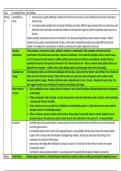
Topic Sociologist/Theory Key findings
Durkhei Inevitability of Not everyone is equally effectively socialised into shared norms and values. Some individuals will be prone to deviate or
m crime break the law.
In complex modern societies there is diversity of lifestyles and values. Different groups develop their own subcultures with
distinctive norms and values, and what the members of the subculture regard as normal, mainstream culture may see as
deviant.
Modern societies tend towards anomie or normlessness - the rules governing behaviour become weak or unclear. Modern
societies have a complex, specialised division of labour, which leads to individuals becoming increasingly different from one
another. This weakens the shared culture of collective conscience and results in high levels of deviance.
Boundary Crime produces a reaction from society, uniting its members in condemnation of the wrongdoer and reinforcing their
maintenance commitment to the shared norms and values. Function of punishment - not to make the wrongdoer suffer or mend his ways,
nor is it to remove the crime society. To reaffirm societies shared values and reinforce social solidarity. Stanley Cohen has
examined the important role played by the media in this ‘dramatisation of evil’ - where courtroom rituals publicly shame and
stigmatise the wrongdoer – reaffirms values of law-abiding majority and discourages others from rule breaking.
Adaptation and All change starts with an act of deviance individuals with new ideas, values tend to be deviant, even criminal. Thus criminal acts
change alters society for the need of change. If those with new ideas are supressed, society will stagnate and be unable to make
necessary adaptive changes. Therefore, Durkheim seeks a desirable level of crime. Too high – threatens the social order. Too
low- suggests society is too controlling of its members, preventing social change.
Other functions Davis- prostitution acts as a safety value for the release of men’s sexual frustrations, without threatening the monogamous
of crime nuclear family.
Polsky- pornography safely ‘channels’ a variety of sexual desires away from alternatives such as adultery, which would pose
a much greater threat to the family.
Cohen- deviance acts as a warning that an institution is not functioning properly i.e. high rates of truancy means that the
education system isn't functioning properly.
Erikson- if deviance performs positive social functions, then perhaps it means that society is actually organised so as to
promote deviance. The police may sustain a certain level of crime rather than to rid society of it – to keep their jobs?.
Evaluation - Durkheim argues that society requires a certain amount of crime to function effectively but offers no way of knowing how
much the right amount is.
- Functionalists explain crime in terms of its supposed function, social solidarity. But this doesn’t mean that society actually
creates crime in advance with the intention of strengthening solidarity. Just because crime does these things, it isn’t
necessarily why it exists in the first place.
- Ignores how crime might affect individuals or groups in society. It is ‘functional’ for the victim of a murder for instance.
Functional for whom?
- Crime doesn’t always promote solidarity. It can actually have the opposite affect leading to isolation and violence.
Merton Strain theory People engage in deviant or criminal behaviour when they are unable to achieve socially approved goals by legitimate means.
Durkhei Inevitability of Not everyone is equally effectively socialised into shared norms and values. Some individuals will be prone to deviate or
m crime break the law.
In complex modern societies there is diversity of lifestyles and values. Different groups develop their own subcultures with
distinctive norms and values, and what the members of the subculture regard as normal, mainstream culture may see as
deviant.
Modern societies tend towards anomie or normlessness - the rules governing behaviour become weak or unclear. Modern
societies have a complex, specialised division of labour, which leads to individuals becoming increasingly different from one
another. This weakens the shared culture of collective conscience and results in high levels of deviance.
Boundary Crime produces a reaction from society, uniting its members in condemnation of the wrongdoer and reinforcing their
maintenance commitment to the shared norms and values. Function of punishment - not to make the wrongdoer suffer or mend his ways,
nor is it to remove the crime society. To reaffirm societies shared values and reinforce social solidarity. Stanley Cohen has
examined the important role played by the media in this ‘dramatisation of evil’ - where courtroom rituals publicly shame and
stigmatise the wrongdoer – reaffirms values of law-abiding majority and discourages others from rule breaking.
Adaptation and All change starts with an act of deviance individuals with new ideas, values tend to be deviant, even criminal. Thus criminal acts
change alters society for the need of change. If those with new ideas are supressed, society will stagnate and be unable to make
necessary adaptive changes. Therefore, Durkheim seeks a desirable level of crime. Too high – threatens the social order. Too
low- suggests society is too controlling of its members, preventing social change.
Other functions Davis- prostitution acts as a safety value for the release of men’s sexual frustrations, without threatening the monogamous
of crime nuclear family.
Polsky- pornography safely ‘channels’ a variety of sexual desires away from alternatives such as adultery, which would pose
a much greater threat to the family.
Cohen- deviance acts as a warning that an institution is not functioning properly i.e. high rates of truancy means that the
education system isn't functioning properly.
Erikson- if deviance performs positive social functions, then perhaps it means that society is actually organised so as to
promote deviance. The police may sustain a certain level of crime rather than to rid society of it – to keep their jobs?.
Evaluation - Durkheim argues that society requires a certain amount of crime to function effectively but offers no way of knowing how
much the right amount is.
- Functionalists explain crime in terms of its supposed function, social solidarity. But this doesn’t mean that society actually
creates crime in advance with the intention of strengthening solidarity. Just because crime does these things, it isn’t
necessarily why it exists in the first place.
- Ignores how crime might affect individuals or groups in society. It is ‘functional’ for the victim of a murder for instance.
Functional for whom?
- Crime doesn’t always promote solidarity. It can actually have the opposite affect leading to isolation and violence.
Merton Strain theory People engage in deviant or criminal behaviour when they are unable to achieve socially approved goals by legitimate means.


