
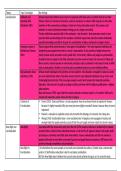
Theory Topic/ Sociologist Key findings
Functionalism Solidarity and Schools means that children have to learn to cooperate with those who are neither their kin nor their
Specialist skills friends. School is a microcosm of society- society in miniature. In school a child must get on with other
(Durkheim 1903) members of the community according to a fixed set of rules, like wider society. This creates social
solidarity in society (individual members feeling part of a single community).
Teaches individuals specialist skills in the workplace, ‘role allocation’. Next generation needs to learn
specialist skills and knowledge for the workplace. Durkheim argues that education teaches individuals
specialist knowledge and skills to be part of a social division of labour (achieved via subject choice).
Passing on values of Parsons argues that school becomes a ‘focal agent of socialisation’ - the most important institution for
Meritocracy (Parsons integrating young people intersociety a society's expectations. It also provides a bridge between the
1961) family (private world) and wider society (public life). In the family, children are judged on particularistic
standards that only apply to that child, education lays down universal values for everyone to follow just
like in society. Schools operate on meritocratic principles; status is achieved on the basis of merit an effort
such as exam grades. Similarly, in work we gain a promotion based on our own individual efforts.
Role allocation (Davis Schools match individuals to the job they are best suited to- role allocation. Inequality is natural as some
and Moore 1945) are more talented than others. Education ensures that the most talented individuals end up in the most
challenging/important jobs. This encourages people to work hard/compete for important positions.
Education ‘sifts and sorts’ of pupils according to ability and those with the highest qualifications = highest
paid positions.
Blau and Duncan (1978)- argue that the economy depends on human capital i.e. its workers’ skills and a
meritocratic education system allows for this to happen.
Criticisms of Tumin (1953) - Davis and Moore = circular argument: How do we know this job is important? Answer:
Functionalism because it's highly rewarded. Why are some jobs more highly rewarded? Answer: because they are more
important!
Marxists - education in capitalist society only transmits the ideology of a minority- the ruling class.
Wrong (1961)- functionalists have a ‘over-socialised view’ of people as mere puppets of society and
wrongly imply that pupils passively accept all that they are taught and never reject the school's values.
New Right and New Right Associated with the conservative party from the mid 1970s onwards, believes in neoliberal (free market)
neo-liberalism economic ideas. Critical of state education because a ‘one size fits all’ approach doesn't suit pupils needs
and imposes conformity (want little state intervention). Favour marketisation and the free market as
people will be able to meet their own needs if parents and pupils become consumers. Will improve the
provision through competition and privatisation.
New Right vs (1) both believe that some people are not really more talented than others, (2) both value a meritocratic
Functionalism system, (3) both believe education is key for secondary socialisation.
BUT the New Right doesn't believe that current state schools achieve that goal, as it is run by the state.
Functionalism Solidarity and Schools means that children have to learn to cooperate with those who are neither their kin nor their
Specialist skills friends. School is a microcosm of society- society in miniature. In school a child must get on with other
(Durkheim 1903) members of the community according to a fixed set of rules, like wider society. This creates social
solidarity in society (individual members feeling part of a single community).
Teaches individuals specialist skills in the workplace, ‘role allocation’. Next generation needs to learn
specialist skills and knowledge for the workplace. Durkheim argues that education teaches individuals
specialist knowledge and skills to be part of a social division of labour (achieved via subject choice).
Passing on values of Parsons argues that school becomes a ‘focal agent of socialisation’ - the most important institution for
Meritocracy (Parsons integrating young people intersociety a society's expectations. It also provides a bridge between the
1961) family (private world) and wider society (public life). In the family, children are judged on particularistic
standards that only apply to that child, education lays down universal values for everyone to follow just
like in society. Schools operate on meritocratic principles; status is achieved on the basis of merit an effort
such as exam grades. Similarly, in work we gain a promotion based on our own individual efforts.
Role allocation (Davis Schools match individuals to the job they are best suited to- role allocation. Inequality is natural as some
and Moore 1945) are more talented than others. Education ensures that the most talented individuals end up in the most
challenging/important jobs. This encourages people to work hard/compete for important positions.
Education ‘sifts and sorts’ of pupils according to ability and those with the highest qualifications = highest
paid positions.
Blau and Duncan (1978)- argue that the economy depends on human capital i.e. its workers’ skills and a
meritocratic education system allows for this to happen.
Criticisms of Tumin (1953) - Davis and Moore = circular argument: How do we know this job is important? Answer:
Functionalism because it's highly rewarded. Why are some jobs more highly rewarded? Answer: because they are more
important!
Marxists - education in capitalist society only transmits the ideology of a minority- the ruling class.
Wrong (1961)- functionalists have a ‘over-socialised view’ of people as mere puppets of society and
wrongly imply that pupils passively accept all that they are taught and never reject the school's values.
New Right and New Right Associated with the conservative party from the mid 1970s onwards, believes in neoliberal (free market)
neo-liberalism economic ideas. Critical of state education because a ‘one size fits all’ approach doesn't suit pupils needs
and imposes conformity (want little state intervention). Favour marketisation and the free market as
people will be able to meet their own needs if parents and pupils become consumers. Will improve the
provision through competition and privatisation.
New Right vs (1) both believe that some people are not really more talented than others, (2) both value a meritocratic
Functionalism system, (3) both believe education is key for secondary socialisation.
BUT the New Right doesn't believe that current state schools achieve that goal, as it is run by the state.


