

25 markers
27 January 2025 18:47
1. Evaluate the view that technological change tends to bring industries closer to the market structure of perfect
competition.
25M
Plan
Definiti Technological change —> the. process by which new methods, ideas or tools are developed and adopted to improve productivity, efficiency and
on of economic performance.
key
terms. Innovation —> using inventions to increase efficiencies and productivity, improve the factors of production
Perfect competition we assume homogenous goods, no barriers to entry and exit, perfect information, many buyers and sellers, price takers,
supernormal profits only in short run
1. Technological change may increase competition by reducing barriers to entry —> reduction in fixed costs, enabling smaller firms or new entrants to
Point compete —> for example, E-commerce platforms like Shopify or Amazon reduced the need of physical stores, significantly lowering fixed costs —>
reduction in sunk costs from advertising, now can adversitise on Instagram for very low costs —> Global e-commerce sales surpassed $6 trillion —>
Overall reduced fixed costs , tech change lowers barriers to entry allowing new firms to allocate resources more efficiently and compete in the
market
Additionally increase access to tech and resources for small firms allowing them to meet productive efficiency AC=MC —> cloud services like AWS
start at around $0.023 per GB, making high performance computing accessible to new entrants
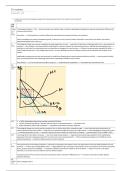
If low barriers —> no more supernormal profits in long run —> eroded away by competition —> incumbent firms lose demand =AR
AN
(diagra
m?)
APP • In 2023, global digital advertising spending reached $626 billion
• FinTech companies like Monzo + Revolut reduced reliance on physical branches —> 30 million users
• Airbnb reported 4 million hosts worldwide —> competition with hotels with lower fixed cost
EV 1 Technological change can also be used by incumbent firms to further boost their competitive edge —> most commonly tech advancments do
require significant fixed costs in R&D —> large firms can spread these high fixed costs over larger ouptut—> achieving signifcant economies of scale
—> technical economies of scale —> increase in barriers of entry as harder for small firms to compete —> Amazon spent $73 bn on R&D in 2023
EV 2 Since large firms more likely to innovate —> also more likely to place patents —> legal protection preventing competitors from replicating or
improving on the tech, allowing incumbet firm to extract even more monopoly profits —> Pfizer maintained monopoly on its COVID 19 vaccine
during the pandemic—> Disney has lifetime patents on their characters
2. Tech advancments in information provision—> decrease in asymmetric information ( where one party knows more than other) between firm and
Point customer —> reduces price making ability of firm —> digital platforms give consumers and producers access to transparent and real time info about
prices, product quality and availability —> comparison websites ( Skyscanner) enable for all of the above —> allows consumers to be better
informed so can choose most cost efficient and cost-effective option.
Transparency forces firms to lower their prices and produce closer to the MC = MR(profit max) —> consumer and producers better aligned,
allocative efficiency
AN
(diagra Same as diagram above
m?)
, APP
EV 1 However, AI, robotics and retention of personal data on marekets, making markets less competitive —> onlince customers now receiving
personalised adverts —> price discrimination occuring which increases profits for firms—> larger firms in monopoly have more database—> can
discriminate more—> outcompete as they can perfectly match price with consumer
EV 2 Important to note that some industries tech change has lead to decrease in number of firms —> creative destruction ( process where innovation
disrupts existing industries, leadinf to demise of outdated businesses) —> the firms aquiring new tech, benefits from less comp and much higher
barriers o entry —> Amazon’s rise disrupted traditional brick-and-mortar retailers —> Amazon controlled 50% of US e-commercemarket.
3. Depends on the industry —> some moved closer to perfect comp —> in E-commerce retail drastically reduced barriers to entry in enabling small
Point businesses to sell directly to consumers online —> all you need is a laptop—> no fixed costs —> platforms like Amazon allow businesses to access
global markets without need of physical stores or large scale infrastructure —> many sellers —> homogenous goods ( most goods are similair,
consumers make purchasing based on price) —> perfect info ( customer reviews and price comparison tools)
AN
(diagra
m?)
APP Etsy reported having 7.5 million active sellers in 2023
EV 1 In some industries tech has beocome super advanced —> requiring enormous capital investment to develop cuttin-edge chips —> only firms with
supernormal profits can do this and only ones experiencing huge economies of scale
EV 2 Building a new chip fabrication plant costs upwards of $20bn —> only few firms like TSMC, Intel and Samsung can afford this, creating high barriers
to entry and reducing competition
Nvidia holds over 90% of the GPU market for AI training
Final Overall have to recognise that perfect comp is unattainable ideal in many sectors —> best thought of as one end of spectrum of market strucrues
Judgem whichi should be guided—> tech change leads to more comp in some industries than others —> overall depends on nature of industry —> pick a
ent side don’t really care
2. Since economies of scale give major advantages to large firms, is there any future, without
government intervention, for small firms in a global economy? Justify your answer.
25M 3. Critically assess the proposition that perfect competition will always result in an efficient allocation of resources, no matter what good or serv
Plan is being produced and consumed
Definiti Perfect competition —> assumption that there are many firms, no barriers to entry or exit, homogenous goods ( no substitutability, perfectly elastic),
on of perfect information, firms are price takers
key
terms Efficiency measured with allocative efficiency (MC=AR), productive efficiency( AC = MC) and dynamic efficiency ( supernormal profits)
Allocation of resources refers to how factors of production are distributed across the economy to produce goods and services that best meet consum
preferences and maximise economic welfare
1. Perfect competition is the only market strucutre in which firms achieve both allocative and productive efficiency in the long run
Point
AN In perfect competition firms in the short run will produce at profit max output where MC=MR, however, in the long run in perfect competition this is
(diagra the allocatively efficient outptu (MC=AR) and the productively efficient output( AC=MC)
m?)
This is because, in perfect competition —> no barriers to entry or exit, and perfect information means that if incumbent firm is making supernormal
profits in short run, these will be eroded away through new firms entering the market + since goods are homogenous —> firms cannot rely on brand
loyalty or product differentiation, so price becomes key competitive tool
Forces firms to be productively efficient ensuring no X-inefficiencies to minimise costs of production and survive in the long run
APP
EV 1 However, in perfect competition dynamic efficiency is limited —> firms make no supernormal profits as they price at AR=AC —> firms don’t have the
additional profit to invest in R&D or generally improving quality or quantity of the factors of production, leading to a lack of innovation, harming
consumer welfare as lower quality goods are produced
EV 2 HOWEVER - firms can be dyamically efficient even without supernormal profits especially in perfect competition —> competition pressure forces firm
innovate just to survive and limit x-inefficiencies —> this is because consumers can easily swtich to alternaitve providers so firms must constantly find
ways to reduce costs and improve product quality to survive
2. Depends on the Good ( Merit goods) even in perfect competition these may be underconsumed due to information failure or positive externalities
Point
AN Merit goods are under-consumed in the free market,despite providing positive externalities —> benefits to third parties not reflected in the market p
(diagra —> example (education)
m?)
In perfect comp goods are allocated by price signals and firms operate at MC=P, assumed that consumers make rational decisions based on perfect in
But with merit goods, consumers only consider private benefits, not external ones, infleunced by short-term thinking, leading to underconsumption a
Qp, where MPB is less than MSB, rather than at socially optimum level Qs, which signals allocative inefficiency and market failure
APP
EV 1 However, what constitutes a “merit good” is a value-laden concept —> depends on normative judgments about what people should consume
27 January 2025 18:47
1. Evaluate the view that technological change tends to bring industries closer to the market structure of perfect
competition.
25M
Plan
Definiti Technological change —> the. process by which new methods, ideas or tools are developed and adopted to improve productivity, efficiency and
on of economic performance.
key
terms. Innovation —> using inventions to increase efficiencies and productivity, improve the factors of production
Perfect competition we assume homogenous goods, no barriers to entry and exit, perfect information, many buyers and sellers, price takers,
supernormal profits only in short run
1. Technological change may increase competition by reducing barriers to entry —> reduction in fixed costs, enabling smaller firms or new entrants to
Point compete —> for example, E-commerce platforms like Shopify or Amazon reduced the need of physical stores, significantly lowering fixed costs —>
reduction in sunk costs from advertising, now can adversitise on Instagram for very low costs —> Global e-commerce sales surpassed $6 trillion —>
Overall reduced fixed costs , tech change lowers barriers to entry allowing new firms to allocate resources more efficiently and compete in the
market
Additionally increase access to tech and resources for small firms allowing them to meet productive efficiency AC=MC —> cloud services like AWS
start at around $0.023 per GB, making high performance computing accessible to new entrants
If low barriers —> no more supernormal profits in long run —> eroded away by competition —> incumbent firms lose demand =AR
AN
(diagra
m?)
APP • In 2023, global digital advertising spending reached $626 billion
• FinTech companies like Monzo + Revolut reduced reliance on physical branches —> 30 million users
• Airbnb reported 4 million hosts worldwide —> competition with hotels with lower fixed cost
EV 1 Technological change can also be used by incumbent firms to further boost their competitive edge —> most commonly tech advancments do
require significant fixed costs in R&D —> large firms can spread these high fixed costs over larger ouptut—> achieving signifcant economies of scale
—> technical economies of scale —> increase in barriers of entry as harder for small firms to compete —> Amazon spent $73 bn on R&D in 2023
EV 2 Since large firms more likely to innovate —> also more likely to place patents —> legal protection preventing competitors from replicating or
improving on the tech, allowing incumbet firm to extract even more monopoly profits —> Pfizer maintained monopoly on its COVID 19 vaccine
during the pandemic—> Disney has lifetime patents on their characters
2. Tech advancments in information provision—> decrease in asymmetric information ( where one party knows more than other) between firm and
Point customer —> reduces price making ability of firm —> digital platforms give consumers and producers access to transparent and real time info about
prices, product quality and availability —> comparison websites ( Skyscanner) enable for all of the above —> allows consumers to be better
informed so can choose most cost efficient and cost-effective option.
Transparency forces firms to lower their prices and produce closer to the MC = MR(profit max) —> consumer and producers better aligned,
allocative efficiency
AN
(diagra Same as diagram above
m?)
, APP
EV 1 However, AI, robotics and retention of personal data on marekets, making markets less competitive —> onlince customers now receiving
personalised adverts —> price discrimination occuring which increases profits for firms—> larger firms in monopoly have more database—> can
discriminate more—> outcompete as they can perfectly match price with consumer
EV 2 Important to note that some industries tech change has lead to decrease in number of firms —> creative destruction ( process where innovation
disrupts existing industries, leadinf to demise of outdated businesses) —> the firms aquiring new tech, benefits from less comp and much higher
barriers o entry —> Amazon’s rise disrupted traditional brick-and-mortar retailers —> Amazon controlled 50% of US e-commercemarket.
3. Depends on the industry —> some moved closer to perfect comp —> in E-commerce retail drastically reduced barriers to entry in enabling small
Point businesses to sell directly to consumers online —> all you need is a laptop—> no fixed costs —> platforms like Amazon allow businesses to access
global markets without need of physical stores or large scale infrastructure —> many sellers —> homogenous goods ( most goods are similair,
consumers make purchasing based on price) —> perfect info ( customer reviews and price comparison tools)
AN
(diagra
m?)
APP Etsy reported having 7.5 million active sellers in 2023
EV 1 In some industries tech has beocome super advanced —> requiring enormous capital investment to develop cuttin-edge chips —> only firms with
supernormal profits can do this and only ones experiencing huge economies of scale
EV 2 Building a new chip fabrication plant costs upwards of $20bn —> only few firms like TSMC, Intel and Samsung can afford this, creating high barriers
to entry and reducing competition
Nvidia holds over 90% of the GPU market for AI training
Final Overall have to recognise that perfect comp is unattainable ideal in many sectors —> best thought of as one end of spectrum of market strucrues
Judgem whichi should be guided—> tech change leads to more comp in some industries than others —> overall depends on nature of industry —> pick a
ent side don’t really care
2. Since economies of scale give major advantages to large firms, is there any future, without
government intervention, for small firms in a global economy? Justify your answer.
25M 3. Critically assess the proposition that perfect competition will always result in an efficient allocation of resources, no matter what good or serv
Plan is being produced and consumed
Definiti Perfect competition —> assumption that there are many firms, no barriers to entry or exit, homogenous goods ( no substitutability, perfectly elastic),
on of perfect information, firms are price takers
key
terms Efficiency measured with allocative efficiency (MC=AR), productive efficiency( AC = MC) and dynamic efficiency ( supernormal profits)
Allocation of resources refers to how factors of production are distributed across the economy to produce goods and services that best meet consum
preferences and maximise economic welfare
1. Perfect competition is the only market strucutre in which firms achieve both allocative and productive efficiency in the long run
Point
AN In perfect competition firms in the short run will produce at profit max output where MC=MR, however, in the long run in perfect competition this is
(diagra the allocatively efficient outptu (MC=AR) and the productively efficient output( AC=MC)
m?)
This is because, in perfect competition —> no barriers to entry or exit, and perfect information means that if incumbent firm is making supernormal
profits in short run, these will be eroded away through new firms entering the market + since goods are homogenous —> firms cannot rely on brand
loyalty or product differentiation, so price becomes key competitive tool
Forces firms to be productively efficient ensuring no X-inefficiencies to minimise costs of production and survive in the long run
APP
EV 1 However, in perfect competition dynamic efficiency is limited —> firms make no supernormal profits as they price at AR=AC —> firms don’t have the
additional profit to invest in R&D or generally improving quality or quantity of the factors of production, leading to a lack of innovation, harming
consumer welfare as lower quality goods are produced
EV 2 HOWEVER - firms can be dyamically efficient even without supernormal profits especially in perfect competition —> competition pressure forces firm
innovate just to survive and limit x-inefficiencies —> this is because consumers can easily swtich to alternaitve providers so firms must constantly find
ways to reduce costs and improve product quality to survive
2. Depends on the Good ( Merit goods) even in perfect competition these may be underconsumed due to information failure or positive externalities
Point
AN Merit goods are under-consumed in the free market,despite providing positive externalities —> benefits to third parties not reflected in the market p
(diagra —> example (education)
m?)
In perfect comp goods are allocated by price signals and firms operate at MC=P, assumed that consumers make rational decisions based on perfect in
But with merit goods, consumers only consider private benefits, not external ones, infleunced by short-term thinking, leading to underconsumption a
Qp, where MPB is less than MSB, rather than at socially optimum level Qs, which signals allocative inefficiency and market failure
APP
EV 1 However, what constitutes a “merit good” is a value-laden concept —> depends on normative judgments about what people should consume


