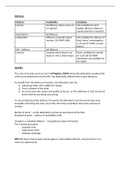
Defences
Defence Availability Limitation
Insanity All offences where mens rea Not available for strict
is required liability offences where no
mental element is required
Automatism All offences
Intoxication Offences of specific intent Not available for offences of
murder, S18 OAPA 1861 basic intent, manslaughter,
ss 20 and 47 OAPA, assault,
battery
Self – defence All offences
Consent Assaults where there is no Never available for murder
injury or only a minor injury of ss 18 and 20 OAPA.
Sometimes not available for
S47 OAPA
Insanity
The rules of insanity were set out in M’Naghten (1843) where the defendant murdered the
victim as he believed he was the PM. The defendant suffered from insane delusions.
To benefit from the defence of insanity, the defendant must be:
1) Labouring under such a defect of reason
2) From a disease of the mind
3) As not to know the nature and quality of the act, or if he did know it, that he did not
know what he was doing was wrong.
To successfully plead the defence of insanity, the defendant must show that they were
incapable of forming the mens rea of the crime they committed, due to the reasons of
insanity
Burden of proof – on the defendant to prove he was insane at the time
Standard of proof – balance of probability (civil)
Insanity is a complete defence – ‘not guilty by reason of insanity’
The Criminal procedure:
- Hospital order
- Supervision order
- Absolute discharge
DPP V H shows that insanity cannot apply to strict liability offences, because there is no
mens rea requirement.
, Element 1 – defect of reason
Clarke – the defect of reason must be more than confusion or absent- mindedness
The defendant must be incapable of using his powers of reasoning: if the defendant is
capable of reasoning but failed to use those powers, then they not have a defect of reason.
Element 2 – disease of the mind
This is a legal term, not medical. As a result, the disease can be mental or physical which
affects the mind
Kemp – suffered from hardening of the arteries which caused problems with blood supply
to the brain. He was found not guilty by reason of insanity.
Sullivan – the source of the disease is irrelevant; insanity includes epilepsy as it affects the
mind.
Hennessy – high blood sugar levels because of diabetes were classed as insanity because
the levels affected the defendant’s mind.
Burgees – in some cases, sleep walking falls within the defence of insanity.
Quick – the cause of the defendant being in a state of now knowing what is doing has to be
an internal disease not an external cause.
Insanity applies when the defendant is insane due to an internal disease (e.g. diabetes,
schizophrenia)
Element 3 – not knowing the nature and quality of the act or not knowing it is wrong
Not knowing the nature and quality of the act means that the defendant is in a state of
unconsciousness or impaired consciousness or the defendant is conscious but doesn’t
understand or know what he is doing. (applied in Kemp, Sullivan, Hennessy and Burgess)
If the defendant knows the nature and quality of the act he can still use the defence of
insanity if he doesn’t know that what he did was wrong.
Windle – this means legally wrong not morally wrong. This case showed that the defendant
knew that what he did was illegal as a result he couldn’t use the defence of insanity and was
found guilty of murder. The case of Johnson applied Windle.
Defence Availability Limitation
Insanity All offences where mens rea Not available for strict
is required liability offences where no
mental element is required
Automatism All offences
Intoxication Offences of specific intent Not available for offences of
murder, S18 OAPA 1861 basic intent, manslaughter,
ss 20 and 47 OAPA, assault,
battery
Self – defence All offences
Consent Assaults where there is no Never available for murder
injury or only a minor injury of ss 18 and 20 OAPA.
Sometimes not available for
S47 OAPA
Insanity
The rules of insanity were set out in M’Naghten (1843) where the defendant murdered the
victim as he believed he was the PM. The defendant suffered from insane delusions.
To benefit from the defence of insanity, the defendant must be:
1) Labouring under such a defect of reason
2) From a disease of the mind
3) As not to know the nature and quality of the act, or if he did know it, that he did not
know what he was doing was wrong.
To successfully plead the defence of insanity, the defendant must show that they were
incapable of forming the mens rea of the crime they committed, due to the reasons of
insanity
Burden of proof – on the defendant to prove he was insane at the time
Standard of proof – balance of probability (civil)
Insanity is a complete defence – ‘not guilty by reason of insanity’
The Criminal procedure:
- Hospital order
- Supervision order
- Absolute discharge
DPP V H shows that insanity cannot apply to strict liability offences, because there is no
mens rea requirement.
, Element 1 – defect of reason
Clarke – the defect of reason must be more than confusion or absent- mindedness
The defendant must be incapable of using his powers of reasoning: if the defendant is
capable of reasoning but failed to use those powers, then they not have a defect of reason.
Element 2 – disease of the mind
This is a legal term, not medical. As a result, the disease can be mental or physical which
affects the mind
Kemp – suffered from hardening of the arteries which caused problems with blood supply
to the brain. He was found not guilty by reason of insanity.
Sullivan – the source of the disease is irrelevant; insanity includes epilepsy as it affects the
mind.
Hennessy – high blood sugar levels because of diabetes were classed as insanity because
the levels affected the defendant’s mind.
Burgees – in some cases, sleep walking falls within the defence of insanity.
Quick – the cause of the defendant being in a state of now knowing what is doing has to be
an internal disease not an external cause.
Insanity applies when the defendant is insane due to an internal disease (e.g. diabetes,
schizophrenia)
Element 3 – not knowing the nature and quality of the act or not knowing it is wrong
Not knowing the nature and quality of the act means that the defendant is in a state of
unconsciousness or impaired consciousness or the defendant is conscious but doesn’t
understand or know what he is doing. (applied in Kemp, Sullivan, Hennessy and Burgess)
If the defendant knows the nature and quality of the act he can still use the defence of
insanity if he doesn’t know that what he did was wrong.
Windle – this means legally wrong not morally wrong. This case showed that the defendant
knew that what he did was illegal as a result he couldn’t use the defence of insanity and was
found guilty of murder. The case of Johnson applied Windle.