For enzyme to work:
• Must come in contact with substrate!
• Must have active site that fits the substrate!
Almost all factors affecting enzyme activity, affect one of the above.
Measuring enzyme-catalysed reactions.
Time-course of enzyme measured to measure enzyme-catalysed reaction progress.
Changes most often measured:
• Products -- e.g. volume of O2 produced when enzyme catalase acts on hydrogen peroxide.
• Disappearance of substrate -- e.g. reduction of starch concentration (substrate) due to
amylase.
, Measuring rate of change:
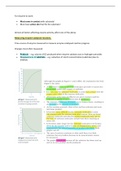
Gradient (gives us e.g. volume, or something that is being measured/PER UNIT OF TIME)
Measure gradient of tangent if curved.
*When investigating effect of a named variable e.g. volume, on the rate of an enzyme reaction ALL
OTHER VARIABLES MUST BE KEPT CONSTNANT (pH, enzyme concentration, substrate concentration)
= control variables.
Effect of temperature on enzyme action:
1. Temperature rises --> kinetic energy of molecules increases.
2. More rapid + more frequent successful collisions.
3. Enzyme + substrate molecules come together more often!
4. More effective, frequent, successful collisions --> more enzyme-substrate complexes --> rate
of reaction increases.
• Temperature rise causes hydrogen + other bonds in enzyme molecule to break --> so active
site, enzyme changes shape.
• For many human enzymes -- this begins at approx. 45oC
• At first, substrate fits less easily into the changed active site, slowing down rate of reaction.
• denaturation -- permanent change to enzyme occurs -- ***note killed because they aren't
alive.
Many enzymes within humans have an optimum temperature at 40oC, but our body has evolved to
be at 37oC
• If our body temp was 40oC or above, we could increase metabolic rate, but due to the
increased metabolism + temp, we would need MORE energy (from food) to maintain this
increase.
• Other proteins (not enzymes) can be denatured.
• Any further rise (e.g. illness) --> denature enzymes.
• Must come in contact with substrate!
• Must have active site that fits the substrate!
Almost all factors affecting enzyme activity, affect one of the above.
Measuring enzyme-catalysed reactions.
Time-course of enzyme measured to measure enzyme-catalysed reaction progress.
Changes most often measured:
• Products -- e.g. volume of O2 produced when enzyme catalase acts on hydrogen peroxide.
• Disappearance of substrate -- e.g. reduction of starch concentration (substrate) due to
amylase.
, Measuring rate of change:
Gradient (gives us e.g. volume, or something that is being measured/PER UNIT OF TIME)
Measure gradient of tangent if curved.
*When investigating effect of a named variable e.g. volume, on the rate of an enzyme reaction ALL
OTHER VARIABLES MUST BE KEPT CONSTNANT (pH, enzyme concentration, substrate concentration)
= control variables.
Effect of temperature on enzyme action:
1. Temperature rises --> kinetic energy of molecules increases.
2. More rapid + more frequent successful collisions.
3. Enzyme + substrate molecules come together more often!
4. More effective, frequent, successful collisions --> more enzyme-substrate complexes --> rate
of reaction increases.
• Temperature rise causes hydrogen + other bonds in enzyme molecule to break --> so active
site, enzyme changes shape.
• For many human enzymes -- this begins at approx. 45oC
• At first, substrate fits less easily into the changed active site, slowing down rate of reaction.
• denaturation -- permanent change to enzyme occurs -- ***note killed because they aren't
alive.
Many enzymes within humans have an optimum temperature at 40oC, but our body has evolved to
be at 37oC
• If our body temp was 40oC or above, we could increase metabolic rate, but due to the
increased metabolism + temp, we would need MORE energy (from food) to maintain this
increase.
• Other proteins (not enzymes) can be denatured.
• Any further rise (e.g. illness) --> denature enzymes.