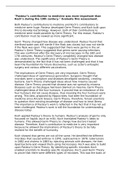
"Pasteur’s contribution to medicine was more important than
Koch’s during the 19th century." Evaluate this assessment.
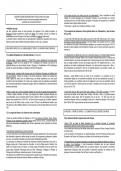
Both Pasteur's contributions to medicine and Koch's contributions to
medicine were huge. Pasteur developed Germ Theory and Koch built upon
this to develop bacteriology. However, both of their contributions to
medicine were made possible by Germ Theory. For this reason, Pasteur's
contribution must be viewed as more significant.
Germ Theory changed how disease was understood. Pasteur found that
sterilised water was still sterile if the flask was closed, but was not sterile
if the flask was open. This suggested that there were germs in the air.
Pasteur’s Germ Theory suggested that germs were causing infections.
This was confirmed after the discovery of microscopes in the 16th and
17th centuries. Pasteur’s Germ Theory completely changed how disease
was understood. The significance of Pasteur's Germ Theory is
demonstrated by the fact that it has not been challenged and that it has
been the foundation for future discoveries, such as Lister's antiseptic
surgery and various different vaccinations.
The implications of Germ Theory are very important. Germ Theory
challenged ideas of spontaneous generation. Surgeons thought that
microbes were a symptom and diseases developed randomly, creating
bacteria. Germ Theory challenged ideas about how miasma caused
disease. Germ Theory proved that disease was not spread by miasma.
Diseases such as the plague had been blamed on miasma. Germ Theory
challenged ideas of the four humours. It proved that an imbalance of the
four humours did not cause disease, thus meaning the four humours were
wrong. This idea, proposed by Hippocrates, had been the foundation of
medicine since Ancient Greece. Germ Theory, therefore, forced scientists
to question their existing knowledge of disease and how to treat illness.
The importance of Pasteur's work is reflected in the fact that it has not yet
been challenged. Pasteur's work is still the foundation for understanding
disease today.
Koch applied Pasteur’s theory to humans. Pasteur’s analysis of germs only
focussed on liquids (such as milk). Koch translated Pasteur’s ideas to
humans. This allowed Germ Theory to change how doctors treated
disease. Therefore, Koch's contribution to medicine is very important
because he allowed the implications of Pasteur's theory to be fully
realised for the benefit of humanity.
Koch showed that germs are not all the same. He identified the different
microbes that caused anthrax in 1876, septicaemia in 1878, tuberculosis
in 1882 and cholera in 1883 by injecting animals with diseases. He then
dyed bacteria and viewed them using microscopes. Koch was able to build
upon Pasteur’s Germ Theory. By identifying specific microbes Koch
enabled scientists to develop specific responses. Koch used Germ Theory
to prove that there were different types of microbes. This was the basis of
Koch’s during the 19th century." Evaluate this assessment.
Both Pasteur's contributions to medicine and Koch's contributions to
medicine were huge. Pasteur developed Germ Theory and Koch built upon
this to develop bacteriology. However, both of their contributions to
medicine were made possible by Germ Theory. For this reason, Pasteur's
contribution must be viewed as more significant.
Germ Theory changed how disease was understood. Pasteur found that
sterilised water was still sterile if the flask was closed, but was not sterile
if the flask was open. This suggested that there were germs in the air.
Pasteur’s Germ Theory suggested that germs were causing infections.
This was confirmed after the discovery of microscopes in the 16th and
17th centuries. Pasteur’s Germ Theory completely changed how disease
was understood. The significance of Pasteur's Germ Theory is
demonstrated by the fact that it has not been challenged and that it has
been the foundation for future discoveries, such as Lister's antiseptic
surgery and various different vaccinations.
The implications of Germ Theory are very important. Germ Theory
challenged ideas of spontaneous generation. Surgeons thought that
microbes were a symptom and diseases developed randomly, creating
bacteria. Germ Theory challenged ideas about how miasma caused
disease. Germ Theory proved that disease was not spread by miasma.
Diseases such as the plague had been blamed on miasma. Germ Theory
challenged ideas of the four humours. It proved that an imbalance of the
four humours did not cause disease, thus meaning the four humours were
wrong. This idea, proposed by Hippocrates, had been the foundation of
medicine since Ancient Greece. Germ Theory, therefore, forced scientists
to question their existing knowledge of disease and how to treat illness.
The importance of Pasteur's work is reflected in the fact that it has not yet
been challenged. Pasteur's work is still the foundation for understanding
disease today.
Koch applied Pasteur’s theory to humans. Pasteur’s analysis of germs only
focussed on liquids (such as milk). Koch translated Pasteur’s ideas to
humans. This allowed Germ Theory to change how doctors treated
disease. Therefore, Koch's contribution to medicine is very important
because he allowed the implications of Pasteur's theory to be fully
realised for the benefit of humanity.
Koch showed that germs are not all the same. He identified the different
microbes that caused anthrax in 1876, septicaemia in 1878, tuberculosis
in 1882 and cholera in 1883 by injecting animals with diseases. He then
dyed bacteria and viewed them using microscopes. Koch was able to build
upon Pasteur’s Germ Theory. By identifying specific microbes Koch
enabled scientists to develop specific responses. Koch used Germ Theory
to prove that there were different types of microbes. This was the basis of