1.1 Monomers and polymers
● Monomer: smaller units from which larger molecules are made of
● Polymer: molecules made from a large number of monomers joined together
● Condensation reaction: joins 2 molecules together with the formation of a chemical
bond, releasing a molecule of water
● Hydrolysis reaction: breaks chemical bond between 2 molecules, using a molecule
of water
1.2 Carbohydrates
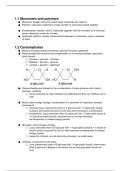
● Made of monosaccharide monomers: glucose, fructose, galactose
● Disaccharides are formed by the condensation of 2 monosaccharides, glycosidic
bond formed
○ Sucrose = glucose + fructose
○ Maltose = glucose + glucose
○ Lactose = glucose + galactose
● Polysaccharides are formed by the condensation of many glucose units: starch,
glycogen, cellulose
○ All are insoluble so water potential is unaffected and they can’t diffuse out of
cells
● Starch: plant energy storage, condensation of 2 polymers of α-glucose: amylose,
amylopectin
○ Amylose: long, unbranched chain of α-glucose with 1-4 glycosidic bonds,
compact and coiled structure so can store lots of energy in a small space
○ Amylopectin: long, branched chain of α-glucose with 1-4 glycosidic bonds &
1-6 bonds at branch points, enzymes can act on side branches
simultaneously to release energy quicker
● Glycogen: animal energy storage:
○ Long, branched chain of α-glucose with 1-4 glycosidic bonds & 1-6 bonds at
branch points, enzymes can act on side branches simultaneously to release
energy quicker
○ Large but compact, so can store lots of energy in a small space
● Cellulose: component of cell walls:
○ Long unbranched chain of β-glucose with 1-4 glycosidic bonds, where every
other β-glucose is flipped so the atoms line up and glycosidic bonds can
form
, ○ Forms straight cellulose chains, joined by hydrogen bonds to form
microfibrils
○ Strong fibres provide structural support, preventing the cell from bursting
under osmotic pressure
● Reducing sugars (all monosaccharides, some disaccharides) test:
○ Add Benedict’s, heat in water bath, red precipitate
● Non-reducing sugars (all polysaccharides, some disaccharides) test:
○ Add HCl, heat in water bath, then neutralise with NaHCO 3
○ Add Benedict’s, heat in water bath, red precipitate
● Starch test: add iodine in potassium iodide, blue/black to orange/brown
1.3 Lipids
● Triglycerides are formed by the condensation of 1 glycerol and 3 fatty acids
(RCOOH), forming 3 ester bonds, releasing 3 water molecules as 1 water molecule
is released per fatty acid joined by an ester bond
○ Storage molecule as many C-H bonds in the 3 fatty acids contain lots of
energy
○ Has a relatively low mass, useful for animals as they don’t need to carry as
much mass around
○ Insoluble so don’t affect water potential, can clump together as insoluble
droplets in water
● Saturated fatty acids: no C=C bonds
● Unsaturated fatty acids: C=C bonds present, causes the molecule to bend, so
structure is not as compact and is liquid at room temperature
● Phospholipids have 1 glycerol, 2 fatty acids, and 1 phosphate group
○ Phosphate group heads are hydrophilic, fatty acid tails are hydrophobic
○ Forms the cell membrane bilayer, heads facing out on either side
○ Tails face inward so the centre of the bilayer is hydrophobic, meaning water-
soluble substances can’t pass through. The cell membrane acts as barrier
● Emulsion test: Add ethanol, then water, and mix, white emulsion
1.4.1 General properties of proteins
● Made of amino acid monomers
● Variable R group side chain: R group differentiates the 20 amino acids
● Monomer: smaller units from which larger molecules are made of
● Polymer: molecules made from a large number of monomers joined together
● Condensation reaction: joins 2 molecules together with the formation of a chemical
bond, releasing a molecule of water
● Hydrolysis reaction: breaks chemical bond between 2 molecules, using a molecule
of water
1.2 Carbohydrates
● Made of monosaccharide monomers: glucose, fructose, galactose
● Disaccharides are formed by the condensation of 2 monosaccharides, glycosidic
bond formed
○ Sucrose = glucose + fructose
○ Maltose = glucose + glucose
○ Lactose = glucose + galactose
● Polysaccharides are formed by the condensation of many glucose units: starch,
glycogen, cellulose
○ All are insoluble so water potential is unaffected and they can’t diffuse out of
cells
● Starch: plant energy storage, condensation of 2 polymers of α-glucose: amylose,
amylopectin
○ Amylose: long, unbranched chain of α-glucose with 1-4 glycosidic bonds,
compact and coiled structure so can store lots of energy in a small space
○ Amylopectin: long, branched chain of α-glucose with 1-4 glycosidic bonds &
1-6 bonds at branch points, enzymes can act on side branches
simultaneously to release energy quicker
● Glycogen: animal energy storage:
○ Long, branched chain of α-glucose with 1-4 glycosidic bonds & 1-6 bonds at
branch points, enzymes can act on side branches simultaneously to release
energy quicker
○ Large but compact, so can store lots of energy in a small space
● Cellulose: component of cell walls:
○ Long unbranched chain of β-glucose with 1-4 glycosidic bonds, where every
other β-glucose is flipped so the atoms line up and glycosidic bonds can
form
, ○ Forms straight cellulose chains, joined by hydrogen bonds to form
microfibrils
○ Strong fibres provide structural support, preventing the cell from bursting
under osmotic pressure
● Reducing sugars (all monosaccharides, some disaccharides) test:
○ Add Benedict’s, heat in water bath, red precipitate
● Non-reducing sugars (all polysaccharides, some disaccharides) test:
○ Add HCl, heat in water bath, then neutralise with NaHCO 3
○ Add Benedict’s, heat in water bath, red precipitate
● Starch test: add iodine in potassium iodide, blue/black to orange/brown
1.3 Lipids
● Triglycerides are formed by the condensation of 1 glycerol and 3 fatty acids
(RCOOH), forming 3 ester bonds, releasing 3 water molecules as 1 water molecule
is released per fatty acid joined by an ester bond
○ Storage molecule as many C-H bonds in the 3 fatty acids contain lots of
energy
○ Has a relatively low mass, useful for animals as they don’t need to carry as
much mass around
○ Insoluble so don’t affect water potential, can clump together as insoluble
droplets in water
● Saturated fatty acids: no C=C bonds
● Unsaturated fatty acids: C=C bonds present, causes the molecule to bend, so
structure is not as compact and is liquid at room temperature
● Phospholipids have 1 glycerol, 2 fatty acids, and 1 phosphate group
○ Phosphate group heads are hydrophilic, fatty acid tails are hydrophobic
○ Forms the cell membrane bilayer, heads facing out on either side
○ Tails face inward so the centre of the bilayer is hydrophobic, meaning water-
soluble substances can’t pass through. The cell membrane acts as barrier
● Emulsion test: Add ethanol, then water, and mix, white emulsion
1.4.1 General properties of proteins
● Made of amino acid monomers
● Variable R group side chain: R group differentiates the 20 amino acids