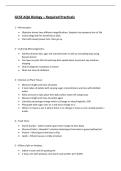
GCSE AQA Biology – Required Practicals
1 – Microscopes:
• Objective lenses have different magnifications. Eyepiece has eyepiece lens of 10x
• Coarse (big) and fine (small) focus dials
• Start with lowest power lens, then go up
2 – Culturing Microorganisms:
• Sterilise all petri dish, agar and nutrient broth as well as inoculating loop using
Bunsen burner
• Use tape on petri dish lid and keep dish upside down to prevent any moisture
dripping
• Only 25 degrees incubation at school
• Work out zone of inhibition
3 – Osmosis on Plant Tissue:
• Measure length and mass of potato
• 3 tests tubes of potato with varying sugar concentrations and one with distilled
water
• Allow osmosis to take place then dab surface water off using tissue
• Measure length and mass of potato again
• Calculate percentage change which is (change in value/original) x 100
• Plot graph with sugar conc on x and mass change on y.
• Where it crosses x axis is where there is no change in mass as conc outside potato =
inside.
4 – Food Tests:
• Starch (Carbs) - Iodine solution goes from orange to blue-black
• Glucose (Carbs) - Benedict’s solution heated goes from blue to green/yellow/red
• Protein – Biuret goes from blue to lilac
• Lipids – Ethanol causes a milky emulsion
5 – Effect of pH on Amylase:
• Iodine in each well of spotting tile
• 3 tests, one with amylase, one starch and another pH 5 buffer
, • All in a water bath at 30, then combine all test tubes to one
• Put them back in water bath and start stopwatch
• At 30s, put a drop of solution in iodine tile – iodine turns blue black
• Carry this on until no starch is present meaning digestion is done – iodine doesn’t go
blue black
6 – Photosynthesis:
• Boiling tube 10cm away from light lamp
• Fill boiling tube with sodium hydrogen carbonate and put some pondweed
• Oxygen bubbles will produce and count them
• To this at different distances.
• Problems are bubble size and if too much bubbles are hard to count
1. Microscopy (Light microscope + calculating magnification)
Typical question types:
• Label parts of a microscope (eyepiece, objective lens, stage, diaphragm)
• Put steps in the correct order (focusing on low → high power)
• State why stains are used
• Calculate magnification using magnification = image size ÷ real size
• Rearrange the equation
• Convert units (mm ↔ µm)
• Measure image size using a ruler
• Identify mistakes in a student’s method
• Describe how to improve image clarity
• Identify sources of error (e.g. inaccurate measurement)
2. Culturing Microorganisms
Typical question types:
• State why agar plates are used
• Explain aseptic technique (sterilising loop, lid half-open)
• Why plates are taped but not sealed
• Why plates are incubated at 25°C
• Calculate percentage increase / decrease in colonies
• Compare growth with/without antibiotics
1 – Microscopes:
• Objective lenses have different magnifications. Eyepiece has eyepiece lens of 10x
• Coarse (big) and fine (small) focus dials
• Start with lowest power lens, then go up
2 – Culturing Microorganisms:
• Sterilise all petri dish, agar and nutrient broth as well as inoculating loop using
Bunsen burner
• Use tape on petri dish lid and keep dish upside down to prevent any moisture
dripping
• Only 25 degrees incubation at school
• Work out zone of inhibition
3 – Osmosis on Plant Tissue:
• Measure length and mass of potato
• 3 tests tubes of potato with varying sugar concentrations and one with distilled
water
• Allow osmosis to take place then dab surface water off using tissue
• Measure length and mass of potato again
• Calculate percentage change which is (change in value/original) x 100
• Plot graph with sugar conc on x and mass change on y.
• Where it crosses x axis is where there is no change in mass as conc outside potato =
inside.
4 – Food Tests:
• Starch (Carbs) - Iodine solution goes from orange to blue-black
• Glucose (Carbs) - Benedict’s solution heated goes from blue to green/yellow/red
• Protein – Biuret goes from blue to lilac
• Lipids – Ethanol causes a milky emulsion
5 – Effect of pH on Amylase:
• Iodine in each well of spotting tile
• 3 tests, one with amylase, one starch and another pH 5 buffer
, • All in a water bath at 30, then combine all test tubes to one
• Put them back in water bath and start stopwatch
• At 30s, put a drop of solution in iodine tile – iodine turns blue black
• Carry this on until no starch is present meaning digestion is done – iodine doesn’t go
blue black
6 – Photosynthesis:
• Boiling tube 10cm away from light lamp
• Fill boiling tube with sodium hydrogen carbonate and put some pondweed
• Oxygen bubbles will produce and count them
• To this at different distances.
• Problems are bubble size and if too much bubbles are hard to count
1. Microscopy (Light microscope + calculating magnification)
Typical question types:
• Label parts of a microscope (eyepiece, objective lens, stage, diaphragm)
• Put steps in the correct order (focusing on low → high power)
• State why stains are used
• Calculate magnification using magnification = image size ÷ real size
• Rearrange the equation
• Convert units (mm ↔ µm)
• Measure image size using a ruler
• Identify mistakes in a student’s method
• Describe how to improve image clarity
• Identify sources of error (e.g. inaccurate measurement)
2. Culturing Microorganisms
Typical question types:
• State why agar plates are used
• Explain aseptic technique (sterilising loop, lid half-open)
• Why plates are taped but not sealed
• Why plates are incubated at 25°C
• Calculate percentage increase / decrease in colonies
• Compare growth with/without antibiotics