

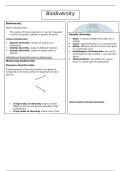
Biodiversity
Biodiversity
What is biodiversity?
- The variety of living organisms. It can be measured
in terms of species, habitat or genetic diversity. Genetic Diversity
Types of biodiversity: Gene- a section of DNA that codes for a
protein
Species diversity- number of species in a Locus- position/location on a chromosome
community Allele- different versions of the same gene
Habitat diversity- range of different habitats or a particular locus
Genetic diversity- variety of alleles within a Homologous chromosomes- one set of
species chromosomes from mother + one set from
Definitions of important terms in biodiversity: father
Polymorphism- two alleles for a given
Measuring
Habitat=biodiversity
area habited by a species locus in a gene pool of a population.
Community= all organisms in a given area
Simpsons diversity index
Population= number of individuals of a species in a
given area of the total number of organisms
A measurement
Abundance=
compared number
to the total of individuals
number per of
of organisms species
each
species. Total number of
Measures of biodiversity:
individuals of one
SPECIES RICHNESS- number of different species
species in a
given area.
SPECIES EVENNESS- measure of abundance.
Total number of
“sum organisms of all
of..” species
How is genetic diversity assessed?
A high index of diversity means several
different species are equally abundant (high
biodiversity)
A low index of diversity means one or two
species dominate over the others (low
Biodiversity
What is biodiversity?
- The variety of living organisms. It can be measured
in terms of species, habitat or genetic diversity. Genetic Diversity
Types of biodiversity: Gene- a section of DNA that codes for a
protein
Species diversity- number of species in a Locus- position/location on a chromosome
community Allele- different versions of the same gene
Habitat diversity- range of different habitats or a particular locus
Genetic diversity- variety of alleles within a Homologous chromosomes- one set of
species chromosomes from mother + one set from
Definitions of important terms in biodiversity: father
Polymorphism- two alleles for a given
Measuring
Habitat=biodiversity
area habited by a species locus in a gene pool of a population.
Community= all organisms in a given area
Simpsons diversity index
Population= number of individuals of a species in a
given area of the total number of organisms
A measurement
Abundance=
compared number
to the total of individuals
number per of
of organisms species
each
species. Total number of
Measures of biodiversity:
individuals of one
SPECIES RICHNESS- number of different species
species in a
given area.
SPECIES EVENNESS- measure of abundance.
Total number of
“sum organisms of all
of..” species
How is genetic diversity assessed?
A high index of diversity means several
different species are equally abundant (high
biodiversity)
A low index of diversity means one or two
species dominate over the others (low


