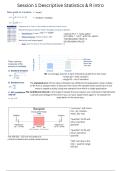
Session 1 Descriptive Statistics & R intro
-> “mean”
-> “median” (middle)
raw f -> “table”
relative (%) f -> “prop.table”
sort table -> “sort”, with the option
“DECREASING=TRUE” or
DECREASING=FALSE”
SD: on average, how far is each individual grade from the mean.
->small SD = little variation
->large SD = lot of variation
The standard error of the mean indicates how different the population mean is likely
to be from a sample mean. It tells you how much the sample mean would vary if you
were to repeat a study using new samples from within a single population.
The confidence interval is the range of values that you expect your estimate to fall between
a certain percentage of the time if you run your experiment again or re-sample the
population in the same way.
Boxplot “summary” will return
min, Q1, median,
mean, Q3, max.
“quantile” (0.25) will
return Q1 (first
quartile)
“quantile” (0.75) will
return Q3 (third
The IQR (Q3 – Q1) can be used as a quartile)
criteria to determine outlier observations
“IQR” will return the
inter- quartile range
(Q3-Q1).
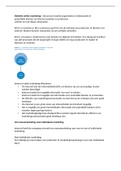
, Session 2 Research & Qualitative Research P1
(test a specific hypothesis) (complex and sensitive
f.e. Researchers aim to test phenomena)
whether the including green f.e. Researchers aim to explore
labels on product packaging the experiences of consumers
leads to higher sales with disabilities when
accessing online shopping
platforms.
->advantage lies in its ability to foster a deeper
understanding of your respondents' thoughts, attitudes,
and behaviors, facilitated by an increased level of intimacy.
larger number of participants, (e.g., 6-10). These participants share certain
demographic similarities, (e.g., age, education)
->advantage is the opportunity to establish a forum for group discussion. Gain
insights about how individuals perceive and engage with products and services.
most in-depth observational research method that studies people in their naturally occurring
environment
->advantage of this method is that it gives you the opportunity to better understand the
cultures, challenges, motivations of consumers in their natural environments.
Observation research involves documenting the actions of participants, focusing on their behavior
within a specific environment.
-> advantage of this method lies in its natural and authentic data collection experience. Consumers
behave as they normally would, without the pressure of being under study.
, Session 2 Research & Qualitative Research P2
-> my_lex/lexicon <- c(“example
word, quality,...)
-> sentences <- c(“example
sentence, I really loved the..,...)
-> nb_words
(lexicon=my_lex,corpus=sentence)
1.Creating new datasets based on an existing dataset
1.Filtering out participants
2.Selecting variables
1.Within a dataset:
1.Creating new variables as functions of old variables
2.Recoding old variables into new variables
-> “mean”
-> “median” (middle)
raw f -> “table”
relative (%) f -> “prop.table”
sort table -> “sort”, with the option
“DECREASING=TRUE” or
DECREASING=FALSE”
SD: on average, how far is each individual grade from the mean.
->small SD = little variation
->large SD = lot of variation
The standard error of the mean indicates how different the population mean is likely
to be from a sample mean. It tells you how much the sample mean would vary if you
were to repeat a study using new samples from within a single population.
The confidence interval is the range of values that you expect your estimate to fall between
a certain percentage of the time if you run your experiment again or re-sample the
population in the same way.
Boxplot “summary” will return
min, Q1, median,
mean, Q3, max.
“quantile” (0.25) will
return Q1 (first
quartile)
“quantile” (0.75) will
return Q3 (third
The IQR (Q3 – Q1) can be used as a quartile)
criteria to determine outlier observations
“IQR” will return the
inter- quartile range
(Q3-Q1).
, Session 2 Research & Qualitative Research P1
(test a specific hypothesis) (complex and sensitive
f.e. Researchers aim to test phenomena)
whether the including green f.e. Researchers aim to explore
labels on product packaging the experiences of consumers
leads to higher sales with disabilities when
accessing online shopping
platforms.
->advantage lies in its ability to foster a deeper
understanding of your respondents' thoughts, attitudes,
and behaviors, facilitated by an increased level of intimacy.
larger number of participants, (e.g., 6-10). These participants share certain
demographic similarities, (e.g., age, education)
->advantage is the opportunity to establish a forum for group discussion. Gain
insights about how individuals perceive and engage with products and services.
most in-depth observational research method that studies people in their naturally occurring
environment
->advantage of this method is that it gives you the opportunity to better understand the
cultures, challenges, motivations of consumers in their natural environments.
Observation research involves documenting the actions of participants, focusing on their behavior
within a specific environment.
-> advantage of this method lies in its natural and authentic data collection experience. Consumers
behave as they normally would, without the pressure of being under study.
, Session 2 Research & Qualitative Research P2
-> my_lex/lexicon <- c(“example
word, quality,...)
-> sentences <- c(“example
sentence, I really loved the..,...)
-> nb_words
(lexicon=my_lex,corpus=sentence)
1.Creating new datasets based on an existing dataset
1.Filtering out participants
2.Selecting variables
1.Within a dataset:
1.Creating new variables as functions of old variables
2.Recoding old variables into new variables