
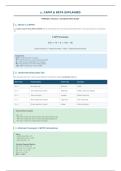
CAPM & BETA EXPLAINED
FINN1011 Finance | Complete Mini-Guide
1. What is CAPM?
The Capital Asset Pricing Model (CAPM) tells us the expected return an investor should require from a risky asset, based on its systematic
risk.
CAPM Formula:
E(Rᵢ) = Rf + βᵢ × (Rm - Rf)
Expected Return = Risk-Free Rate + Beta × Market Risk Premium
Components:
• E(Rᵢ) = Expected return on asset i
• Rf = Risk-free rate (e.g., government bond yield)
• βᵢ = Beta of asset i (systematic risk measure)
• Rm = Expected return on the market portfolio
• (Rm - Rf) = Market Risk Premium (MRP)
2. Understanding Beta (β)
Beta measures how much a stock moves relative to the market. It captures systematic risk only.
Beta Value Interpretation Stock Type Examples
β=0 No market risk Risk-free T-Bills
β<1 Less volatile than market Defensive Utilities, Consumer Staples
β=1 Same as market Average Market index fund
β>1 More volatile than market Aggressive Tech, Small-caps
β<0 Moves opposite to market Hedge Gold (sometimes)
Interpretation Example:
If β = 1.5:
• When the market rises 10%, the stock rises approximately 15%
• When the market falls 10%, the stock falls approximately 15%
• The stock is 50% more volatile than the market
3. Worked Example: CAPM Calculation
Given:
• Risk-free rate (Rf) = 4%
• Market return (Rm) = 10%
• Stock beta (β) = 1.3
Calculate Expected Return:
E(R) = Rf + β × (Rm - Rf)
E(R) = 4% + 1.3 × (10% - 4%)
E(R) = 4% + 1.3 × 6%
E(R) = 4% + 7.8%
E(R) = 11.8%
FINN1011 Finance | Complete Mini-Guide
1. What is CAPM?
The Capital Asset Pricing Model (CAPM) tells us the expected return an investor should require from a risky asset, based on its systematic
risk.
CAPM Formula:
E(Rᵢ) = Rf + βᵢ × (Rm - Rf)
Expected Return = Risk-Free Rate + Beta × Market Risk Premium
Components:
• E(Rᵢ) = Expected return on asset i
• Rf = Risk-free rate (e.g., government bond yield)
• βᵢ = Beta of asset i (systematic risk measure)
• Rm = Expected return on the market portfolio
• (Rm - Rf) = Market Risk Premium (MRP)
2. Understanding Beta (β)
Beta measures how much a stock moves relative to the market. It captures systematic risk only.
Beta Value Interpretation Stock Type Examples
β=0 No market risk Risk-free T-Bills
β<1 Less volatile than market Defensive Utilities, Consumer Staples
β=1 Same as market Average Market index fund
β>1 More volatile than market Aggressive Tech, Small-caps
β<0 Moves opposite to market Hedge Gold (sometimes)
Interpretation Example:
If β = 1.5:
• When the market rises 10%, the stock rises approximately 15%
• When the market falls 10%, the stock falls approximately 15%
• The stock is 50% more volatile than the market
3. Worked Example: CAPM Calculation
Given:
• Risk-free rate (Rf) = 4%
• Market return (Rm) = 10%
• Stock beta (β) = 1.3
Calculate Expected Return:
E(R) = Rf + β × (Rm - Rf)
E(R) = 4% + 1.3 × (10% - 4%)
E(R) = 4% + 1.3 × 6%
E(R) = 4% + 7.8%
E(R) = 11.8%


