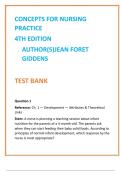
CONCEPTS FOR NURSING
PRACTICE
4TH EDITION
• AUTHOR(S)JEAN FORET
GIDDENS
TEST BANK
Question 1
Reference: Ch. 1 — Development — Application in Pediatric
Nursing
Stem: A 3-month-old infant is brought to the clinic for a well-
child visit. The nurse observes the infant lying on the
examination table. When the nurse shakes a rattle to the side of
the infant's head, the infant turns their head toward the sound
but does not reach for the rattle. The parent expresses concern
,that the baby is not grabbing toys yet. How should the nurse
respond?
• A. "This is a delay. We should refer you to a developmental
specialist immediately."
• B. "This is expected. Reaching and grasping typically begins
around 4 to 6 months of age."
• C. "Let's try a louder toy. Not responding to sound can be a
sign of hearing problems."
• D. "Your baby should be rolling over by now. We need to
focus on gross motor skills first."
Correct Answer: B
Rationales:
• Correct Rationale (B): This response demonstrates
accurate knowledge of age-appropriate developmental
milestones. At 3 months, turning the head toward a sound
demonstrates appropriate auditory and cognitive
development. Voluntary reaching and grasping (fine motor
skills) are not expected until later in infancy, typically
between 4-6 months. The nurse uses this knowledge to
educate the parent and alleviate anxiety, which is a key
nursing role in supporting healthy development.
• Incorrect Rationale (A): This is an overreaction to a normal
finding and would unnecessarily alarm the parent. It does
not align with standard developmental milestones.
, • Incorrect Rationale (C): The stem indicates the
infant did turn toward the sound, which is an appropriate
response. Suggesting a hearing problem ignores this
positive assessment finding.
• Incorrect Rationale (D): This statement contains incorrect
information. Rolling over typically begins around 4-7
months, not by 3 months. It also incorrectly prioritizes
gross motor over other developmental domains.
Teaching Point: Know your milestones! Use standardized tools
(like DENVER II) to assess, but always interpret findings within
the context of the child's age to provide accurate education and
reassurance.
Citation: Giddens, J. F. (2025). Concepts for Nursing
Practice (4th ed.). Chapter 1.
Question 2
Reference: Ch. 1 — Development — Clinical Judgment &
Prioritization
Stem: A nurse is planning care for four hospitalized patients.
Which patient requires the most immediate nursing
intervention based on developmental risk?
• A. A 16-year-old with diabetes who is non-adherent with
insulin administration.
, • B. A 45-year-old post-operative patient who is refusing to
ambulate.
• C. An 80-year-old with mild dementia who has new onset
of urinary incontinence.
• D. A 6-month-old infant with bronchiolitis who has a
respiratory rate of 54 breaths/min.
Correct Answer: D
Rationales:
• Correct Rationale (D): This infant is exhibiting a sign of
respiratory distress (tachypnea). Infants have smaller
airways and are less able to compensate for respiratory
illnesses. Airway and breathing are always the highest
priority, and a change in respiratory status in an infant
requires immediate assessment and intervention to
prevent respiratory failure.
• Incorrect Rationale (A): While adolescent risk-taking and
non-adherence are serious concerns related to identity vs.
role confusion (Erikson), this is a chronic management
issue requiring education and support, not an acute
physiological threat.
• Incorrect Rationale (B): Refusal to ambulate post-
operatively increases the risk for complications like
atelectasis and DVT, but it is not an immediate life threat.
This requires motivational interviewing and collaboration.
PRACTICE
4TH EDITION
• AUTHOR(S)JEAN FORET
GIDDENS
TEST BANK
Question 1
Reference: Ch. 1 — Development — Application in Pediatric
Nursing
Stem: A 3-month-old infant is brought to the clinic for a well-
child visit. The nurse observes the infant lying on the
examination table. When the nurse shakes a rattle to the side of
the infant's head, the infant turns their head toward the sound
but does not reach for the rattle. The parent expresses concern
,that the baby is not grabbing toys yet. How should the nurse
respond?
• A. "This is a delay. We should refer you to a developmental
specialist immediately."
• B. "This is expected. Reaching and grasping typically begins
around 4 to 6 months of age."
• C. "Let's try a louder toy. Not responding to sound can be a
sign of hearing problems."
• D. "Your baby should be rolling over by now. We need to
focus on gross motor skills first."
Correct Answer: B
Rationales:
• Correct Rationale (B): This response demonstrates
accurate knowledge of age-appropriate developmental
milestones. At 3 months, turning the head toward a sound
demonstrates appropriate auditory and cognitive
development. Voluntary reaching and grasping (fine motor
skills) are not expected until later in infancy, typically
between 4-6 months. The nurse uses this knowledge to
educate the parent and alleviate anxiety, which is a key
nursing role in supporting healthy development.
• Incorrect Rationale (A): This is an overreaction to a normal
finding and would unnecessarily alarm the parent. It does
not align with standard developmental milestones.
, • Incorrect Rationale (C): The stem indicates the
infant did turn toward the sound, which is an appropriate
response. Suggesting a hearing problem ignores this
positive assessment finding.
• Incorrect Rationale (D): This statement contains incorrect
information. Rolling over typically begins around 4-7
months, not by 3 months. It also incorrectly prioritizes
gross motor over other developmental domains.
Teaching Point: Know your milestones! Use standardized tools
(like DENVER II) to assess, but always interpret findings within
the context of the child's age to provide accurate education and
reassurance.
Citation: Giddens, J. F. (2025). Concepts for Nursing
Practice (4th ed.). Chapter 1.
Question 2
Reference: Ch. 1 — Development — Clinical Judgment &
Prioritization
Stem: A nurse is planning care for four hospitalized patients.
Which patient requires the most immediate nursing
intervention based on developmental risk?
• A. A 16-year-old with diabetes who is non-adherent with
insulin administration.
, • B. A 45-year-old post-operative patient who is refusing to
ambulate.
• C. An 80-year-old with mild dementia who has new onset
of urinary incontinence.
• D. A 6-month-old infant with bronchiolitis who has a
respiratory rate of 54 breaths/min.
Correct Answer: D
Rationales:
• Correct Rationale (D): This infant is exhibiting a sign of
respiratory distress (tachypnea). Infants have smaller
airways and are less able to compensate for respiratory
illnesses. Airway and breathing are always the highest
priority, and a change in respiratory status in an infant
requires immediate assessment and intervention to
prevent respiratory failure.
• Incorrect Rationale (A): While adolescent risk-taking and
non-adherence are serious concerns related to identity vs.
role confusion (Erikson), this is a chronic management
issue requiring education and support, not an acute
physiological threat.
• Incorrect Rationale (B): Refusal to ambulate post-
operatively increases the risk for complications like
atelectasis and DVT, but it is not an immediate life threat.
This requires motivational interviewing and collaboration.