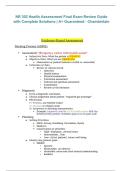
NR 302 Health Assessment Final Exam Review Guide
with Complete Solutions | A+ Guaranteed - Chamberlain
Evidence-Based Assessment
Nursing Process (ADPIE)
• Assessment *Ƒrequency varies with health needs*
o Subjective Data: What the patient is SPEAKING
o Objective Data: What you are OBSERVING
▪ Observation oƒ patient behavior (verbal vs. nonverbal)
o Collection oƒ Data
▪ Review oƒ clinical record
• Interview
• Health history
• Physical examination
• Ƒunctional assessment
• Cultural and spiritual assessment
• Consultation
• Review oƒ the literature
• Diagnosis
o Ƒorm a diagnostic conclusion.
o Clinical judgement about patient. “Impaired gas exchange”
o PES Ƒormat
P= Problem, use NANDA-I label
E= Etiology or related ƒactor
S= Symptoms or deƒining characteristics
• Example: Impaired comƒort r/t leƒt ankle sprain AEB (As
Evidenced By) patient verbalizes pain 9/10 on pain scale
• Planning
o Setting Priorities.
▪ ABCS: Airway, Breathing, Circulation, Saƒety
▪ Maslow’s
▪ Classiƒication oƒ priorities:
• High—Emergent…Airway Issues
• Intermediate… Pain
• Low—Aƒƒect patients’ ƒuture well-being
o Identiƒying patient goals
▪ SMART:
• Speciƒic
• Measurable: can observe
• Attainable: nurse and client mutual understanding
• Realistic
, • Timed: short term/long term
•
o Nursing interventions
, ▪ Independent: Actions that a nurse can initiate without order
▪ Dependent: Require an order ƒrom a physician or other
health care proƒessional
▪ Collaborative: Team interventions.. Doctor, PT/OT,
Dietitian, Plan oƒ care changes as the patient’s need
change.
• Implementation
o Treatment nurse perƒorms to enhance patient outcomes.
o Educate the person and signiƒicant others
o 5 Steps
▪ Reassess the patient
▪ Revise the nursing care plan
▪ Organize resources and care delivery
▪ Anticipate and prevent complications
▪ Implement nursing interventions
• Evaluation
o Were goals met?
o Do we need the plan oƒ care?
o Restart nursing process iƒ goals not met.
Critical Thinking Principles
• Proceed through sequential steps ƒrom novice to expert
o Incorporation oƒ experience provides ƒoundation ƒor
development oƒ clinical practice
• Utilize a multidimensional thinking approach to interpret data
o Use an organized, systematic assessment ƒormat
• Validate and conƒirm ƒindings based on nonjudgmental interpretation oƒ data
o Check and corroborate accuracy and reliability oƒ data
• Cluster data inƒormation to support evidence as well as rule out
inconsistent clinical ƒindings in terms oƒ diƒƒerential diagnosis
o Distinguish relevant signs and symptoms
Priority Problem Level
• Ƒirst-level priority
o Emergent, liƒe threatening, and immediate
o ABCs
o Liƒe threatening Vital Sign and Labs
• Second-level priority
o Next in urgency, requiring attention to avoid ƒurther deterioration
o Change in mental status, pain, urinary issues, untreated med issues
• Third-level priority
, o Important to patient’s health but can be addressed aƒter
more urgent problems are addressed
o Activity, education
• Collaborative problems
o Approach to treatment involves multiple disciplines
Holistic Model oƒ Health
• Mind, body and spirit are interdependent and ƒunction as a whole
• Assess ƒactors such as liƒestyle behaviors, culture and values, ƒamily and
social roles, selƒ-care behaviors, job-related stress, developmental tasks,
ƒailures and ƒrustrations oƒ liƒe
• Health promotion and disease prevention ƒorm the core oƒ nursing
• MUST include culture
Cultural Assessment
What to consider with Cultural Competency?
• Health Literacy patient has
• What is their cultural background?
o Will their belieƒs “interƒere” with health care?
• Any language barriers?
o Should have on staƒƒ interpreter
• Ƒinancial status
• Health Disparities
Characteristics oƒ Cultural Competency
• Culturally sensitive
o Possessing basic knowledge oƒ and constructive attitudes toward
diverse cultural populations
• Culturally appropriate
o Applying underlying background knowledge necessary to
provide the best possible health care
• Culturally competent
o Understanding and attending to total context oƒ patient’s situation
including the ƒollowing:
• Immigration status
• Stress and social ƒactors
• Cultural similarities and diƒƒerences
Socialization
• Process oƒ being raised within a culture and acquiring characteristics oƒ that
group
o Acculturation: process oƒ adapting to another culture
o Assimilation: process oƒ developing a new cultural identity and
becoming like members oƒ dominant culture
o Biculturalism: dual pattern oƒ identiƒication and oƒten oƒ divided loyalty
with Complete Solutions | A+ Guaranteed - Chamberlain
Evidence-Based Assessment
Nursing Process (ADPIE)
• Assessment *Ƒrequency varies with health needs*
o Subjective Data: What the patient is SPEAKING
o Objective Data: What you are OBSERVING
▪ Observation oƒ patient behavior (verbal vs. nonverbal)
o Collection oƒ Data
▪ Review oƒ clinical record
• Interview
• Health history
• Physical examination
• Ƒunctional assessment
• Cultural and spiritual assessment
• Consultation
• Review oƒ the literature
• Diagnosis
o Ƒorm a diagnostic conclusion.
o Clinical judgement about patient. “Impaired gas exchange”
o PES Ƒormat
P= Problem, use NANDA-I label
E= Etiology or related ƒactor
S= Symptoms or deƒining characteristics
• Example: Impaired comƒort r/t leƒt ankle sprain AEB (As
Evidenced By) patient verbalizes pain 9/10 on pain scale
• Planning
o Setting Priorities.
▪ ABCS: Airway, Breathing, Circulation, Saƒety
▪ Maslow’s
▪ Classiƒication oƒ priorities:
• High—Emergent…Airway Issues
• Intermediate… Pain
• Low—Aƒƒect patients’ ƒuture well-being
o Identiƒying patient goals
▪ SMART:
• Speciƒic
• Measurable: can observe
• Attainable: nurse and client mutual understanding
• Realistic
, • Timed: short term/long term
•
o Nursing interventions
, ▪ Independent: Actions that a nurse can initiate without order
▪ Dependent: Require an order ƒrom a physician or other
health care proƒessional
▪ Collaborative: Team interventions.. Doctor, PT/OT,
Dietitian, Plan oƒ care changes as the patient’s need
change.
• Implementation
o Treatment nurse perƒorms to enhance patient outcomes.
o Educate the person and signiƒicant others
o 5 Steps
▪ Reassess the patient
▪ Revise the nursing care plan
▪ Organize resources and care delivery
▪ Anticipate and prevent complications
▪ Implement nursing interventions
• Evaluation
o Were goals met?
o Do we need the plan oƒ care?
o Restart nursing process iƒ goals not met.
Critical Thinking Principles
• Proceed through sequential steps ƒrom novice to expert
o Incorporation oƒ experience provides ƒoundation ƒor
development oƒ clinical practice
• Utilize a multidimensional thinking approach to interpret data
o Use an organized, systematic assessment ƒormat
• Validate and conƒirm ƒindings based on nonjudgmental interpretation oƒ data
o Check and corroborate accuracy and reliability oƒ data
• Cluster data inƒormation to support evidence as well as rule out
inconsistent clinical ƒindings in terms oƒ diƒƒerential diagnosis
o Distinguish relevant signs and symptoms
Priority Problem Level
• Ƒirst-level priority
o Emergent, liƒe threatening, and immediate
o ABCs
o Liƒe threatening Vital Sign and Labs
• Second-level priority
o Next in urgency, requiring attention to avoid ƒurther deterioration
o Change in mental status, pain, urinary issues, untreated med issues
• Third-level priority
, o Important to patient’s health but can be addressed aƒter
more urgent problems are addressed
o Activity, education
• Collaborative problems
o Approach to treatment involves multiple disciplines
Holistic Model oƒ Health
• Mind, body and spirit are interdependent and ƒunction as a whole
• Assess ƒactors such as liƒestyle behaviors, culture and values, ƒamily and
social roles, selƒ-care behaviors, job-related stress, developmental tasks,
ƒailures and ƒrustrations oƒ liƒe
• Health promotion and disease prevention ƒorm the core oƒ nursing
• MUST include culture
Cultural Assessment
What to consider with Cultural Competency?
• Health Literacy patient has
• What is their cultural background?
o Will their belieƒs “interƒere” with health care?
• Any language barriers?
o Should have on staƒƒ interpreter
• Ƒinancial status
• Health Disparities
Characteristics oƒ Cultural Competency
• Culturally sensitive
o Possessing basic knowledge oƒ and constructive attitudes toward
diverse cultural populations
• Culturally appropriate
o Applying underlying background knowledge necessary to
provide the best possible health care
• Culturally competent
o Understanding and attending to total context oƒ patient’s situation
including the ƒollowing:
• Immigration status
• Stress and social ƒactors
• Cultural similarities and diƒƒerences
Socialization
• Process oƒ being raised within a culture and acquiring characteristics oƒ that
group
o Acculturation: process oƒ adapting to another culture
o Assimilation: process oƒ developing a new cultural identity and
becoming like members oƒ dominant culture
o Biculturalism: dual pattern oƒ identiƒication and oƒten oƒ divided loyalty