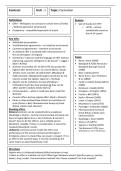
Contract Unit - 1 Topic: Formation
Definitions Statute
Offer – Willingness to contract on certain terms (Trietle) Sale of Goods Act 1979
/ Definite agreement to be bound o s57(2) – actions
Acceptance – unqualified expression of assent symbolically closed on
the hit of a gavel
Key Info:
Rebuttable presumption –
Social/domestic agreements – no intention to be bound
Commercial agreements – intention to be bound
A unilateral offer is accepted with commencement of
the act (Errington v Errington)
Sometimes “a person used the language of offer without Cases
expressing a genuine willingness to be bound” – Leggat J Barry v Davis (2000)
(Blue v Ashley) Blackpool & Fylde Aeroclub v
Auctions must follow s57 of SGA 1979 and accept the Blackpool Borough Council
highest offer where there is no reserve (Barry v Davis) (1990)
Tenders must consider all valid tenders (Blackpool & Blue v Ashley (2017)
Fylde Aeroclub v Blackpool Borough Council) but do not Byrne & Co v Van Tienhoven
need to accept the highest. (Spencer v Harding) & Co (1880)
Adverts can be invitations to treat (Partdirge v Carlill v Carbolic Smoke Ball Co
Crittenden) much like shop windows or they can be (1893)
offers (Carlill v Carbolic Smoke Ball co). Dickinson v Dodds (1876)
Communication – when it could have been read (The Errington v Errington (1952)
Brimnes) Fischer v Bell (1961)
Counter offers destroy original offers (Hyde v Wrench) Hyde v Wrench (1840)
Items in shop window/shop shelves are invitations to Luxor v Cooper (1941)
treat (Fischer v Bell; Pharmaceutical Society of Great Mountford v Scott (1975)
Britain v Boots Cash Chemist) Partridge v Crittenden (1968)
Revoking offers- Pharmaceutical Society of
Bilateral contracts can be revoked before acceptance Great Britain v Boots Cash
(Routledge v Grant) – must be communicated and posal rule Chemist (1953)
does not apply (Byrne & co v Van Tienhoven & co) but it Routledge v Grant (1829)
doesn’t have to be the offeror, just a reliable person Shuey v US (1875)
(Dickinson v Dodds). If there is consideration, it cannot be Spencer v Harding (1870)
revoked (Mountford v Scott). The Brimnes (1975) Tenax
Unilateral contracts cannot revoke the offer once Steamship Co. Ltd v The Brimnes
performance of the act has commenced (Errington v
Errington) unless it is stated they can (Luxor v Cooper). If it is
an offer to the world at large, it must be revoked by the
same means as advertised (Shuey v US)
Structure
Explain why it is bilateral/unilateral/offer/invitation to treat.
Is there an offer or invitation to treat? What type? Between whom? Specifics type e.g. auction,
advert, shop, tender. Communication method? Has it been revoked? Can it be revoked?
Definitions Statute
Offer – Willingness to contract on certain terms (Trietle) Sale of Goods Act 1979
/ Definite agreement to be bound o s57(2) – actions
Acceptance – unqualified expression of assent symbolically closed on
the hit of a gavel
Key Info:
Rebuttable presumption –
Social/domestic agreements – no intention to be bound
Commercial agreements – intention to be bound
A unilateral offer is accepted with commencement of
the act (Errington v Errington)
Sometimes “a person used the language of offer without Cases
expressing a genuine willingness to be bound” – Leggat J Barry v Davis (2000)
(Blue v Ashley) Blackpool & Fylde Aeroclub v
Auctions must follow s57 of SGA 1979 and accept the Blackpool Borough Council
highest offer where there is no reserve (Barry v Davis) (1990)
Tenders must consider all valid tenders (Blackpool & Blue v Ashley (2017)
Fylde Aeroclub v Blackpool Borough Council) but do not Byrne & Co v Van Tienhoven
need to accept the highest. (Spencer v Harding) & Co (1880)
Adverts can be invitations to treat (Partdirge v Carlill v Carbolic Smoke Ball Co
Crittenden) much like shop windows or they can be (1893)
offers (Carlill v Carbolic Smoke Ball co). Dickinson v Dodds (1876)
Communication – when it could have been read (The Errington v Errington (1952)
Brimnes) Fischer v Bell (1961)
Counter offers destroy original offers (Hyde v Wrench) Hyde v Wrench (1840)
Items in shop window/shop shelves are invitations to Luxor v Cooper (1941)
treat (Fischer v Bell; Pharmaceutical Society of Great Mountford v Scott (1975)
Britain v Boots Cash Chemist) Partridge v Crittenden (1968)
Revoking offers- Pharmaceutical Society of
Bilateral contracts can be revoked before acceptance Great Britain v Boots Cash
(Routledge v Grant) – must be communicated and posal rule Chemist (1953)
does not apply (Byrne & co v Van Tienhoven & co) but it Routledge v Grant (1829)
doesn’t have to be the offeror, just a reliable person Shuey v US (1875)
(Dickinson v Dodds). If there is consideration, it cannot be Spencer v Harding (1870)
revoked (Mountford v Scott). The Brimnes (1975) Tenax
Unilateral contracts cannot revoke the offer once Steamship Co. Ltd v The Brimnes
performance of the act has commenced (Errington v
Errington) unless it is stated they can (Luxor v Cooper). If it is
an offer to the world at large, it must be revoked by the
same means as advertised (Shuey v US)
Structure
Explain why it is bilateral/unilateral/offer/invitation to treat.
Is there an offer or invitation to treat? What type? Between whom? Specifics type e.g. auction,
advert, shop, tender. Communication method? Has it been revoked? Can it be revoked?