

Triangle Geometry - Similarity
In polygons: Two polygons are similar if their corresponding angles are equal and their
In polygons: corresponding sides are in the same proportion.
In triangles: Only one of the above conditions needs to be true in order for the two triangles to
In triangles: be similar. Two polygons are similar if their corresponding angles are equal or their
In triangles: corresponding sides are in the same proportion.
lll = similar
= congruent
lll
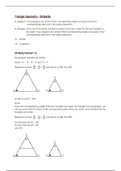
Similarity theorem 1a
Equiangular triangles are similar.
Given: ˆA = ˆD , ˆB = ˆE and ˆC = ˆF
𝐴𝐵 𝐴𝐶 𝐵𝐶
Required to prove: 𝐷𝐸
= 𝐷𝐹
= 𝐸𝐹
and hence, ∆ ABC lll ∆ DEF
A
⨀
D
.
⨀
B ∎ x C E ∎ x F
∆ ABC lll ∆ DEF - AAA
Proof:
Since the corresponding angles of the two triangles are equal, the triangles are equiangular, we
will now prove that the ratios of the corresponding sides will be the same, which implies that the
triangles are similar.
𝐴𝐵 𝐴𝐶 𝐵𝐶
Required to prove: 𝐷𝐸
= 𝐷𝐹
= 𝐸𝐹
and hence, ∆ ABC lll ∆ DEF
On AB mark off AG = DE.
On AC mark off AH = DF.
Join GH.
A
⨀
.
- - D
⨀
- -
B ∎ x C E ∎ x F
, In ∆ AGH and ∆ DEF:
- AG = DE (construction)
- ˆA = ˆD (given)
- AH = DF (construction)
∴ ∆AGH ∆DEF
lll
∴ ˆG1 = ˆE
But ˆB = ˆE (given)
∴ ˆG1 = ˆB
∴ GH ll BC (corresponding angles equal)
𝐴𝐵 𝐴𝐶
∴ 𝐴𝐺
= 𝐴𝐻
𝐴𝐵 𝐴𝐶
∴ 𝐷𝐸
= 𝐷𝐹
(AG = DE , AH = DF)
∴ ∆ ABC lll ∆ DEF - corresponding sides of triangle in proportion
Notation and hint
In ∆ ABC and ∆ FDE
Keep the order the same as given for the first triangle.
1. ˆA = ˆD
2. ˆB = ˆF
3. ˆC = ˆE → Write the answer, but do not have to find (reason: 3 angles of a triangle)
∆ ABC lll ∆ DFE (aaa) - Order must match what has been proved above
As soon as proved through angles, write proportions out.
𝐹𝑖𝑟𝑠𝑡 𝑡𝑤𝑜 𝑓𝑟𝑜𝑚 ∆𝐴𝐵𝐶 𝐿𝑎𝑠𝑡 𝑡𝑤𝑜 𝑓𝑟𝑜𝑚 ∆𝐴𝐵𝐶 𝐹𝑖𝑟𝑠𝑡 𝑎𝑛𝑑 𝑙𝑎𝑠𝑡 𝑓𝑟𝑜𝑚 ∆𝐴𝐵𝐶
𝐹𝑖𝑟𝑠𝑡 𝑡𝑤𝑜 𝑓𝑟𝑜𝑚 ∆𝐷𝐹𝐸
= 𝐿𝑎𝑠𝑡 𝑡𝑤𝑜 𝑓𝑟𝑜𝑚 ∆𝐷𝐹𝐸 = 𝐹𝑖𝑟𝑠𝑡 𝑎𝑛𝑑 𝑙𝑎𝑠𝑡 𝑓𝑟𝑜𝑚 ∆𝐷𝐹𝐸
𝐴𝐵 𝐵𝐶 𝐴𝐶
∴ = =
𝐷𝐹 𝐹𝐸 𝐷𝐸
Example:
P A
In the diagram, PA ll BC and ˆB1 = ˆC 1
2
Prove that:
1. ∆ PAB lll ∆ ABC
2. PA : AB = PB : AC 1⨀ 2 ⨀
3. AB.AC = BP.BC C
B
1. ˆP = ˆA2 (3 angles of a triangle)
1. ˆA1 = ˆB2 (PA ll BC, Alternative angles)
1. ˆB1 = ˆC (given)
∴ ∆ PAB lll ∆ ABC (aaa)
𝑃𝐴 𝐴𝐵 𝑃𝐵
∴ 𝐴𝐵
= 𝐵𝐶
= 𝐴𝐶
(From lll triangle)
𝑃𝐴 𝐴𝐵
2. 𝐴𝐵
= 𝐵𝐶
(see above)
𝐴𝐵 𝑃𝐵
3. 𝐵𝐶
= 𝐴𝐶
3. ∴ AB.AC = BP.BC (cross multiplication)
In polygons: Two polygons are similar if their corresponding angles are equal and their
In polygons: corresponding sides are in the same proportion.
In triangles: Only one of the above conditions needs to be true in order for the two triangles to
In triangles: be similar. Two polygons are similar if their corresponding angles are equal or their
In triangles: corresponding sides are in the same proportion.
lll = similar
= congruent
lll
Similarity theorem 1a
Equiangular triangles are similar.
Given: ˆA = ˆD , ˆB = ˆE and ˆC = ˆF
𝐴𝐵 𝐴𝐶 𝐵𝐶
Required to prove: 𝐷𝐸
= 𝐷𝐹
= 𝐸𝐹
and hence, ∆ ABC lll ∆ DEF
A
⨀
D
.
⨀
B ∎ x C E ∎ x F
∆ ABC lll ∆ DEF - AAA
Proof:
Since the corresponding angles of the two triangles are equal, the triangles are equiangular, we
will now prove that the ratios of the corresponding sides will be the same, which implies that the
triangles are similar.
𝐴𝐵 𝐴𝐶 𝐵𝐶
Required to prove: 𝐷𝐸
= 𝐷𝐹
= 𝐸𝐹
and hence, ∆ ABC lll ∆ DEF
On AB mark off AG = DE.
On AC mark off AH = DF.
Join GH.
A
⨀
.
- - D
⨀
- -
B ∎ x C E ∎ x F
, In ∆ AGH and ∆ DEF:
- AG = DE (construction)
- ˆA = ˆD (given)
- AH = DF (construction)
∴ ∆AGH ∆DEF
lll
∴ ˆG1 = ˆE
But ˆB = ˆE (given)
∴ ˆG1 = ˆB
∴ GH ll BC (corresponding angles equal)
𝐴𝐵 𝐴𝐶
∴ 𝐴𝐺
= 𝐴𝐻
𝐴𝐵 𝐴𝐶
∴ 𝐷𝐸
= 𝐷𝐹
(AG = DE , AH = DF)
∴ ∆ ABC lll ∆ DEF - corresponding sides of triangle in proportion
Notation and hint
In ∆ ABC and ∆ FDE
Keep the order the same as given for the first triangle.
1. ˆA = ˆD
2. ˆB = ˆF
3. ˆC = ˆE → Write the answer, but do not have to find (reason: 3 angles of a triangle)
∆ ABC lll ∆ DFE (aaa) - Order must match what has been proved above
As soon as proved through angles, write proportions out.
𝐹𝑖𝑟𝑠𝑡 𝑡𝑤𝑜 𝑓𝑟𝑜𝑚 ∆𝐴𝐵𝐶 𝐿𝑎𝑠𝑡 𝑡𝑤𝑜 𝑓𝑟𝑜𝑚 ∆𝐴𝐵𝐶 𝐹𝑖𝑟𝑠𝑡 𝑎𝑛𝑑 𝑙𝑎𝑠𝑡 𝑓𝑟𝑜𝑚 ∆𝐴𝐵𝐶
𝐹𝑖𝑟𝑠𝑡 𝑡𝑤𝑜 𝑓𝑟𝑜𝑚 ∆𝐷𝐹𝐸
= 𝐿𝑎𝑠𝑡 𝑡𝑤𝑜 𝑓𝑟𝑜𝑚 ∆𝐷𝐹𝐸 = 𝐹𝑖𝑟𝑠𝑡 𝑎𝑛𝑑 𝑙𝑎𝑠𝑡 𝑓𝑟𝑜𝑚 ∆𝐷𝐹𝐸
𝐴𝐵 𝐵𝐶 𝐴𝐶
∴ = =
𝐷𝐹 𝐹𝐸 𝐷𝐸
Example:
P A
In the diagram, PA ll BC and ˆB1 = ˆC 1
2
Prove that:
1. ∆ PAB lll ∆ ABC
2. PA : AB = PB : AC 1⨀ 2 ⨀
3. AB.AC = BP.BC C
B
1. ˆP = ˆA2 (3 angles of a triangle)
1. ˆA1 = ˆB2 (PA ll BC, Alternative angles)
1. ˆB1 = ˆC (given)
∴ ∆ PAB lll ∆ ABC (aaa)
𝑃𝐴 𝐴𝐵 𝑃𝐵
∴ 𝐴𝐵
= 𝐵𝐶
= 𝐴𝐶
(From lll triangle)
𝑃𝐴 𝐴𝐵
2. 𝐴𝐵
= 𝐵𝐶
(see above)
𝐴𝐵 𝑃𝐵
3. 𝐵𝐶
= 𝐴𝐶
3. ∴ AB.AC = BP.BC (cross multiplication)


