Methods in Social Neuroscience
Eddie Harmon-Jones & Jennifer S. Beer
Methods and Techniques in Social Neuroscience (200900352)
Chapter 1: Introduction to Social and Personality Neuroscience Methods
Social psychology is defined as the scientific study of how thoughts, feelings, and behaviors of an individual are
influenced by the actual, imagined, or implied presence of others. Study objectives are attraction, close
relationships, attitudes, and so on. Personality psychology is defined as the scientific study of how dispositional
aspects of the individual influence his or her thoughts, feelings and behavior. Both study similar processes but
from a different point of view. It is also common to look at different personalities in the same social situations:
“trait [personality] x state [social] interactions”. This is called the social and personality neuroscience. The
methods used to measure brain and behavior interactions are usually non-invasive. For example: ERPs or fMRI.
Of course, most of the techniques have pros and cons in terms of special and temporal resolution. Also, non-
invasive brain stimulation techniques are usually based on correlations and therefore are based on
speculations.
Chapter 9: Electroencephalographic Methods in Social and Personality
Pscyhology
Electroencephalographic (EEG) is the recording of electrical brain activity from the human scalp. Electrical brain
activity can be from action potentials or postsynaptic potentials. EEG measures the result of postsynaptic
potentials which are changes that occur as a result of the firing of action potentials and are a sum rather than
one little change. EEG can only be measured in open fields (=neurons’ dendrites are all oriented on one site of
the structure) and where neurons are organized as layers, as in most part of the cortex, parts of the thalamus,
the cerebellum, and other structures.
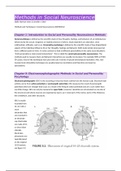
EEG is usually
recorded from
32, 64, 128 or
more
electrodes that
are mounted in
an electrode
cap. Electrodes
are made of tin
or silver/silver
chloride.
Electrodes
placements are
typically based
on the original
10-20 system,
see figure 9.2.
, Usually, conductive gel us used as a medium between the scalp and electors. Frequencies are measured in Hz
and filters can be used to reduce noise. In EEG things can go wrong with the measurements: this is called an
artifact. There are different kind of artifacts. Muscle artifact is a higher frequency than EEG, for example in
measuring extreme emotions. Eye movement artifacts are based on eye movements as blinking and can be
avoided by training. Non biological artifacts are external noises such as electrical lights and can be filtered.
EEG signal can be used to find the psychological state of a person. To do so, one can use frequency bands: delta
(1-4 Hz), theta (4-8 Hz), alpha (8-13 Hz), beta (13-20 Hz), and gamma (>20 Hz).
There are some advantages and disadvantages of using EEG methods. EEG methods are relatively inexpensive,
compared to other neuroimaging methods. EEG has a better temporal resolution then fMRI or PET, but poorer
spatial resolution. This is because it gives less information about the source of the electric signal. However,
because of its precision and non-invasiveness it’s a very useful method in neuroscience.
Chapter 10: Using Event-Related Brain Potentials in Social Psychological
Research
The ERP is an index of brain activity derived from measures of electricity generated by the firing of cortical
neurons. When EEG is measured in the context of an experimental task involving specific events (e.g., stimuli or
responses), it becomes possible to examine epochs of the EEG that reflect neural processes uniquely associated
with those events. This event- related EEG response is called the ERP. The ERP waveform typically comprises a
series of positive and negative voltage deflections, often referred to as “components” (see Figure 10.1).
Specific ERP components are often associated with a particular information- processing operation or set of
operations.
ERPs are measured in the same way as EEG. However, there are minor changes such as in the used frequencies
these are much higher in ERPs such as 250-1000 Hz. ERP measures should be in a quiet and comfortable room,
typically with no distractions to remove artifacts in the data. When ERP data is measured it needs to be
extracted into ERP ‘signal’ and background EEG ‘noise’ by filtering and averaging. Filtering involves passing the
analog signal through a combination of capacitors and resistors designed to allow only signal within a particular
range to pass through. The averaging process capitalizes on the principle that EEG signals unrelated to a
particular event will vary randomly across samples, and that after one centers the data in each epoch (typically
by defining a prevent baseline period), these randomly varying aspects of the background EEG noise will
Eddie Harmon-Jones & Jennifer S. Beer
Methods and Techniques in Social Neuroscience (200900352)
Chapter 1: Introduction to Social and Personality Neuroscience Methods
Social psychology is defined as the scientific study of how thoughts, feelings, and behaviors of an individual are
influenced by the actual, imagined, or implied presence of others. Study objectives are attraction, close
relationships, attitudes, and so on. Personality psychology is defined as the scientific study of how dispositional
aspects of the individual influence his or her thoughts, feelings and behavior. Both study similar processes but
from a different point of view. It is also common to look at different personalities in the same social situations:
“trait [personality] x state [social] interactions”. This is called the social and personality neuroscience. The
methods used to measure brain and behavior interactions are usually non-invasive. For example: ERPs or fMRI.
Of course, most of the techniques have pros and cons in terms of special and temporal resolution. Also, non-
invasive brain stimulation techniques are usually based on correlations and therefore are based on
speculations.
Chapter 9: Electroencephalographic Methods in Social and Personality
Pscyhology
Electroencephalographic (EEG) is the recording of electrical brain activity from the human scalp. Electrical brain
activity can be from action potentials or postsynaptic potentials. EEG measures the result of postsynaptic
potentials which are changes that occur as a result of the firing of action potentials and are a sum rather than
one little change. EEG can only be measured in open fields (=neurons’ dendrites are all oriented on one site of
the structure) and where neurons are organized as layers, as in most part of the cortex, parts of the thalamus,
the cerebellum, and other structures.
EEG is usually
recorded from
32, 64, 128 or
more
electrodes that
are mounted in
an electrode
cap. Electrodes
are made of tin
or silver/silver
chloride.
Electrodes
placements are
typically based
on the original
10-20 system,
see figure 9.2.
, Usually, conductive gel us used as a medium between the scalp and electors. Frequencies are measured in Hz
and filters can be used to reduce noise. In EEG things can go wrong with the measurements: this is called an
artifact. There are different kind of artifacts. Muscle artifact is a higher frequency than EEG, for example in
measuring extreme emotions. Eye movement artifacts are based on eye movements as blinking and can be
avoided by training. Non biological artifacts are external noises such as electrical lights and can be filtered.
EEG signal can be used to find the psychological state of a person. To do so, one can use frequency bands: delta
(1-4 Hz), theta (4-8 Hz), alpha (8-13 Hz), beta (13-20 Hz), and gamma (>20 Hz).
There are some advantages and disadvantages of using EEG methods. EEG methods are relatively inexpensive,
compared to other neuroimaging methods. EEG has a better temporal resolution then fMRI or PET, but poorer
spatial resolution. This is because it gives less information about the source of the electric signal. However,
because of its precision and non-invasiveness it’s a very useful method in neuroscience.
Chapter 10: Using Event-Related Brain Potentials in Social Psychological
Research
The ERP is an index of brain activity derived from measures of electricity generated by the firing of cortical
neurons. When EEG is measured in the context of an experimental task involving specific events (e.g., stimuli or
responses), it becomes possible to examine epochs of the EEG that reflect neural processes uniquely associated
with those events. This event- related EEG response is called the ERP. The ERP waveform typically comprises a
series of positive and negative voltage deflections, often referred to as “components” (see Figure 10.1).
Specific ERP components are often associated with a particular information- processing operation or set of
operations.
ERPs are measured in the same way as EEG. However, there are minor changes such as in the used frequencies
these are much higher in ERPs such as 250-1000 Hz. ERP measures should be in a quiet and comfortable room,
typically with no distractions to remove artifacts in the data. When ERP data is measured it needs to be
extracted into ERP ‘signal’ and background EEG ‘noise’ by filtering and averaging. Filtering involves passing the
analog signal through a combination of capacitors and resistors designed to allow only signal within a particular
range to pass through. The averaging process capitalizes on the principle that EEG signals unrelated to a
particular event will vary randomly across samples, and that after one centers the data in each epoch (typically
by defining a prevent baseline period), these randomly varying aspects of the background EEG noise will