NUR 2092 Health Assessment Exam 2 study guide
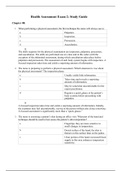
Health Assessment Exam 2: Study Guide Chapter 08: 1. When performing a physical assessment, the first technique the nurse will always use is: a. Palpation. b. Inspection. c. Percussion. d. Auscultation. B The skills requisite for the physical examination are inspection, palpation, percussion, and auscultation. The skills are performed one at a time and in this order (with the exception of the abdominal assessment, during which auscultation takes place before palpation and percussion). The assessment of each body system begins with inspection. A focused inspection takes time and yields a surprising amount of information. 2. The nurse is preparing to perform a physical assessment. Which statement is true about the physical assessment? The inspection phase: a. Usually yields little information. b. Takes time and reveals a surprising amount of information. c. May be somewhat uncomfortable for the expert practitioner. d. Requires a quick glance at the patient’s body systems before proceeding with palpation. B A focused inspection takes time and yields a surprising amount of information. Initially, the examiner may feel uncomfortable, staring at the person without also doing something. A focused assessment is significantly more than a “quick glance.” 3. The nurse is assessing a patient’s skin during an office visit. What part of the hand and technique should be used to best assess the patient’s skin temperature? a. Fingertips; they are more sensitive to small changes in temperature. b. Dorsal surface of the hand; the skin is thinner on this surface than on the palms. c. Ulnar portion of the hand; increased blood supply in this area enhances temperature sensitivity. d. Palmar surface of the hand; this surface is the most sensitive to temperature variations because of its increased nerve supply in this area. B The dorsa (backs) of the hands and fingers are best for determining temperature because the skin is thinner on the dorsal surfaces than on the palms. Fingertips are best for fine, tactile discrimination. The other responses are not useful for palpation. 4. Which of these techniques uses the sense of touch to assess texture, temperature, moisture, and swelling when the nurse is assessing a patient? a. Palpation b. Inspection c. Percussion d. Auscultation A Palpation uses the sense of touch to assess the patient for these factors. Inspection involves vision; percussion assesses through the use of palpable vibrations and audible sounds; and auscultation uses the sense of hearing. 5. The nurse is preparing to assess a patient’s abdomen by palpation. How should the nurse proceed? a. Palpation of reportedly “tender” areas are avoided because palpation in these areas may cause pain. b. Palpating a tender area is quickly performed to avoid any discomfort that the patient may experience. c. The assessment begins with deep palpation, while encouraging the patient to relax and to take deep breaths. d. The assessment begins with light palpation to detect surface characteristics and to accustom the patient to being touched. D Light palpation is initially performed to detect any surface characteristics and to accustom the person to being touched. Tender areas should be palpated last, not first. 6. The nurse would use bimanual palpation technique in which situation? a. Palpating the thorax of an infant b. Palpating the kidneys and uterus c. Assessing pulsations and vibrations d. Assessing the presence of tenderness and pain B Bimanual palpation requires the use of both hands to envelop or capture certain body parts or organs such as the kidneys, uterus, or adnexa. The other situations are not appropriate for bimanual palpation. 7. The nurse is preparing to percuss the abdomen of a patient. The purpose of the percussion is to assess the __________ of the underlying tissue. a. Turgor b. Texture c. Density d. Consistency C Percussion yields a sound that depicts the location, size, and density of the underlying organ. Turgor and texture are assessed with palpation. 8. The nurse is reviewing percussion techniques with a newly graduated nurse. Which technique, if used by the new nurse, indicates that more review is needed? a. Percussing once over each area b. Quickly lifting the striking finger after each stroke c. Striking with the fingertip, not the finger pad d. Using the wrist to make the strikes, not the arm A For percussion, the nurse should percuss two times over each location. The striking finger should be quickly lifted because a resting finger damps off vibrations. The tip of the striking finger should make contact, not the pad of the finger. The wrist must be relaxed and is used to make the strikes, not the arm. 9. When percussing over the liver of a patient, the nurse notices a dull sound. The nurse should: a. Consider this a normal finding. b. Palpate this area for an underlying mass. c. Reposition the hands, and attempt to percuss in this area again. d. Consider this finding as abnormal, and refer the patient for additional treatment. A Percussion over relatively dense organs, such as the liver or spleen, will produce a dull sound. The other responses are not correct. 10. The nurse is unable to identify any changes in sound when percussing over the abdomen of an obese patient. What should the nurse do next? a. Ask the patient to take deep breaths to relax the abdominal musculature. b. Consider this finding as normal, and proceed with the abdominal assessment.
École, étude et sujet
Infos sur le Document
- Publié le
- 23 février 2021
- Nombre de pages
- 146
- Écrit en
- 2020/2021
- Type
- Examen
- Contient
- Questions et réponses
Sujets
-
health assessment exam 2 study guide chapter 08 1 when performing a physical assessment
-
the first technique the nurse will always use is a palpation b inspection c percussion d auscult

Document également disponible en groupe