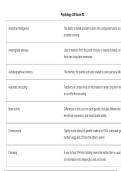
Psychology 100 Exam #2
Analytical intelligence The ability to break problems down into component parts, or a
problem solving
Anterograde amnesia Loss of memory from the point of injury or trauma forward, or t
form new long-term memories
Autobiographical memory The memory for events and facts related to one's personal life
Automatic encoding Tendency of certain kinds of information to enter long term me
or no effortful encoding
Brain activity Differences in this occur in each gender, includes differences in
emotional expression, and visual/spatial ability
Chromosome Tightly would strand of genetic material or DNA. Individual ge
mother's egg and 23 from the father's sperm.
Chunking A way to fool STM into holding more information than is usual.
of information into meaningful units or chunks
, Psychology 100 Exam #2
Collectivistic culture A culture in which people believe that their primary responsibil
families, their communities, and their employers.
Consolidation The changes that take place in the structure and functioning of
memory is formed
Constructive processing Referring to the retrieval of memories in which those memories
revised, or influenced by newer information. Memories are rare
accurate and become less accurate overtime, memory retrieva
constructive process
Creative intelligence The ability to deal with new and different concepts and to com
ways of solving problems
Cross-sectional design Research design in which several different participant age-grou
at one particular point in time
Cross-sequential design Research design in which participants from different age group
repeatedly over a period of months or years
, Psychology 100 Exam #2
Cultural bias The tendency of IQ tests to reflect in language, dialect, and co
culture of the person who designed the test
Curve of forgetting A graph showing a distinct pattern in which forgetting is very fa
hour after learning a list and then tapers off gradually
Decay Loss of memory due to the passage of time, during which the m
not used
Declarative memory Type of LTM containing information that is conscious and know
information that make up knowledge. Ex: knowing the names o
Deviation IQ scores A type of intelligence measure that assumes that IQ is normally
around a mean of 100 with a standard deviation of about 15
Distributed practice Spacing the study of material to be remembered by including
study periods
Disuse Another name for decay, assuming that memories that are not
eventually disappear
Analytical intelligence The ability to break problems down into component parts, or a
problem solving
Anterograde amnesia Loss of memory from the point of injury or trauma forward, or t
form new long-term memories
Autobiographical memory The memory for events and facts related to one's personal life
Automatic encoding Tendency of certain kinds of information to enter long term me
or no effortful encoding
Brain activity Differences in this occur in each gender, includes differences in
emotional expression, and visual/spatial ability
Chromosome Tightly would strand of genetic material or DNA. Individual ge
mother's egg and 23 from the father's sperm.
Chunking A way to fool STM into holding more information than is usual.
of information into meaningful units or chunks
, Psychology 100 Exam #2
Collectivistic culture A culture in which people believe that their primary responsibil
families, their communities, and their employers.
Consolidation The changes that take place in the structure and functioning of
memory is formed
Constructive processing Referring to the retrieval of memories in which those memories
revised, or influenced by newer information. Memories are rare
accurate and become less accurate overtime, memory retrieva
constructive process
Creative intelligence The ability to deal with new and different concepts and to com
ways of solving problems
Cross-sectional design Research design in which several different participant age-grou
at one particular point in time
Cross-sequential design Research design in which participants from different age group
repeatedly over a period of months or years
, Psychology 100 Exam #2
Cultural bias The tendency of IQ tests to reflect in language, dialect, and co
culture of the person who designed the test
Curve of forgetting A graph showing a distinct pattern in which forgetting is very fa
hour after learning a list and then tapers off gradually
Decay Loss of memory due to the passage of time, during which the m
not used
Declarative memory Type of LTM containing information that is conscious and know
information that make up knowledge. Ex: knowing the names o
Deviation IQ scores A type of intelligence measure that assumes that IQ is normally
around a mean of 100 with a standard deviation of about 15
Distributed practice Spacing the study of material to be remembered by including
study periods
Disuse Another name for decay, assuming that memories that are not
eventually disappear