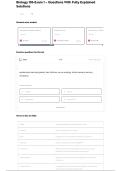
Biology 106 Exam 1 – Questions With Fully Explained
Solutions
Save
Students also studied
Sherpath: Diabetes Mellitus Chapter 21 Test Case Study 4 (Short
30 terms 24 terms 22 terms
jesssbee Preview kenanderson2017 Preview Brittany182
Practice questions for this set
Learn 1 /7 Study using Learn
epidermally derived glands, hair follicles, nerve endings, blood vessels, sensory
receptors.
Choose an answer
1 matter 2 Dermis
3 hydrophilic 4 compound
Don't know?
Terms in this set (105)
matter anything that takes up space and has mass
element basic building block of matter
atom smallest unit of an element composed of protons
molecule atoms of same type bonded together
compound different atoms bonded together all compounds and
molecules, not all molecules are compounds.
chemical bond attraction between atoms that enables the formation of
molecules.
covalent bond a principal force that holds atoms together, electrons are
shared. may be single, double, triple.
, ionic bond attraction between oppositely charged atom. donating or
accepting electrons.
hydrogen bond weak covalent bond, usually between H+ and O2 or N2.
responsible for properties of H20.
water universal solvent, substances dissolve into it.
solute dissolved substance
solution solvent and solute
hydrophilic molecule that attract H20
hydrophobic cannot attract H20
polar slightly changed yet neutral molecules, dissolve in H20
nonpolar electrically neutral, don't dissolve in H20
adhesion H20 to surface
cohesion H20 to H20
acid/base molecule that donates H+ in H20/OH+
pH scale measures amount of hydrogen ions. 7 is neutral, above 7 base,
below 7 acid. Pure water is neutral.
buffer substance that tend to resist changes in pH and help maintain
physiological pH. human blood is 7.4
macromolecule molecule that contains many subunits
synthesis production or macromolecule, dehydration reaction.
catabolism breaking down, hydrolysis reaction add H20 which breaks
bonds.
metabolism all the chemical reactions that occur in cell. all biological must
follow the laws of chemistry and physics. Most reactions
require energy in the form of ATP.
carbohydrates sugars, monomeric unit is monosaccharide.
(animals=glycogen, plants=starch). function is ENERGY
Lipids fats, monomeric unit is glycerol and fatty acids. function is
long term STORAGE, membrane structure. HYDROPHOBIC.
fatty acids- saturated vs unsaturated, cis vs. trans bond.
Phospholipid. Cholesterol.
Phospholipid polar head, non polar tail, involved in membrane structure.
Proteins monomeric unit is amino acid (peptide, polypeptide, protein).
Functions- enzymes, antibodies, support, keratin, transport
molecules, motion, hormones. Peptide bond.
Solutions
Save
Students also studied
Sherpath: Diabetes Mellitus Chapter 21 Test Case Study 4 (Short
30 terms 24 terms 22 terms
jesssbee Preview kenanderson2017 Preview Brittany182
Practice questions for this set
Learn 1 /7 Study using Learn
epidermally derived glands, hair follicles, nerve endings, blood vessels, sensory
receptors.
Choose an answer
1 matter 2 Dermis
3 hydrophilic 4 compound
Don't know?
Terms in this set (105)
matter anything that takes up space and has mass
element basic building block of matter
atom smallest unit of an element composed of protons
molecule atoms of same type bonded together
compound different atoms bonded together all compounds and
molecules, not all molecules are compounds.
chemical bond attraction between atoms that enables the formation of
molecules.
covalent bond a principal force that holds atoms together, electrons are
shared. may be single, double, triple.
, ionic bond attraction between oppositely charged atom. donating or
accepting electrons.
hydrogen bond weak covalent bond, usually between H+ and O2 or N2.
responsible for properties of H20.
water universal solvent, substances dissolve into it.
solute dissolved substance
solution solvent and solute
hydrophilic molecule that attract H20
hydrophobic cannot attract H20
polar slightly changed yet neutral molecules, dissolve in H20
nonpolar electrically neutral, don't dissolve in H20
adhesion H20 to surface
cohesion H20 to H20
acid/base molecule that donates H+ in H20/OH+
pH scale measures amount of hydrogen ions. 7 is neutral, above 7 base,
below 7 acid. Pure water is neutral.
buffer substance that tend to resist changes in pH and help maintain
physiological pH. human blood is 7.4
macromolecule molecule that contains many subunits
synthesis production or macromolecule, dehydration reaction.
catabolism breaking down, hydrolysis reaction add H20 which breaks
bonds.
metabolism all the chemical reactions that occur in cell. all biological must
follow the laws of chemistry and physics. Most reactions
require energy in the form of ATP.
carbohydrates sugars, monomeric unit is monosaccharide.
(animals=glycogen, plants=starch). function is ENERGY
Lipids fats, monomeric unit is glycerol and fatty acids. function is
long term STORAGE, membrane structure. HYDROPHOBIC.
fatty acids- saturated vs unsaturated, cis vs. trans bond.
Phospholipid. Cholesterol.
Phospholipid polar head, non polar tail, involved in membrane structure.
Proteins monomeric unit is amino acid (peptide, polypeptide, protein).
Functions- enzymes, antibodies, support, keratin, transport
molecules, motion, hormones. Peptide bond.