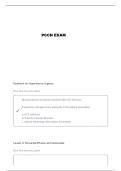
Treatment for Hypertensive Urgency
Give this one a try later!
Blood pressure should be lowered within 24-48 hours
Frequently oral agents are adequate in this patient population
a. ACE inhibitors
b. Calcium Channel Blockers
c. Alpha2 Adrenergic Stimulators (Clonidine)
Causes of Pericardial Effusion and Tamponade
Give this one a try later!
, a. Pericarditis
b. Invasive Cardiac Procedures
c. Indwelling Cardiac Instrumentation
d. Anticoagulant or Thrombolytic Therapy
e. HIV/AIDS
f. Valvular Heart Disease
g. Trauma
h. Pregnancy
i. Aortic Dissection
j. Chronic Heart Failure
Which are supplied by which Coronary Artery
SA Node
Bachmanns Bundle
AV Node
Bundle of His
Give this one a try later!
SA Node - RCA
Bachmanns Bundle - RCA
AV Node - RCA
Bundle of His - LAD
Cardiac Tamponade Surgical Management
Give this one a try later!
, Pericardiocentesis
Needle aspiration of effusion. Subxiphoidal approach. Procedure can be
performed blind, or with ECG clamp, echo or fluoroscopy guidance. If
recurrent effusion is a concern a drainage system should be left in place
for a few days.
a. 6 inch, 16-18 gauge, over-the-needle catheter.
Surgical Drainage
a. Subxiphoid surgical incision and thoracoscopic drainage
b. Video assisted thoracoscopy and drainage
c. Pericardial window and drainage
d. Pericardectomy: complete stripping of the pericardial sac is performed
on some medical
patients with chronic effusion/tamponade. This is typically a last resort.
patient has pain in his calf when he runs that stops when he rests. what could this be?
Give this one a try later!
Chronic Arterial Insufficiency.
This is called intermittent claudication, and it is a symptom of chronic
arterial insufficiency. The pain is caused by lactic acid accumulation when
oxygen consumption exceeds oxygen supply.
Acute arterial occlusion is a sudden or complete occlusion and causes the
six Ps: pain, pallor, pulselessness, paresthesia, paralysis, and polar (cold).
Acute arterial occlusion constitutes a medical emergency, and immediate
action is required to prevent loss of limb.
Chronic arterial insufficiency is a gradual or partial occlusion and causes
less dramatic symptoms. Intermittent claudication; pale, cool limb; and
diminished pulses characterize chronic arterial insufficiency.
Give this one a try later!
Blood pressure should be lowered within 24-48 hours
Frequently oral agents are adequate in this patient population
a. ACE inhibitors
b. Calcium Channel Blockers
c. Alpha2 Adrenergic Stimulators (Clonidine)
Causes of Pericardial Effusion and Tamponade
Give this one a try later!
, a. Pericarditis
b. Invasive Cardiac Procedures
c. Indwelling Cardiac Instrumentation
d. Anticoagulant or Thrombolytic Therapy
e. HIV/AIDS
f. Valvular Heart Disease
g. Trauma
h. Pregnancy
i. Aortic Dissection
j. Chronic Heart Failure
Which are supplied by which Coronary Artery
SA Node
Bachmanns Bundle
AV Node
Bundle of His
Give this one a try later!
SA Node - RCA
Bachmanns Bundle - RCA
AV Node - RCA
Bundle of His - LAD
Cardiac Tamponade Surgical Management
Give this one a try later!
, Pericardiocentesis
Needle aspiration of effusion. Subxiphoidal approach. Procedure can be
performed blind, or with ECG clamp, echo or fluoroscopy guidance. If
recurrent effusion is a concern a drainage system should be left in place
for a few days.
a. 6 inch, 16-18 gauge, over-the-needle catheter.
Surgical Drainage
a. Subxiphoid surgical incision and thoracoscopic drainage
b. Video assisted thoracoscopy and drainage
c. Pericardial window and drainage
d. Pericardectomy: complete stripping of the pericardial sac is performed
on some medical
patients with chronic effusion/tamponade. This is typically a last resort.
patient has pain in his calf when he runs that stops when he rests. what could this be?
Give this one a try later!
Chronic Arterial Insufficiency.
This is called intermittent claudication, and it is a symptom of chronic
arterial insufficiency. The pain is caused by lactic acid accumulation when
oxygen consumption exceeds oxygen supply.
Acute arterial occlusion is a sudden or complete occlusion and causes the
six Ps: pain, pallor, pulselessness, paresthesia, paralysis, and polar (cold).
Acute arterial occlusion constitutes a medical emergency, and immediate
action is required to prevent loss of limb.
Chronic arterial insufficiency is a gradual or partial occlusion and causes
less dramatic symptoms. Intermittent claudication; pale, cool limb; and
diminished pulses characterize chronic arterial insufficiency.