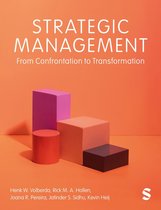
Summary book chapters Strategic Management: From confrontation to
transformation
Included chapters: 1, 2, 3, 4, 6, 7, 8, 9, 10, 11, 12, 15, 16
Chapter 1 Introduction to Strategic Management
What is strategy?
Strategy is defined as a unified, integrated and purposeful set of choices, commitments and
activities aimed at achieving and sustaining above-average performance.
Book definition: Strategy can be defined as the determination of the basic long-term goals
and objectives of an enterprise and the adoption of courses of action and the allocation of
resources necessary for carrying out these goals.
It answers:
1. Where do we compete?
2. How do we differentiate from others?
3. How do we get to where we want to be?
4. What is the sequence/speed of moves?
5. How do we create value and from whom?
Strategy is NOT:
Just a plan
Operational effectiveness (better processes)
* Operational effectiveness is necessary but not sufficient for sustainable competitive
advantage.
Added value, competitive advantage & above-average returns
Added value/Competitive advantage: When a firm outperforms rivals and creates
superior value for stakeholders.
Above-average returns: Returns higher than those of comparable firms with similar
risk exposure (ROI, ROE, ROIC).
If returns are:
* Higher Competitive advantage
* Equal Competitive parity
* Lower Competitive disadvantage
Why some firms outperform others – Two views
A) Industrial organization (I/O) Perspective
Performance is determined mainly by the external environment (industry structure).
Framework: Porter’s Five Forces
The most attractive industries highest likelihood of above-average returns.
,B) Resource-Based View (RBV)
Performance is determined mainly by internal resources/capabilities.
To be sources of advantage, resources must be VRIN:
Valuable
Rare
Inimitable
Non-substitutable
Most realistic explanations combine I/O + RBV
Strategy formation
Deliberate strategy: Planned and intended in advance
Emergent strategy: Develops in response to unexpected opportunities/challenges.
Unrealized strategy: Intended but not implemented
Actual strategy = mix of deliberate + emergent.
Schools of strategy formation
Two categories:
Prescriptive schools (how strategy should be formed):
1. Design school – top managers create strategy
2. Planning school – formal, analytic planning
3. Positioning school – positioning within industry (Porter)
Descriptive schools (how strategy actually forms):
4. Cognitive school
5. Entrepreneurial school
6. Learning school
7. Cultural school
8. Power school
9. Environmental school
,These interpretations highlight that strategy is both analytical and emergent.
Strategy beyond business contexts
Non-profit, not-for-profit and government organizations also need strategy, even though
performance is not measured in monetary terms.
they pursue mission-driven value.
Key takeaway
Strategy is about sustaining added value through deliberate decisions and continual
adaption.
Chapter 2 Direction, purpose and sustainability
Foundational statements
These statements steer strategic decisions:
1. Mission: What is our business?
2. Vision: What do we aspire to?
3. Values: What principles ground our approach to doing business?
4. Purpose: For whom and why do we exist?
5. Strategic objectives
Like “lighthouses”, they keep direction stable even during change.
Mission
Defines what business the company is in
Delimits its business domain
Specifies:
* Target customers
, * Needs served
* Activities/markets covered
It identifies:
* Competitors
* Customers
* Market boundaries
Mission must be specific (not generic) to provide clarity in decision-making.
A mission statement should offer answers to:
* What does the company do?
* How is the function performed?
* For whom is the function performed?
Vision
Defines the long-term aspirations of the firm:
Desired future state
Inspirational direction
Effective visions:
Inspire employees
Provide long-term orientation
Enable focus
A comprehensive vision statement has 6 characteristics:
Imaginable: creates an image of the intended future in the minds of the ones who
read it.
Desirable: appeals to the ones that are aiming to reach it and to customers.
Feasible: brings together the feasible and the incredible.
Focused: provides a concentrated direction for those who follow it.
Flexible: broad enough in scope to allow modifications when needed.
Communicable: easy to articulate to the audience.
Values
Values describe:
Ethical principles
Morals & beliefs
Cultural norms
They guide:
Behavior
Decision-making
Strategy implementation
transformation
Included chapters: 1, 2, 3, 4, 6, 7, 8, 9, 10, 11, 12, 15, 16
Chapter 1 Introduction to Strategic Management
What is strategy?
Strategy is defined as a unified, integrated and purposeful set of choices, commitments and
activities aimed at achieving and sustaining above-average performance.
Book definition: Strategy can be defined as the determination of the basic long-term goals
and objectives of an enterprise and the adoption of courses of action and the allocation of
resources necessary for carrying out these goals.
It answers:
1. Where do we compete?
2. How do we differentiate from others?
3. How do we get to where we want to be?
4. What is the sequence/speed of moves?
5. How do we create value and from whom?
Strategy is NOT:
Just a plan
Operational effectiveness (better processes)
* Operational effectiveness is necessary but not sufficient for sustainable competitive
advantage.
Added value, competitive advantage & above-average returns
Added value/Competitive advantage: When a firm outperforms rivals and creates
superior value for stakeholders.
Above-average returns: Returns higher than those of comparable firms with similar
risk exposure (ROI, ROE, ROIC).
If returns are:
* Higher Competitive advantage
* Equal Competitive parity
* Lower Competitive disadvantage
Why some firms outperform others – Two views
A) Industrial organization (I/O) Perspective
Performance is determined mainly by the external environment (industry structure).
Framework: Porter’s Five Forces
The most attractive industries highest likelihood of above-average returns.
,B) Resource-Based View (RBV)
Performance is determined mainly by internal resources/capabilities.
To be sources of advantage, resources must be VRIN:
Valuable
Rare
Inimitable
Non-substitutable
Most realistic explanations combine I/O + RBV
Strategy formation
Deliberate strategy: Planned and intended in advance
Emergent strategy: Develops in response to unexpected opportunities/challenges.
Unrealized strategy: Intended but not implemented
Actual strategy = mix of deliberate + emergent.
Schools of strategy formation
Two categories:
Prescriptive schools (how strategy should be formed):
1. Design school – top managers create strategy
2. Planning school – formal, analytic planning
3. Positioning school – positioning within industry (Porter)
Descriptive schools (how strategy actually forms):
4. Cognitive school
5. Entrepreneurial school
6. Learning school
7. Cultural school
8. Power school
9. Environmental school
,These interpretations highlight that strategy is both analytical and emergent.
Strategy beyond business contexts
Non-profit, not-for-profit and government organizations also need strategy, even though
performance is not measured in monetary terms.
they pursue mission-driven value.
Key takeaway
Strategy is about sustaining added value through deliberate decisions and continual
adaption.
Chapter 2 Direction, purpose and sustainability
Foundational statements
These statements steer strategic decisions:
1. Mission: What is our business?
2. Vision: What do we aspire to?
3. Values: What principles ground our approach to doing business?
4. Purpose: For whom and why do we exist?
5. Strategic objectives
Like “lighthouses”, they keep direction stable even during change.
Mission
Defines what business the company is in
Delimits its business domain
Specifies:
* Target customers
, * Needs served
* Activities/markets covered
It identifies:
* Competitors
* Customers
* Market boundaries
Mission must be specific (not generic) to provide clarity in decision-making.
A mission statement should offer answers to:
* What does the company do?
* How is the function performed?
* For whom is the function performed?
Vision
Defines the long-term aspirations of the firm:
Desired future state
Inspirational direction
Effective visions:
Inspire employees
Provide long-term orientation
Enable focus
A comprehensive vision statement has 6 characteristics:
Imaginable: creates an image of the intended future in the minds of the ones who
read it.
Desirable: appeals to the ones that are aiming to reach it and to customers.
Feasible: brings together the feasible and the incredible.
Focused: provides a concentrated direction for those who follow it.
Flexible: broad enough in scope to allow modifications when needed.
Communicable: easy to articulate to the audience.
Values
Values describe:
Ethical principles
Morals & beliefs
Cultural norms
They guide:
Behavior
Decision-making
Strategy implementation