MASTERING FETAL MONITORING
VEAL CHOP Simplified Guide + Practice Strip
Scenarios
Fetal heart rate (FHR) monitoring is one of the most important skills in maternity
nursing. Students often get anxious because the strips look confusing and the
patterns seem similar — but VEAL CHOP makes everything simple.
1. Understanding the Basics of Fetal
Monitoring
Before VEAL CHOP, you must know the three major components of fetal
monitoring:
A. Baseline FHR
Normal: 110–160 bpm
Assessed between contractions.
Tachycardia (>160): Infection, hypoxia, dehydration, drugs
Bradycardia (<110): Cord compression, maternal hypotension, anesthesia
B. Variability
Variability = how much the FHR goes up and down around the baseline
It represents fetal oxygenation + CNS function.
, Types:
Type Description Meaning
Absent 0 bpm change BAD – severe hypoxia
Minimal ≤5 bpm Sleep cycle, narcotics, hypoxia
Moderate 6–25 bpm NORMAL & reassuring
Marked >25 bpm Early hypoxia or fetal stress
Most important point:
MODERATE variability = healthy baby
C. Accelerations & Decelerations
Accelerations = good
Decelerations = sometimes bad
Patterns determine the cause.
2. VEAL CHOP — The Ultimate Memory
Trick
A simple mnemonic that pairs FHR patterns with their causes:
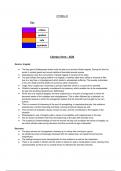
V – Variable → C – Cord Compression
E – Early → H – Head Compression
A – Acceleration → O – Okay (Normal)
L – Late → P – Placental Insufficiency
VEAL CHOP Simplified Guide + Practice Strip
Scenarios
Fetal heart rate (FHR) monitoring is one of the most important skills in maternity
nursing. Students often get anxious because the strips look confusing and the
patterns seem similar — but VEAL CHOP makes everything simple.
1. Understanding the Basics of Fetal
Monitoring
Before VEAL CHOP, you must know the three major components of fetal
monitoring:
A. Baseline FHR
Normal: 110–160 bpm
Assessed between contractions.
Tachycardia (>160): Infection, hypoxia, dehydration, drugs
Bradycardia (<110): Cord compression, maternal hypotension, anesthesia
B. Variability
Variability = how much the FHR goes up and down around the baseline
It represents fetal oxygenation + CNS function.
, Types:
Type Description Meaning
Absent 0 bpm change BAD – severe hypoxia
Minimal ≤5 bpm Sleep cycle, narcotics, hypoxia
Moderate 6–25 bpm NORMAL & reassuring
Marked >25 bpm Early hypoxia or fetal stress
Most important point:
MODERATE variability = healthy baby
C. Accelerations & Decelerations
Accelerations = good
Decelerations = sometimes bad
Patterns determine the cause.
2. VEAL CHOP — The Ultimate Memory
Trick
A simple mnemonic that pairs FHR patterns with their causes:
V – Variable → C – Cord Compression
E – Early → H – Head Compression
A – Acceleration → O – Okay (Normal)
L – Late → P – Placental Insufficiency